




PISCATAWAY – Mental illness is not a moral failure. Addiction is not a lack of faith. Trauma is not a sign of spiritual weakness.
Such are among the stereotypes Bishop John Dolan urges every member of society to break.
“Struggle is not a failure of humanity. Silence is. When we treat addiction or mental illness as something that must be concealed or explained away or endured alone, we unintentionally transform human suffering into spiritual isolation – and isolation is where despair grows.”
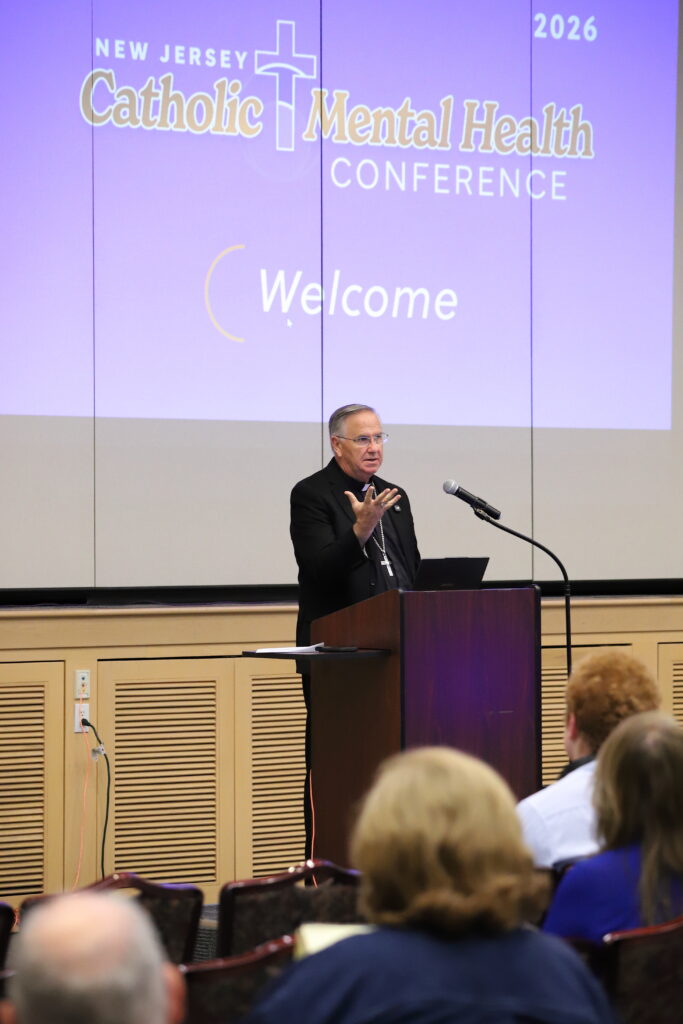
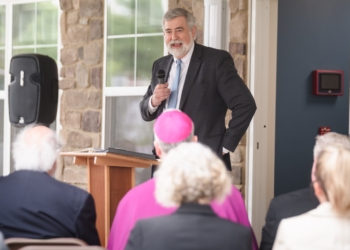
Bishop Dolan, of the Diocese of Phoenix, was the keynote speaker at the New Jersey Catholic Mental Health Conference held May 2 at the John Neumann Pastoral Center. Bishop Dolan, a survivor of suicide loss, spoke on the effects of isolation, combatting stigma, the importance of accompaniment and education initiatives.
“One of the hardest truths to face is that a person can be deeply loved but still feel completely alone,” he said. “That’s why presence matters. Not abstract care, but real encounter.”
Presence, he continued, is not automatic. A person can be in a room and still be distant. One can be surrounded by people and still feel alone. To be with someone is to be present in a way that acknowledges the other and allows that person to matter. Show up. Stay. Listen.
“That is why the word ‘with’ carries such weight,” Bishop Dolan said. “It points to something deeper than proximity. It speaks of relationship. It speaks of identity.”
Lack of Connection
Being present for others is especially important in a world in which humanity is connected more than ever before, whether it is through video calls and cell phones, or 24-hour news and entertainment on demand, he said.
“We are living in a time when connection is constant, but real communion is not, especially among our youth. I have come to say clearly: Isolation kills but communion heals. I say that because I’ve seen it and I’ve experienced it,” he said, explaining that five of his family members have died by suicide.
“There is a silence that follows this kind of loss. It’s different,” he explained. “There are questions that don’t always have answers. You find yourself wondering, ‘What more could have been done? Where did I go wrong? Why wasn’t I there? How may I have made a difference?’”
This is also true among leaders of faith, Bishop Dolan said.
“I’ve met priests who waited years before seeking help, years of quiet anguish, because they feared disappointing their bishop, their community or their people. I’ve met women religious who believe their vows required endurance without expression. Endurance is not the same as holiness. Suffering in silence is not a sacrament or religious virtue,” he said.
One reason people suffer alone is the stigma surrounding mental health. There is also a false theology among people of faith, he said, “a belief that prayer or sacred events such as an ordination or marriage will fix us or exempt a person from human vulnerability – that grace replaces psychology, that faith negates trauma, that holiness looks like emotional invulnerability. This is not good theology. It’s certainly not good anthropology.”
“God does not erase our humanity. God enters into it,” he continued, pointing not only to how God became man, but countless examples of Jesus’ struggles and suffering, too. “God does not wait for us to be well before drawing near. God draws near because we are wounded, or at the very least, humanly limited.”
Education and Advocacy
Bishop Dolan was instrumental in founding the Office of Mental Health Ministry in the Diocese of Phoenix, the first such ministry on the diocesan level in the United States. He also works closely with Deacon Ed Shoener, founder of the International Association of Catholic Mental Health Ministers. A permanent deacon in the Diocese of Scranton, Pa., Deacon Shoener was among the day’s presenters.
Bishop Dolan explained that when it comes to the pastoral approach to mental health ministry, both he and Deacon Shoener – and others – utilize three pillars: education, accompaniment and advocacy.
Education helps people learn how to respond when someone is struggling, thus reducing fear and uncertainty. Education forms people to recognize signs of distress and then to respond with compassion.
Accompaniment brings that understanding into relationships. “It is where communion becomes real,” he said.
Advocacy ensures that mental health is integrated into the life of the Church and society. For example, the Diocese of Phoenix’s Office of Mental Health Ministry worked with the Maricopa County Sheriff Department to allow peer-to-peer accompaniment sessions in prisons.
In addition, the office has partnered with the University of Mary in Bismarck, N.D. – which has a satellite campus in Phoenix – to establish the first-ever Photina Center for Catholic Counseling. (Photina is the name of the Samaritan woman at the well in the Orthodox tradition.) This project will offer a cohort of 15 men and women grants to receive a master of science in psychology degree while interning as counselors in his diocese’s Catholic grade schools.
Such initiatives, he said, help the Church “become recognizable not just as an institution, but a place of encounter. A place where isolation begins to loosen its grip. A place where a person can begin to believe they are not alone. A place where hope can begin to take root again.”





 at the bottom and then tap “Add to Home Screen”
