




From staff and wire reports
For Jamie Lynn Black, the Atlantic Ocean has been an important part of her family’s livelihood.
Having grown up along the shore in The Parish of Saint Monica, Black and her family have relied on careers related to Atlantic City tourism.
“I thank God for the gift of the seashore and all the good it has brought into our lives,” she said.
Jamie Graiff also relies on the environment for business as the president of Dan Graiff Farms in Newfield. “We need to take care of the ground because that’s what feeds us and feeds everybody else.”
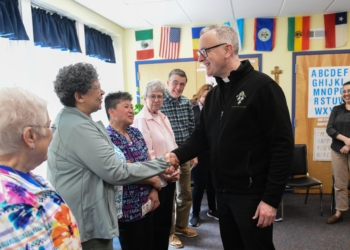
Graiff and his nephew, Scott, were among the dozens to attend the Aug. 16 Farm Mass celebrated by Bishop Dennis Sullivan.
“The two heat waves we’ve had, between the heat and the rain … we’ve lost acres of [crops],” Scott Graiff said.
As the World Day of Prayer for the Care of Creation approaches Sept. 1, Christians and non-Christians alike are again being urged to an “ecological conversion” to look at living “our vocation to be protectors of God’s handiwork,” as Pope Francis wrote in his 2015 encyclical, “Laudato Si’” (On Care for our Common Home).
This year’s World Day of Prayer for the Care of Creation – an observance begun by the Orthodox Church and now celebrated by various Christian faiths – comes on the heels of the latest climate assessment report from the U.N.’s Intergovernmental Panel on Climate Change, or IPCC.
Released Aug. 9, the document, covering 3,900-plus pages, serves as a “reality check” on how the planet is being reshaped by rising global temperatures, said Valerie Masson-Delmotte, co-chair of one of several working groups that compiled the report.
The report was written by 234 climate scientists and draws its conclusions based on more than 14,000 studies since the last assessment report in 2013.
It says that temperatures have risen by 1.1 degrees Celsius (2 degrees Fahrenheit) since the 19th century, reaching their highest level in more than 100,000 years. The report concludes that human activities, through the burning of fossil fuels, like wood, oil, coal and natural gas, accounts for almost all of the temperature rise. Burning those fuels releases heat-trapping greenhouse gases, such as carbon dioxide and methane.
The warming atmosphere is affecting virtually every corner of the planet, the report said. Rising temperatures are leading to the melting of glaciers, ice packs and sea ice, contributing to rising sea levels that threaten coastal communities; increased extreme weather events such as stronger hurricanes, torrential rains – like those that have recently caused widespread flooding in Europe and China – and droughts that can lead to wildfires and the loss of tillable farmland.
The report also outlines a series of paths that describe increasingly greater warming and projected progressively dire outcomes across the planet by the mid-21st century. It also said that it’s not too late to slow those changes and avoid the worst environmental catastrophes.
Catholic leaders in the environmental protection movement said the Church can cement a leading role in addressing climate change based on the report’s conclusions.
Dan Misleh, executive director of the Catholic Climate Covenant, said that the science behind the report makes clear it is time for people to reduce the consumption of fossil fuels in an effort to slow climate change.
“These reports come out regularly, and each time the scientists are saying this is a problem and we need to address it,” he said. “The difference now is more and more people are experiencing the impact of climate change. Perhaps this time the message will fall on a few more ears than it has in previous IPCC reports.”
Misleh turned to a Gospel story to stress his concern, citing from Matthew 9:7 in which Jesus asks the disciples, “What parent among you would hand your child a stone when your child asks for bread?”
“Young people are asking of us older people to give them bread and nourishment, and we keep handing them stones. We don’t do what we need to do – to pass the gift of God’s creation to them as we’ve done before,” Misleh said.
Key to the Church’s response will be the Laudato Si’ Action Platform, introduced in May by Pope Francis. It is designed to carry out a global grassroots movement to create a more inclusive, fraternal, peaceful and sustainable world based on the pope’s 2015 encyclical on the environment.
The report also points to the need for Catholics to “understand the stakes and the realities” warming temperatures pose to all life on earth, said Michael Schuck, co-director of the International Jesuit Ecology Project at Loyola University Chicago.
“We have to go again with Pope Francis’ emphasis on integral ecology, not only the integration of the ecology and the social, but the integration of the inner self and the outer. Our own souls need transformation,” Schuck explained.
He also encouraged people who are passionate about protecting God’s creation to talk about it with others. It’s also time to allow the younger generation to lead, Schuck added.
“We elders, we have to keep listening and empathizing with the next generation.”
Dennis Sadowski of Catholic News Service, and Jennifer Mauro and Dave Hernandez of the Catholic Star Herald contributed to this report.
What You Can Do: The Laudato Si’ Action Platform, introduced in May by Pope Francis, is designed to carry out a global grassroots movement toward a more sustainable world.
Learn more about these goals at laudatosiactionplatform.org.



 at the bottom and then tap “Add to Home Screen”
