


The world is shocked and dismayed over the wonton and unprovoked military incursion by Russia into the sovereign and independent country of Ukraine. Religious and political leaders from throughout the world condemned the invasion.
Pope Francis, in an unprecedented move, went so far as to go to the Russian embassy in Rome, as a Vatican spokesman described, “to convey his concern for the war.” On the surface, this statement may seem somewhat perfunctory, but it really belies the Russian myth that this is not a war, but as they insist, only a “special military operation.” Pope Francis even called upon all Christians throughout the world to fast and pray for peace on Ash Wednesday, saying, “I encourage believers in a special way to devote themselves intensely to prayer and fasting on that day. May the Queen of Peace protect the world from the folly of war.”
The U.S. Conference of Catholic Bishops joined Pope Francis, stating, “We continue to pray for Ukraine and echo the Holy Father’s call for all Catholics to fast on Ash Wednesday, March 2, in a special way for peace and an end to war. Mary, Queen of Peace, protect us from war!” The Anglican Archbishop of Canterbury, Justin Welby, called upon all Anglicans throughout the world to make Feb. 27 a day of peace.
Many other religious leaders took part in an online vigil for peace over the past week, including Presiding Bishop Michael Curry of the U.S. Episcopal Church; Presiding Bishop Elizabeth Eaton of the Evangelical Lutheran Church in America; Rabbi Jonah Dov Pesner, director of the Religious Action Center of Reform Judaism; and Mohamed Elsanousi, executive director of The Network for Religious and Traditional Peacemakers.
Ever since Ukraine became a separate country in 1991, following the collapse of the former Soviet Union, Russia has opposed its reaching out to Western European nations and NATO countries. In a nutshell, the father of the Soviet Union, Vladimir Lenin, envisioned those countries, territories and lands annexed by the USSR to be able to keep their distinctive cultural and linguistic heritages. After he died, his successor, Joseph Stalin, sought the “Russification” of all the annexed Soviet “republics” by eliminating any cultural or linguistic heritages. President Putin, in a strange and often unnoticed view, believes that Ukraine belongs to the greater “Russia,” partly due to its common entrance into the Christian world.
Orthodox Christians in both Russia and Ukraine trace their faith back to the conversion in 988 AD of the Grand Prince of Kyiv. Known as Vladimir by Russians and Volodymyr by Ukrainians, the pagan grand prince was baptized by missionaries from Constantinople, the capital of the Byzantine Empire. Kyiv became the most important religious center for the East Slavs. After the Mongolian takeover in 1240 AD, Kyiv fell into decline, and in 1686 AD, Russia had conquered eastern Ukraine and Kyiv. In that same year, the Patriarch of Constantinople formally transferred his spiritual authority over Ukraine to the Patriarch of Moscow.
In more modern times, many Ukrainian Orthodox Christians have tried to form their own independent (autocephalous) Orthodox Church in 1921, 1942 and 1992, with little success. The churches they formed then were never formally recognized by the worldwide Orthodox community, thus the Ukrainian Orthodox community remained under the jurisdiction of the autocephalous Patriarchate of Moscow. It wasn’t until December 2018 that Orthodox Christians in the Ukraine created the autocephalous Orthodox Church of Ukraine. In January 2019, the Ecumenical Patriarch Bartholomew of Constantinople signed a formal decree proclaiming the new Church autocephalous (from the Russian Orthodox Patriarchy).
Ecumenical Patriarch Bartholomew of Constantinople is generally recognized as the spiritual leader of Orthodoxy as the “first among equals.” However, the Patriarch of Moscow refuses to recognize the autocephalic claims of the Ukrainian Orthodox Church. For the Moscow Patriarchate, Russians and Ukrainians are one people. Therefore, a single Church (Moscow) should unite them. The Moscow autocephalous Patriarch Kirill broke communion with Constantinople over its role in creating the autocephalous Ukrainian Orthodox Church. Putin has echoed the sentiment of Patriarch Kirill in recent statements characterizing the Orthodox Church of Ukraine as an attack on the “spiritual unity” of the Russian and Ukrainian peoples. A religious subtext often ignored by the secular press.
So let us join so many from throughout the world, praying for a peaceful solution to these many historical and spiritual roads that have led to this dangerous and deadly war!
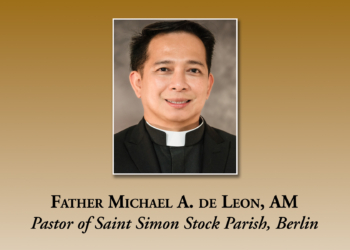
Father Joseph D. Wallace is diocesan director of Ecumenical and Inter-religious Affairs and pastor of Christ the Redeemer Parish, Atco.



 at the bottom and then tap “Add to Home Screen”
