




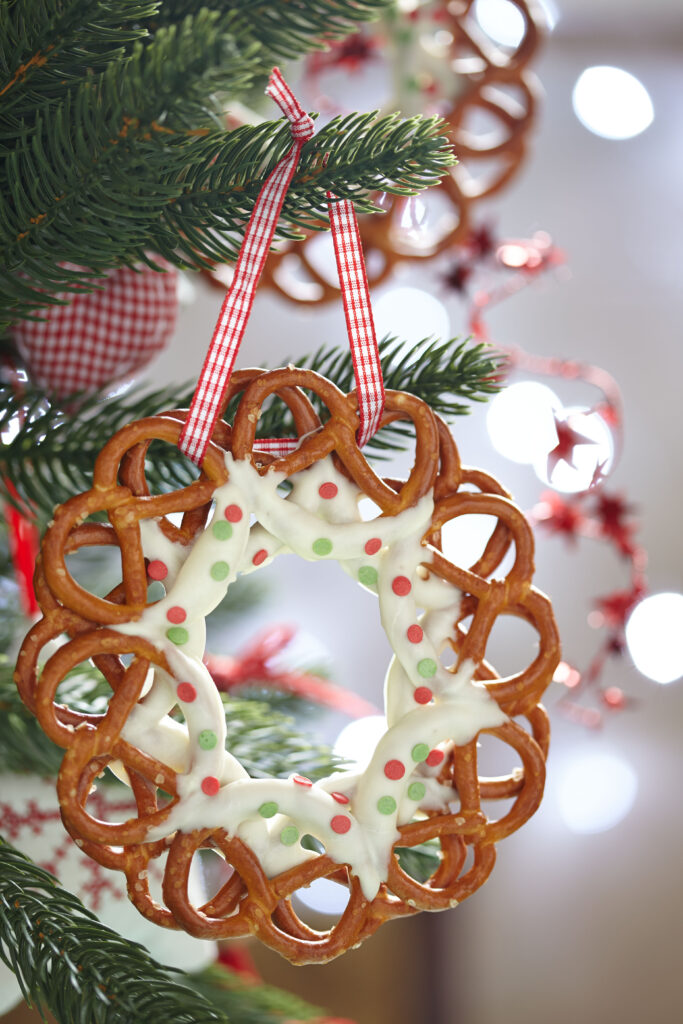
On a recent visit to Philadelphia, I took note of a Christmas tree decorated with the city’s iconic pretzels interlaced among the branches. The origins of the treat, like so much in food myth lore, are shrouded in controversy. Some claim that they date to 6th century Italy, while others argue that the roots lie instead in France or Germany. But by the 1600s, they were familiar enough to be appearing in European art.
It is generally accepted that the shape was meant to mark arms folded in prayer, and were given to children to encourage them to learn Christian devotions. Pretzels used to, in fact, be hidden for children on Easter, and so served as the inspiration for the Easter egg hunts we host today; the eggs eventually coming to represent life bursting forth from the walls of the tomb.
The hard, crunchy version of the baked snacks is believed to have been invented in the Lancaster, Pa., region in the 17th or 18th century. Drying them made them easier to package and sell at long distances. Today, more than 80% of pretzels across the United States are still made in the Philadelphia region.
Other seasonal pastry traditions have similar Christian roots. The Milanese Christmas cake, panettone, is widely available in the United States. Similar to a fruitcake because of the candied fruit and raisins mixed with the batter, its cupola shape draws to mind some of the great basilicas of Europe. No self-respecting Italian arrives at a family visit around the holidays without one, or its cousin, the pandoro, which is a Veronese specialty less well-known here. The latter is deep eggy yellow in color (the name means “golden bread”) and is a star-shaped cake dusted in vanilla powdered sugar.
The King Cake, today most associated in America with Louisiana’s Mardi Gras festivities, is actually a derivation of the roscón de reyes, a similar round dessert eaten in Spain on the feast of the Epiphany in honor of the Magi. Whoever finds the little figurine of the wiseman or baby Jesus (or sometimes even a humble fava bean) baked into the cake has to either pay for the cake the next year, do the dishes, or gets to put their feet up and be acknowledged as royalty for the day, depending on the family’s customs. I have a little porcelain king I bit into a few years ago tucked on my office bookshelf as a good luck charm, after a good scrubbing of course.
France’s Bûche de Noël mimics a yule log, often burning as part of the Christmas Eve celebrations. But its rolled shape is almost identical to the cake known as a “pio nono.” This dessert, which is still very popular at this time of year in my wife’s native Argentina, is named for Pope Pius IX, as it was believed to be invented to honor him in the 1800s.
Setting out cookies and milk for Santa Claus is a distinctly American tradition, though the association of gingerbread with Christmas can be traced to Queen Victoria and Prince Albert’s predilection for the unique flavorings brought from the spice routes and England’s tumultuous relationship with India, through which they also developed their love of tea and bitter pale ales.
The modern sugar cookie is a descendant of the religious Moravian community, one of the oldest proto-Protestant denominations, who named them after their adopted homeland of Nazareth, Pa., in the Lehigh Valley. In fact, the “Nazareth Sugar Cookie” is the official cookie of the commonwealth.
A repostería (or a biscochito) is a Mexican take on a similar theme, with shortbread coated in cinnamon sugar and often served with coffee or spiced hot chocolate. These are often enjoyed surrounded by the ubiquitous blossoming poinsettias, which are called “Flores de Noche Buena” in Spanish – Christmas Eve Flowers. The name springing from the legend that a little Mexican girl offered weeds to Jesus and Mary on Dec. 24, and they miraculously sprouted into the familiar red plants reminiscent of the star of Bethlehem.
A few years ago, I received as a gift “The Vatican Christmas Cookbook,” compiled by officers in the Pontifical Swiss Guard. Each year when I return to it, I contemplate both the global celebration that marks Christ’s Incarnation as the savior of the entire world, and the local contours of distinct cultures and popular piety that allow traditions like these to grow and flourish. As one can see, virtually none of the above elements that play such a familiar part of contemporary Christmas celebrations date to the time of Jesus and the apostles. Subsequent generations found creative ways to memorialize his Birth, Death and Resurrection given their social location and geographical surroundings.
So as new traditions arise today, we should make a point to continue to welcome and enjoy and learn from them, rather than view them as threats to a faux nostalgia for imagined days of “Auld Lang Syne.”
Originally from Collingswood, Michael M. Canaris, Ph.D., teaches at Loyola University, Chicago.



 at the bottom and then tap “Add to Home Screen”
