






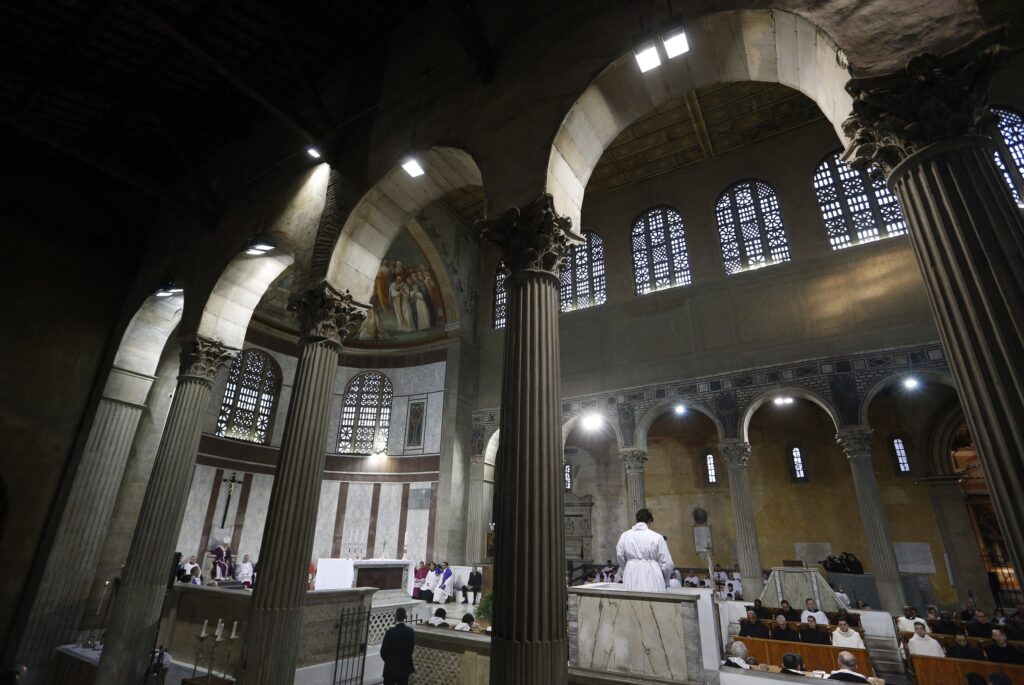
Due to the ongoing health challenges facing the Holy Father, this year’s traditional opening of Lent was celebrated by Cardinal Angelo De Donatis, an Italian prelate who heads the Apostolic Penitentiary, the Roman tribunal office overseeing the forgiveness of sins and the welfare of individual souls before God in cases that are reserved to the Holy See.
The stational Mass and central ceremony of the distribution of ashes has long been celebrated, not at Saint Peter’s Basilica as one might expect, but instead at the fifth century Basilica of Santa Sabina atop the Aventine Hill. It was here that the cardinal led the faithful in officially inaugurating our Lenten journey.
This mother church of the Order of Preachers, or Dominicans, is dedicated to the early Christian woman, Sabina. As with many of these early figures, the particularities of her life and death are shrouded in legend and mystery. But this historical figure who likely gave her life for the faith, or at the very least served as a chief benefactress of an early Christian community, has been venerated in the Church since at least the 430s AD. It is situated near a pre-existent temple to Juno, the queen of the pagan Roman gods.
Probably the most famous element of the basilica, and perhaps one of the reasons it has become inextricably intertwined with the mortifications of Lent, is its ornate wooden door, which art historians claim is one of the earliest public and positive depictions of Christ’s Crucifixion between the two thieves. These words “public” and “positive” are important qualifiers because the oldest image of the Crucifixion ever found is actually a mocking piece of Roman graffiti with a body on the cross with the head of an ass, and a caricature of an apparent believer named Alexamenos “worshipping his god.”
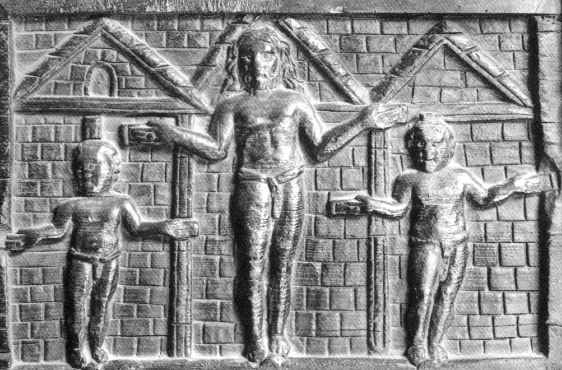
Lent offers us a chance to unite ourselves ever more closely to the sufferings of Jesus, attested to on the famous doors of Santa Sabina, and perhaps also in this providential twist of fate where Jesus is humiliated, derided and scandalous to many from the very outset of the Church’s witness. This is of course captured both in the undignified ashes that we place on our heads as a sign of authentic repentance (as opposed, say, to a crown) and the palms from which they originally come, which themselves mark the fickleness of the human condition to welcome the messiah with our words and betray him with our deeds soon after. “This people honors me with their lips, but their hearts are far from me.” (Mt 15:8, citing Isaiah 29:13)
From the time of Saint Gregory the Great in the 600s, the liturgy at Santa Sabina commences the traditional 40 station churches of Lent, where each day a site in Rome takes center stage to host pilgrims with special Masses and processions. But it is a particularly powerful one that really does transport the visitor across the centuries back to the early Church. Standing amidst its rows of columns, repurposed from pagan temples, one can almost hear the early priests weeping like the season’s opening reading from the Book of Joel: “Spare, O Lord, your people, and make not your heritage a reproach, with the nations ruling over them! Why should they say among the peoples, ‘Where is their God?’” (Joel 2:17)
One of the tombs in the basilica, that of Spanish Cardinal Ausiàs Despuig (d. 1483), has a particularly striking phrase inscribed on it: “Ut moriens viveret, vixit ut moriturus.” This echoes a Lenten call to each of us: “So that dying he would yet live, he lived as one about to die.”
Home at one time to Saints Dominic, Thomas Aquinas, Pius V, Giacinto and Sabina herself, the church complex is a storied one. It is not a coincidence that the path to this quintessential Lenten church is a steep climb, as will be the days ahead for us spiritually, when we are called to die to self so as to live for others and for the One above all others.
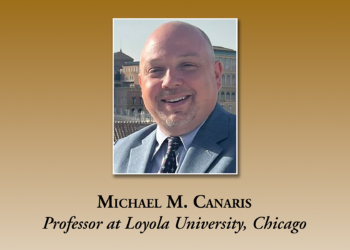
An alumnus of Camden Catholic High School, Cherry Hill, Michael M. Canaris, Ph.D., teaches at Loyola University, Chicago.




 at the bottom and then tap “Add to Home Screen”
