




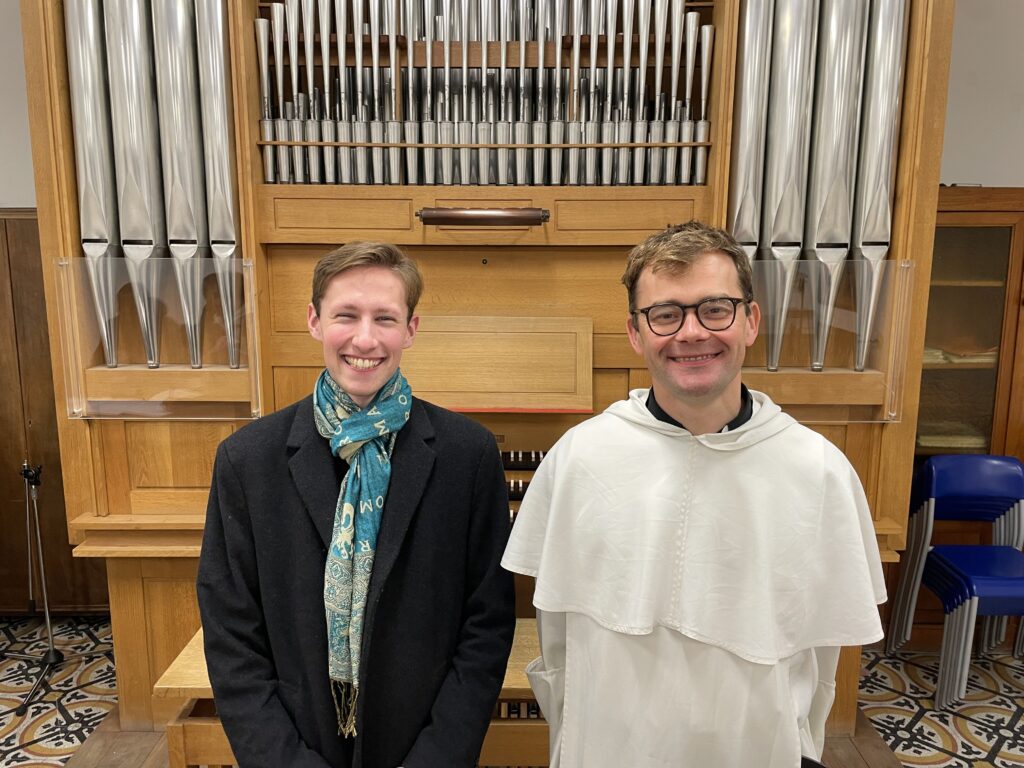
Like many young Catholics, Connor Morrissey first became involved in his home parish of Saint Elizabeth Ann Seton, Absecon, as an altar server. He later joined the children’s choir, which helped to link his spirituality and faith with song.
“It was through the choir that I first saw that I could combine going to church and singing,” Morrissey said.
The 22-year-old would go on to study music composition at Rutgers University’s Mason Gross School of the Arts, where he is currently in his last semester. The connections to his faith have remained steady through his journey, especially now as he prepares to present his senior capstone project – what he describes as “a classically-informed, liturgically-appropriate, and theologically-sound setting of the Mass Ordinary and Propers to take place on the Tuesday Within the Octave of Easter.”
“All of this music will be done in liturgical context,” Morrissey said, “restoring the beautiful texts of the Mass to their proper place.”
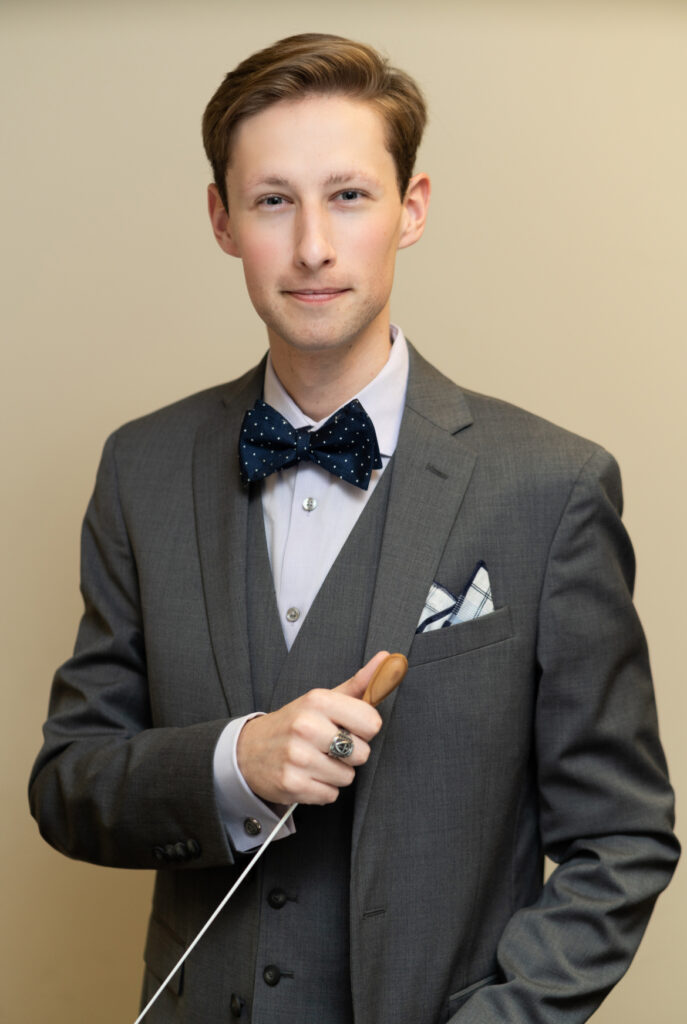
He will present his Mass setting on April 22 in Saint Peter the Apostle University and Community Parish (94 Somerset St., New Brunswick), with a prelude at 6:30 p.m. and Mass at 7 p.m. In addition to his composition, he is authoring a thesis chronicling his investigation into the history of liturgical music in the Catholic Church.
“While I have been familiar with the Mass pretty much since birth, I had no idea how interconnected everything was until I sat down to set the texts to music,” Morrissey said. “The beautifully incarnational theology of the Church, set in motion through Christ’s inbreaking into our tiny human realm through the Nativity, is continually fulfilled at Mass, with us here and now, through that fractioned Eucharist, held aloft for all to see.”
Morrissey said that his project came about thanks to the encouragement of his composition teacher, who suggested he compose a Mass setting because of his interest in liturgical music. As he developed his project, he worked to incorporate all that he has learned, as well as to reflect the interconnectivity of components of the Mass.
“Musically speaking, I try tying all of these things together in my Mass setting either by musical motif – like the same melody getting repeated across two different parts of the Mass – or through harmony and orchestration,” he explained.
Reflecting on his research and the development of his composition, Morrissey describes it as “a labor of love.” In addition to exploring the history of liturgical music, he also researched choral music through history in the Western European tradition, as well as commentaries on Catholic theology – with a particular focus on 20th century theologian Hans Urs von Balthasar.
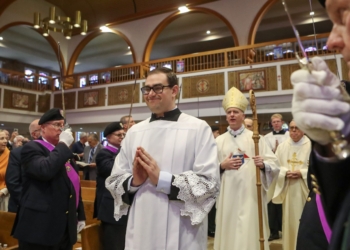
Morrissey was also the recipient of a prestigious grant that allowed him to spend 10 days at the Vatican last November with the Sistine Chapel Choir.
“My experiences researching in the Vatican were incredibly eye-opening,” he said. “I was able to examine the rich musical traditions of the Church firsthand.”
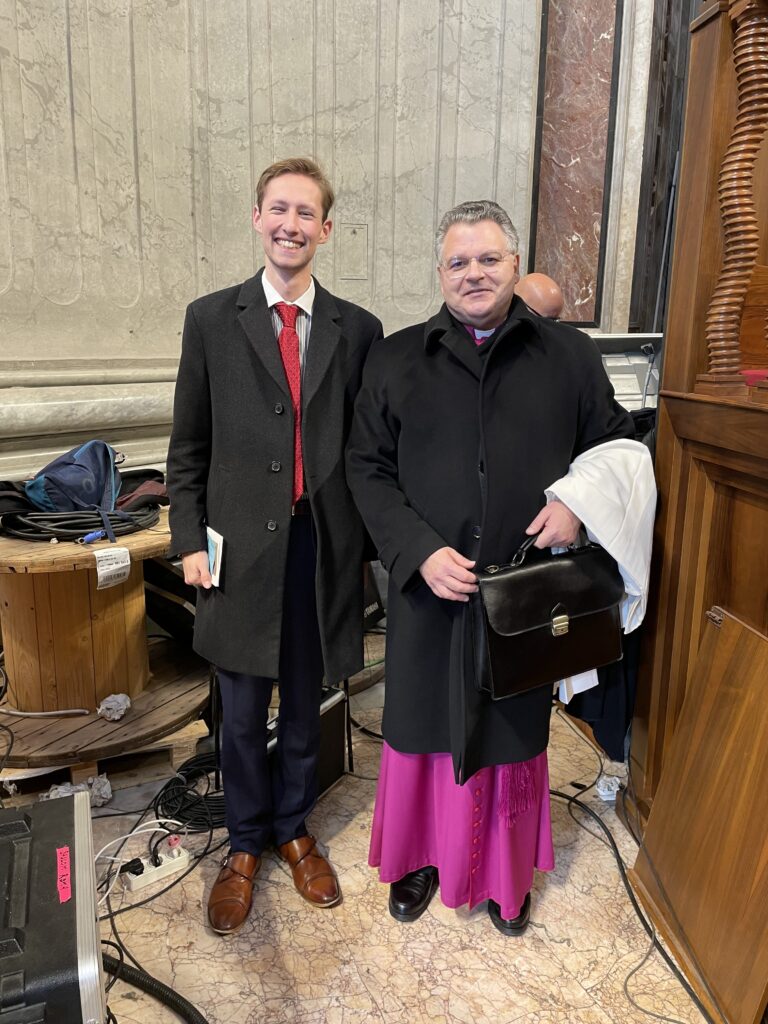
Msgr. Pavan is an opera singer-turned-priest; the Sistine Chapel Choir is the personal choir of the papacy.
During his stay, Morrisey audited a class on the Gregorian Chant at the Pontifical Institute of Sacred Music, and engaged in discussions with seminarians and music directors at the North American Pontifical College and the Venerable English College. Perhaps his favorite experience was the opportunity to secure a much-cherished and sought-after ticket to attend a Papal Mass – as a guest of the Sistine Chapel Choir.
After Morrissey graduates from Rutgers later this year, he will begin studies at the University of Notre Dame. He will pursue a master of sacred music degree with a concentration on choral conducting; he is just one of three to be accepted to the program this year. And while he does not know for sure what will come next, he has some ideas in mind.
“Through my training as a composer at Rutgers and my graduate study at Notre Dame, I could definitely foresee a future career where I am able to compose, direct, sing and publish on this subject,” he said. “Perhaps that will take the form of being in academia and researching this material, or assisting in its creation as a parish music director. That being said, musicians tend to have quite a few plates up in the air at any given point in time, and that’s just the way I like it.”
Morrissey encourages faithful to consider the words they are singing in the daily hymns – as well as the meaning behind them.
“Listen twice as loud as you sing,” he said. “Your vocal participation is welcome – and needed – but pay deep attention to the words that you are singing, and not just the tune. I think you’ll be surprised at what you find.”
If You Go
What: Original Mass setting composed by Connor Morrissey
When: 6:30 p.m., April 22 (during the Easter Octave)
Where: Saint Peter the Apostle University and Community Parish, 94 Somerset St., New Brunswick




 at the bottom and then tap “Add to Home Screen”
