




Because of the sheer volume of information and perspectives on the global and historical impact of the last pope, whittling down the salient points for a column of this length and type becomes a daunting task. And while John Paul II’s legendary and lasting patrimony of papal teaching and important documents is undoubtedly notable and worthy of reflection, I have chosen instead to focus my attention on the Renaissance-man himself, hoping to shed light on aspects of his life and personal history which are less often discussed.
Karol Josef Wojtyla was born in 1920 in Wadowice, a small city on the Skawa river in southern Poland, which is today the most Catholic country in the world by percentage (excluding the somewhat anomalous populations of Vatican City and Malta). Karol’s mother died when he was still young. It would be nearly impossible to argue that this loss did not influence Karol psychologically and spiritually for the rest of his life, especially in regard to the distinctly Marian flavor of his lived expression of Catholicism.
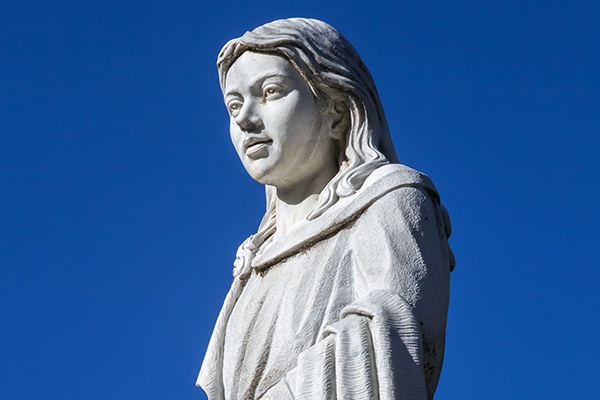
Many years later as pontiff, he would be told that letters of the alphabet are traditionally to be avoided in official ecclesiastical heraldry. He overrode the “advice” and placed an “M” on his pontifical crest, along with his motto “Totus Tuus” (“Totally Yours”), in honor of his unflagging devotion to the Mother of the Church.
As a young man, Karol had by today’s standards the most “normal” upbringing of any recent pontiff. He was an avid outdoorsman and athlete, an actor and passionate debater of all things literary and philosophical, and even dated women for a short period of his youth. It is difficult to imagine Pius XII or Paul VI as a goalkeeper for the local soccer team (one which in Karol’s case interestingly included a number of Jewish youths with whom he was entirely comfortable and friendly).
After working as a manual laborer in a quarry and chemical plant, Karol decided to study in the underground Polish seminary, a network ill at ease with the occupying Nazi forces. He had numerous close calls with the National Socialists, the most famous of which was his hiding in a basement during a search of his uncle’s house which is more than a little reminiscent of the tragic Anne Frank story.
He was ordained and went to study in Rome, eventually earning two doctorates, one in theology and the second in philosophy and ethics. His dissertations focused on St. John of the Cross, of mystical “dark night of the soul” fame, and Max Scheler, a philosophical phenomenologist who had been influenced by Edmund Husserl.
Pius XII named him a bishop at the extraordinarily young age of 38. His talents for integrating modern philosophy, classical theology, ethics (especially concerning sexuality and the body), and a staggering ability for languages and linguistics combined with an engaging and affable personality, led many in the church to view him as a rising ecclesiastical star.
He was central to many of the discussions at the Second Vatican Council. While the Germans, led by Ratzinger and Rahner, came to devote much of their scholarship and energy to the document on the workings and nature of the church itself (Lumen Gentium), Wojtyla was busying himself with the more dialogical constitution on the relationship between Catholicism and the modern world (Gaudium et Spes). In retrospect, one can see their individual interests in these matters defining their later pontificates to some degree.
The decision to elect the first non-Italian pope since 1522 sent shockwaves through the Vatican. Standing on the balcony of St. Peter’s after his election, John Paul II (who had originally intended to take the typically Polish name of Stanislaus before being dissuaded from it in favor of reverencing his predecessors), immediately ingratiated himself with the city which would become his home until his memorable death. “Even if I am unsure that I can express myself well in your, or rather our, Italian language, I’m sure that you will correct me if I make some mistakes.”
The former actor with a flair for the dramatic had his audience in the palm of his hands from the outset.
He went on to embody the globalization of the papacy, traversing the globe to bring the office of pope to the people, instead of sitting regally upon his throne and waiting for the world to come to him. His dedication to the family and its role in society, his support of the Solidarity movement (to the point of making the communists literally quake in their shoes on Polish television), his defense of life and the dignity of every human person, can only be touched upon tangentially here.
Perhaps because of my own parallel experience with Cardinal Avery Dulles toward the end of his life, I feel that more than anything else John Paul’s physical decline and death spoke to the world. Our culture largely seeks to sanitize death, whitewashing the tragic reality of suffering and its redemptive qualities. More comfortable with notes of condolences than the fidgeting discussions at every funeral parlor and wake in this country, contemporary society, despite its wordplay to the opposite, is still primarily utilitarian in outlook. It seems to say if the aged and the infirmed can’t contribute to society, they should quietly and in effect (if not in reality — see the debates over euthanasia) be removed from the center of focus, if only to make everyone more at ease.
The closing years of John Paul’s life profoundly rebut this opinion. It is precisely in suffering that Christ redeems. There is no Resurrection without the painful trauma of Good Friday or the lost and perhaps angry helplessness of Holy Saturday. John Paul’s peaceful and public decline modeled for the world not only how to live, but how to die. We will all face death; that is a non-negotiable dimension to the human existence. If we see the end as a culmination and summary of the entire pilgrimage of one’s life, John Paul had much to teach us when his words became slurred beyond comprehension and his hand unable to grasp a pen.
Michael M. Canaris of Collingswood is an administrator at Fairfield University’s Center for Faith and Public Life and is on the faculty for the Department of Philosophy, Theology, and Religious Studies at Sacred Heart University.




 at the bottom and then tap “Add to Home Screen”