



This fall, Carmel Children’s House will be starting in Hammonton, a Catholic program based on the principles born of the work of an Italian female physician and educator more than 100 years ago.
Carmel Children’s House, located in the former Saint Joseph Regional School, will offer children ages three to five classroom instruction based in the time-honored, child-directed Montessori method.
Student-led educational practices
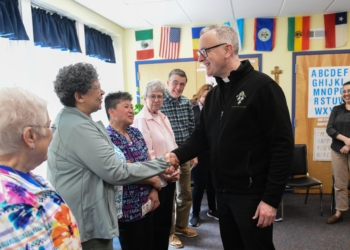
Father David Rivera, pastor of Saint Mary of Mount Carmel Parish, explained how the Montessori method differs from other types of instruction.
“The Montessori method supports children in selecting their own materials according to their interests for an extended period of time,” he said. “We allow the children to work independently or in pairs, and the classroom is very quiet. We manage their engagement with the material and get out of the way.”
The American Montessori Society defines the method as “an education philosophy and practice that fosters rigorous, self-motivated growth for children and adolescents in all areas of their development, with a goal of nurturing each child’s natural desire for knowledge, understanding and respect.” Named for its creator, Dr. Maria Montessori, the method created in 1907 is based upon individual learning goals, multi-sensory tasks, and self-motivated growth in all areas of development.
In short: The children take the lead in the quest for knowledge.
The teacher, or guide, acts as a link between the child and the materials. Their focus is to “lead from behind,” carefully observing each student, encouraging independent work and presenting lessons, or “presentations” to each child according to his or her individual work plan.
The lead guide for Carmel Children’s House will be Lisa Lorusso, a teacher in the Camden Diocese for the past 11 years. Lorusso has worked in Saint Joseph Regional School, Hammonton, and Saint Mary School, Williamstown, including an assignment of teaching a combined first and second grade where she saw the advantages of the kind of mixed-age learning environment typical of Montessori classrooms. Since 2015, she has taught religious education for the parish programs of Christ the Redeemer, Atco, and Saint Mary of Mount Carmel, Hammonton.
Lorusso has been participating in a year-long training course in Princeton Montessori School. Carmel Children’s House will add guides and assistants as its student population grows.
Montessori principles and Catholic education
Religious education in the Catholic Montessori will also follow a child-focused program known as Catechesis of the Good Shepherd (CGS). Created in Italy in the 1950s by Biblical scholar Sofia Cavalletti and Gianna Gobi, CGS is based upon what Maria Montessori discovered about the developmental and spiritual capabilities of young from between birth to age 12.
An atrium, an area separate from the main classroom, contains shelves at child height filled with items commonly found in a church, as well as child-sized models of the Holy Family, even cleaning supplies for them to care for their environment. Lorusso noted that teacher instruction at the start of the session leads to multiple activities.
“It begins with circle time,” she said. “We might sing a song and learn about the parts of the Mass. A child can select which item they want to carry in a procession, set up the altar, listen to a Gospel reading. All the items [such as the chalice, candles and Bible] are real.”
Conversations with guides on Scripture and liturgy might lead one child to mimic the celebration of Mass, while another might use the figures of Jesus and the sheep to bring the parable of the Good Shepherd to life. Colored vestments for the different seasons of the Church year add to the explanation of the cycle of Jesus’ Birth, ministry, Death and Resurrection in a tactile way.
“I’ve seen it work in my own parish [Christ the Redeemer]” Lorusso said. “I went to visit the class and watched a four-year-old girl explain the reason a priest poured a bit of water from the cruet into the chalice, and thought, ‘If this child can explain this, I’m sold.’ I even took my own religious education class to the atrium, and the kids were fascinated.”
Father Rivera added, “The Church presumes children are naturally spiritual. We are all spiritual beings. Montessori takes that seriously – it’s a matter of the heart.”
Entire family benefits
Father Rivera has become a staunch proponent of Montessori education. The pastor plans to introduce the Montessori method this fall with a class of no more than 24 three- to five-year-old students. He is working with the Office of Catholic Education on the process of adding additional grades one per year up to fifth grade. He freely admits the program might elicit skepticism amongst potential families.
“This is new here. We might struggle with stereotypes,” Father Rivera said. “For those who say, ‘Montessori is only for rich people,’ I point out that it will cost the same as our [existing] Little Cubs. For those who think that ‘it’s only for hippies,’ Maria Montessori designed it for poor children of factory workers.”
He recalled a conversation with a fellow pastor and friend who had instituted the Montessori method and the Catechesis of the Good Shepherd in his South Dakota school – the children excitedly brought home stories of their lessons and worship, and prompted their own parents to more regularly attend Mass.
“With the students bringing their faith back home to their families,” Father Rivera said, “I told him, ‘That’s all I need to know.’”
For more information on the Carmel Children’s House, including videos and resources, see carmelchildrenshouse.org.



 at the bottom and then tap “Add to Home Screen”
