


Pastoral or parish councils? It’s not just a change in semantics.
Addressing the pastoral needs of a parish in the transformed landscape that is the Camden Diocese brings new opportunities for parishioners to express their baptismal call in prayer, discernment and action. Parish Pastoral Councils will be instrumental in helping pastors set goals and create strategies that carry out the mission of each parish.
Relating mission to vision
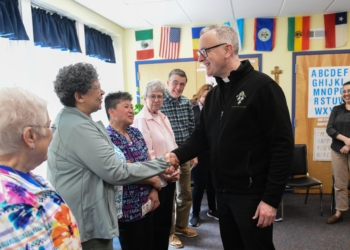
“Bishop (Joseph) Galante continues to encourage lay people to step up and join hands with the clergy and religious of the diocese,” said Father Anthony DiBardino, pastor of the Catholic Community of the Holy Spirit, encompassing Mullica Hill, Woodstown and Elmer. “He calls all of us to take responsibility for the life of the Catholic Church in South Jersey.”
In each parish within the diocese, pastoral councils will embody the visionary spirit that works toward creating a more dynamic community of faith, hope and love.
“At the very core of each pastoral council will be the drive to develop a vision of that vibrant parish which really does bring the light of Christ to the ministries that are served by the faith community,” said Father DiBardino.
Pastoral councils will be instrumental in helping parishes review and enliven their liturgical life; raise awareness about vocations; reach out to young people; create more opportunity for lifelong faith formation; strengthen lay ministries; and expand compassionate outreach efforts.
“These are key components of vibrant parish life,” said Sister Antoine Lawlor, director of Pastoral Priorities of the Camden Diocese.
Sister Antoine has been traveling to parishes throughout the diocese to facilitate Information Night Workshops. The workshops provide on-going formation for council members as they learn what pastoral planning entails; how they as members or as candidates for the parish pastoral council will advise the pastor; and how they will help discern what will be the best path for the future of that particular parish at that particular time.
Empowering the community
“Prior to the 1980s, parish councils, by and large, offered a supportive role to help the pastor ‘run’ the parish,” explained Father William Moore, pastor of Mary, Queen of All Saints Parish, Pennsauken. “They did this in an advisory way, helping to put together and coordinate various ministries involving the laity and implementing parish or church policies.”
Mark F. Fischer of St. John’s Seminary in Camarillo, California is author and co-editor of various books on pastoral councils. His books and website offer guidance as parishes establish a more contemporary model of a parish council — an envisioning body that will help articulate the mission of the parish and empower the people in their community.
“Pastoral councils were first recommended in Vatican II’s Decree on the Pastoral Office of Bishops,” Fischer explained. “Yet even today, almost 50 years after Vatican II, the debate about the nature of the pastoral council still continues. People discuss what councils do, how they do it, and the motive for putting their gifts at the service of the church.”
Fischer reports that “since the 1970s and 1980s, the number of councils in the USA has grown tremendously,” existing in three-quarters of nearly 19,000 Catholic parishes. Vatican documents, including the 1983 Code of Canon Law, are the foundation for the more contemporary model.
Fischer explained that the church intends these councils to “offer pastors wise advice about practical matters.”
“He wants to lead wisely, and consults the council because their study and reflection can help the parish. Councillors, for their part, share his commitment. They want to make prudent recommendations about what the parish should do based on genuine knowledge. In the church’s view, the pastor consults and councillors collaborate with him. Both want truth and wisdom to permeate all parish decisions.”
“Members of the pastoral councils, although consultative to the pastor, work in collaboration with him,” explained Father Moore. “They will have a role in discerning how the parish goals and objectives are consistent with the overall mission of the parish and how they are implemented.”
“This newer model, being expressly pastoral in nature, is especially supportive of the pastor’s role to see that the vision of the church in parish life is focal and consistently addressed at council meetings,” explained Father Moore. “There is a great feeling of comfort for the pastor to know that the Pastoral Council works in collaboration with him to examine issues and concerns that can lead to a consensus of how the parish might proceed to address them.”
At the Information Night Workshops, Sister Antoine reviews the diocese’s newly revised Guidelines for Parish Pastoral Councils. She offers insights as parishes adopt the new model, encouraging the members to ask: “Who are we, and what are we doing now? What do we want to see in the future? How are we going to do it?”
The Pastoral Council at Mary, Queen of All Saints Parish has begun their work. “One of the primary objectives of our council is to keep parishioners well informed of its purpose, deliberations and intent,” said Father Moore.
“This was especially important to us when two parishes united as one,” he said. “The emphasis was clearly placed on beginning anew, inviting participation by parishioners from both former parishes and encouraging good stewardship by providing opportunities for parishioners to discover and use their unique strengths (talents and gifts) for the good of the entire faith community.”
“Having consistently publicized the new visionary role of the council, the response from the merged parish community has been a positive one,” Father Moore said. “This has been most notable from the positive responses in support of our newly formed ministries involving more enhanced liturgical celebrations, hiring a music director, creating a bereavement support group, youth ministry expansion, Hispanic Ministry and evangelizing outreach with the ‘Inviting Catholics Home’ program in particular.”
The Catholic Community of the Holy Spirit, established just six months ago, is in its infancy. This Christmas season gave its three now-joined communities a real opportunity to examine the needs of the faithful and the way that they have traditionally met those needs. The various parish ministries came together and coordinated with the parish staff to carry on the missions of their former parishes with material and monetary collections for families in need and for local food banks. Now comes the task of creating one united vision and mission statement.
“Our pastoral council is just beginning to reflect on a common vision, the guiding principle for the work we do,” said Father DiBardino. But first comes the process of discernment and formation.
“I’ve heard again and again about the importance of formation,” he explained. “And about the patience needed to become the pastoral council, rather than to do things that the parish council used to do.”
Evaluating the impact of a pastoral council will be less obvious than measuring the success of the parish carnival or the number of food baskets distributed to needy families at Thanksgiving. “We aren’t looking at what our pastoral council is doing,” said Father DiBardino, “but rather what goals the parish is reaching toward and how we are working toward them. At this moment, we are taking our time to read, study, share — and then develop what these goals will be.”
Father Moore reflected on the challenges that face the parishes of the diocese. “It’s always a challenge to pull back, take stock of where we’re going and how we can best get there,” he said.
“Closing one door in the case of a merging parish, however, can be the very means to throw open a new and more engaging perspective of parish life and ministry than we would not have otherwise thought possible. Parish Pastoral Councils can light the way to find the right door that reveals a united vision unlocking the great potential every parishioner has to move the vision forward.”



 at the bottom and then tap “Add to Home Screen”