




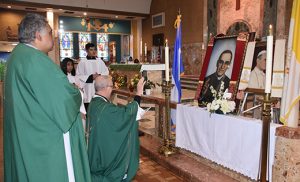
Father Vincent Guest, pastor, blesses an image of Saint Oscar Romero at a Mass celebrating his canonization on Oct. 14 at Our Lady of Guadalupe Parish, Lindenwold. Also pictured is Deacon Omar M. Aguilar of Saint Joseph Pro-Cathedral, Camden.
Years ago I read a fascinating article written by a government official in El Salvador which traced the way political parties — on both the left and right — had attempted to posthumously manipulate the image of Archbishop Oscar Romero for their own strategic ends.
Objectively speaking: Romero was the first Catholic bishop assassinated in a church since Thomas á Becket in 1170 in Canterbury, England. He was the first Salvadorian to be made a saint, which occurred along with Pope Paul VI and a number of others, at a Vatican ceremony this past weekend on Oct. 14. And it is undeniable that he continues to be one of the most widely-referenced figures of 20th century Christianity.
Beyond these facts, like with so much else, ideological battles continue to rage about his ultimate significance for contemporary believers. The article I read mentioned the need to “unlearn” the widely-disseminated history of Romero if one truly hoped to understand the real figure at a deeper and more profound level.
To that end, I often encourage my students to read primary sources by Romero directly, including a lecture he gave when being given an honorary doctorate from the University of Louvain in Belgium in February, 1980.
In this piece, Romero reflects on the “political dimension of the Faith,” but he does so neither as an expert in domestic or international relations, nor as a theoretician reflecting on church-state dynamics. Rather, he speaks as a pastor who models his shepherding duties after a Christ “who lived, worked, battled, and died in the midst of a city, in the polis.”
This public (“political”) element of the life of a Christian makes demands upon him or her, in whatever context one lives and works. Apathy about the social, economic, and moral struggles of our day — even, for instance, regarding elections — is not ultimately the optimal attitude for a believer of Christ. Even with reservations, or in rare instances when we feel compelled to withdraw from a particular process for a specific reason, it ought not simply be indifference to the suffering of others that leads us to this conclusion.
We are instructed by Christ to give Caesar his due when it comes to our responsibilities to the systemic structures that help govern our social lives. The particularities of what the precise demands of a given Christian in a specific complex situation are in this arena remain ultimately rooted in the inviolability of an informed conscience, which stands naked before God.
Romero claims both the incarnation and the constant need for conversion — what he calls the “central truths of our faith” — demand an encounter with the poor, with those who in “this-worldly terms, have heard bad news, and who have lived out even worse realities.”
Such people are not simply the recipients of a message of other-worldly salvation, but also themselves “have Good News to proclaim to the rich. … In this situation of conflict and antagonism, in which just a few persons control economic and political power, the church has placed itself at the side of the poor and has undertaken their defense.” Thus, our faith community also learns from them and receives the gifts, not the threats, which they embody.
The church is not in essence a political institution in competition with others, but rather more profoundly and theologically, manifests “an authentic option for the poor, of becoming incarnate in their world, of proclaiming the Good News to them, of giving them hope, of encouraging them to engage in a liberating praxis, of defending their cause and sharing their fate.”
When the pope canonized Romero, he drew a direct line between the Second Vatican Council, which was so intertwined with the life of now-Saint Paul VI, and Romero:
“Today [Pope Paul VI] still urges us, together with the Council whose wise helmsman he was, to live our common vocation: the universal call to holiness. Not to half measures, but to holiness. It is wonderful that together with him and the other new saints today, there is Archbishop Romero, who left the security of the world, even his own safety, in order to give his life according to the Gospel, close to the poor and to his people, with a heart drawn to Jesus and his brothers and sisters.”
Originally from Collingswood, Michael M. Canaris, Ph.D., teaches at Loyola University, Chicago.



 at the bottom and then tap “Add to Home Screen”
