




Pope Francis has recently named Jose Luis Rueda Aparicio to succeed Cardinal Ruben Salazar Gomez as the Archbishop of Bogotá, Colombia. As noted by Rocco Palmo on Whispers in the Loggia, this nomination has outsized importance because it is, as he puts it, “the de facto ‘capital’ of the Latin American church as the seat of CELAM.”
CELAM is the Spanish acronym for the Consejo Episcopal Latinoamericano, in English: the regional Episcopal Conference of Latin America.
The conference’s roots date to 1955, but it has more famously made an international mark on the reception and interpretation of the Second Vatican Council in the decades since the 1960s. Their meetings in Rio de Janeiro (Brazil), Medellin (Colombia), Puebla (Mexico), Santo Domingo (Dominican Republic), and Aparecida (Brazil) have provided some of the most robust and innovative guidelines on how the contemporary church can evangelize effectively in particular contexts and locations, especially those that suffer from poverty, exclusion and systematic global disadvantage. These struggles have seemingly strengthened, not diminished, the popular piety and energetic growth of the faith in the global south. CELAM has sought to harness and direct this energy into new avenues. This thinking has proved to be of undeniable importance to the Bergoglio papacy.
I have a number of colleagues, friends and relatives by marriage in Latin America, particularly in Argentina, Brazil, and Colombia. I spoke this week with a Loyola graduate student from Bogotá, Aleja Sastoque, who is studying to be a pastoral counselor for Latinx and immigrant communities.
She pointed out how important CELAM has been to her ministry and vocation. “The documents and statements of CELAM have proven to be a fundamental part of what we call ‘la pastoral latinoamericana’ (roughly translated as ‘the pastoral and practical theology of Latin America’). This is because they explain, promote and reflect on the challenges of the Second Vatican Council not only from a pastoral point of view, but also because they take into account the actual current reality of each and every one of the Latin American and Caribbean ‘peoples.’ CELAM helps translate the church’s teachings using local language and thought patterns, and promotes the active participation in the shared work of the community and of the church.”
It is inarguable that the energy and influence of the Catholic Church is shifting toward the Southern hemisphere. Though many residents of the United States, particularly in former bastions of Catholicism in the Northeast and Midwest, still do not recognize the rapidity of these shifts, the face of the global (and North and South American) church is increasingly poor, female and brown. Remaining mired in earlier patterns of provincialism risks locking the vibrant beating heart of the faith up in ivory towers of libraries and unpopulated museums.
This is a social and demographic reality, as much as it is an ecclesial one. Compare as one small example the average fertility rate in the United States (1.8 births per woman), Canada (1.5) and Italy (1.3), to those of Guatemala (2.9), East Timor (4.1), Nigeria (5.5) and Somalia (6.2). The idea behind the hymn “Now We Remain” will ring ever more true to global north Christians over the next century. Our influence will be rightly dwarfed by those living the faith in contexts far from the former corridors of economic, political and theological power. Of course, we are called to live out our call to discipleship faithfully in these regions that served as early seedbeds of belief and the crucibles where doctrinal truths about Christ were developed and refined. The historicity of a faith that was birthed in the Mediterranean world could not demand less. But an indispensable element of that call will now demand us to study how and learn from those in whom that faith has spread and set the world ablaze in what is today the “majority world.”
¡Ven aquí, viento del sur! Sopla mi huerto, despréndanse sus suave fragrancia, para que mi amado entre y pruebe sus deliciosos frutos.” (Cantar de los Cantares 4:16).
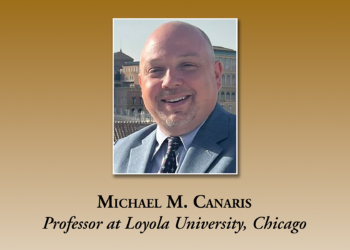
Originally from Collingswood, Michael M. Canaris, Ph.D., teaches at Loyola University, Chicago.



 at the bottom and then tap “Add to Home Screen”
