




Here in Rome where I am teaching a graduate course on the sites and history associated with the spirituality of Saint Ignatius of Loyola, the recent announcement of a consistory naming new cardinals has of course dominated a great deal of the conversation in coffee shops and restaurants among Vatican-watchers. And while I have my own opinions and interpretations of some of the Holy Father’s decisions there, it is not the only important event in the eternal city worthy of comment this month.
Pope Francis recently released a short video introducing his prayer intentions for June 2022. The clip is available at www.thepopevideo.org, a website coordinated by the Pope’s Worldwide Prayer Network. In it, the pontiff asks the world to pray for contemporary families because “by being united in our differences, we evangelize with our example of life.” He notes that while there are no “perfect families,” we should never be afraid of making mistakes, and that “when we argue, when we suffer, when we’re joyful, the Lord is there, and accompanies us, and helps us, and corrects us.” This hope that every family in the world “embody and experience unconditional love as a path to holiness in everyday life” lies at the heart of the 10th World Meeting of Families, which will take place in Rome at the end of the month.
You may remember the eighth WMF, as it brought the pope to Philadelphia in 2015. My good friend Mary Beth Yount, a local professor at Neumann University in Aston, Pa., was the director of content and programming for that papal event. We have collaborated on a number of projects and will be spending time with one another and planning some more future initiatives together during the festivities in Italy this time around.
She has written widely on the role of the family in the ecclesiology of Pope Francis. More than a mini-factory for churning out potential future priests, as noble a goal as that may be, the “domestic church” image that is familiar to many of us in describing family life as the seedbed of faith can be taken further: “The development of this image can convey a radical breaking open to the Holy Spirit, the prophetic nature of inspiration, and the wildness that is relationality, communion and sacramentality.” Both the family and the Church are “in process, graced and dynamic, visible and social embodiments” of God’s self-communication to the kindred human family. There is an unpredictable and developmental quality to our shared inter-relationships and our familial bonds, and their “undomesticated” tendencies and characteristics must inform our way of being with one another, with God and even with ourselves.
If our local parish setting is really a “family of families” as is so often asserted, then we need to continue to ponder the mystery that exists in even our closest inherited and adopted relationships. For example, while I can say that I know many things about my parents and spouse and young child after countless hours spent with them over the course of a lifetime, it is part of the human condition that in some very real sense they always remain a mystery to me in their sheer otherness. We can never entirely plumb the depths of another person, and that is in many ways the root of the dignity of their personhood that is the true imago Dei.
This also echoes our relationship with the transcendent, ineffable, uncontrollable God of the cosmos, who has chosen to draw incomparably near to make us his sons and daughters in baptism, but yet remains utterly mysterious in infinite and unapproachable light. The danger in attempting to domesticate God (and one another in family life) lies in the futile attempt to put the roaring Lion of Judah into a weekend excursion to a petting zoo.
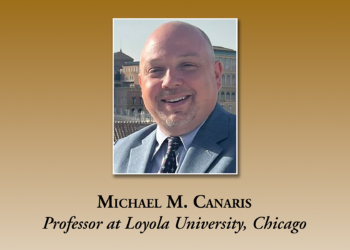
Originally from Collingswood, Michael M. Canaris, Ph.D., teaches at Loyola University, Chicago.



 at the bottom and then tap “Add to Home Screen”
