








Forgive me, dentist, for I am flawed. It has been six months since my last appointment. Let’s see, I’ve eaten sweets, chewed some gum, haven’t flossed regularly. Um, I have drunk coffee and wine even though I know they can stain the enamel. Beer? Is beer bad for your teeth? Soda? Yes, I do drink soda, not that much though. Oh, yea, and I enjoy an occasional cigar. I am sorry for these and all my other dental flaws.
It’s amazing how contrite one can become when faced with an impending crisis. So here I was, sitting in the waiting room while I was nervously rehearsing my periodontal confession.
Don’t get me wrong, my dentist is a great guy. It’s just that my history with the profession has been, shall I say, just a little less than delightful.
My fear of dentists dates back to when I was young and was forced to make our semi-annual excursion to Dr. Painandfear. Bigfoot-like in stature, sprouting a grungy beard, Dr. Painandfear had little tolerance for residual Bazooka Joe bubblegum in the crevices between teeth.
He would stand over me like a crazed mad torturer, harshly reprimand me on my oral hygiene habits. “I brush, twice a day,” I would plead to no avail. He would just grunt for me to open my mouth wide … wider … wider – and then take a weapon of mouth destruction and pick and scrape and chisel at my teeth with a barbarous grin not unlike the dentist in “Little Shop of Horrors.”
Even though I know it is good for me, that it is necessary for overall well-being, and that afterward I will feel the minty freshness of clean and healthy teeth, I still cannot help but feel trepidation when I go.
Many Catholics look at the Sacrament of Reconciliation in a similar way.
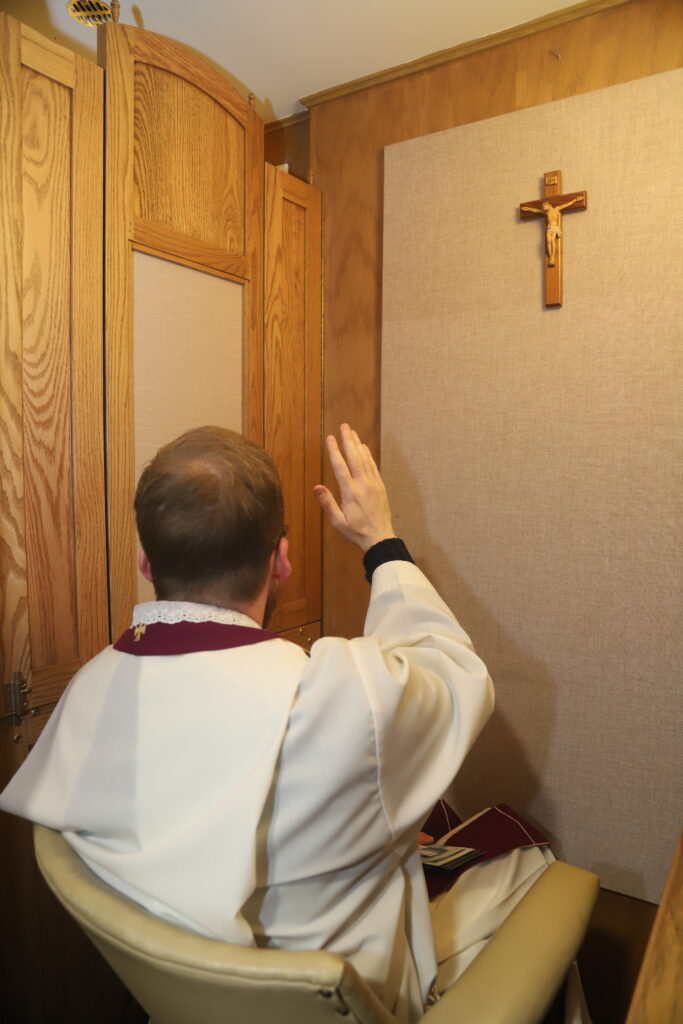
A recent Pew Research Center study found that “overall, 23% of U.S. Catholics say they go to confession at least once a year, while 30% say they go less often. About half of Catholics (47%) say they never go to confession.” Not surprisingly, the study also found that weekly Mass-going Catholics tend to go to confession more often than those who don’t.
Going to confession can sometimes feel uncomfortable, painful and scary, but those feelings don’t come from God, which makes our need for confession all the more imperative.
When I was a kid, we did this thing where we would cross our fingers behind our backs if we were going to say something that was – let’s say – less than truthful. By crossing our fingers behind our backs, we became immune to any accountability because our crossed fingers somehow kept us protected. It was an accepted get-out-of-jail-free for fibbing card.
For many of us, we can sometimes do the same thing but in different ways. Instead of crossing our fingers, we can easily convince ourselves that a sin we’ve committed isn’t so bad as we rationalize the circumstances and causes of the sin, telling ourselves that God understands. Yes, he does understand. In fact, he understands so much that he has given us a way to reconcile ourselves back to Him: The Sacrament of Reconciliation.
Pope Francis said, “The confessional is not a torture chamber, but the place where the Lord’s mercy motivates us to do better.”
We go to the doctor when we’re ill, to the dentist when we have a toothache, but we also go regularly to maintain our overall wellness. In much the same way, going to confession regularly can help our spiritual wellness and strengthen us against the disease and decay of sin.
The Lenten Season is the ideal time to go back to confession. As Pope Saint John Paul II reminded us, “Lent invites us to return to the sacrament of Reconciliation so that we may share more fully in the mystery of Easter.”
So, when we leave the confessional, with a clean fresh smile and two fingers unbound, we can hold those fingers up high to reveal two signs: the first, “V” for victory – Christ’s victory over death, over sin. And, through the Sacrament of Reconciliation, we are left with the second sign – peace.
Deacon Dean Johnson serves at Church of the Holy Family, Sewell.
Did You Know?
Some historians claim that crossing fingers originated with the first century Christians.
During the very early years of Christianity, in times when Christianity was outlawed, people used signs in order to identify each other. One of those signs was crossed fingers. But it was slightly different. It was more like a secret handshake.
They would call it “Ichthys,” meaning “fish” because it kind of looked like a fish, the so-called “Jesus Fish” that one sees on many cars.
How it came to justify a lie can be found in early Christianity as well. According to the article, “Why Do We Cross Our Fingers for Luck and When Lying?”: “Christians started making the cross symbol with their fingers when lying to protect themselves against God’s wrath for breaking one of the commandments. As to when this started, it has been speculated that it dates all the way back to the beginnings of Christianity – the same as the Ichthys, when Christians had to lie about being Christians since the religion was outlawed, often under penalty of death.”






 at the bottom and then tap “Add to Home Screen”
