



Muslims began their holy month of Ramadan on April 23rd. Ramadan is the ninth month of the Islamic calendar, observed by Muslims as a month of fasting, prayer, reflection and community. But like Jews who recently celebrated Passover and Christians who celebrated the Triduum and Easter during the pandemic Covid-19, Muslims are struggling with the social-distancing measures affecting all religious communities and their holidays. The world’s 1.8 billion Muslims like the rest of us are trying to adjust to our new reality as their mosques remain closed and all their feasts after dusk are being held in private.
In the Middle East most of the holy sites for Muslims, including Mecca, are closed and deserted due to the coronavirus. Some countries have amended their curfews to allow people to shop for food. Egypt’s government is allowing more businesses to reopen and supermarkets and businesses can stay open on weekends until sundown. Algeria is easing confinement directives and shortening curfews in some towns. In the Gaza Strip, all mosques will remain closed throughout the month of Ramadan. In Indonesia, the world’s largest Muslim nation, all non-essential travel between provinces has been banned in order to contain the coronavirus. It has been reported, however, that mosques in Pakistan have been full in the lead up to Ramadan, even though their government has called for restrictions.
Saudi Arabia which is home to the holiest cities in Islam, Mecca and Medina, has 14,000 confirmed cases of coronovirus with more than 120 deaths. In a statement, Saudi King Salman bin Abdul-Aziz Al Saud, said, “It pains me to welcome the glorious month of Ramadan under circumstances that forbid us prayers in Mosques and of performing the Ramadan prayers. All this is due to the protective measures taken to save lives and human well-being in light of the global threat of COVID-19.”
In Iran, the Muslim country most affected by the COVID-19 virus, more than 87,000 cases have been confirmed with over 5,500 deaths reported, though it is believed these numbers are understated. Iran for months tried to underplay the extent of the spread of coronovirus in Iran. Even the country’s deputy health minister, Iraj Harirchi, seen on Iranian television looking peaked trying to reassure Iranians was later diagnosed himself with the coronavirus. Iranians have been reluctant to limit the number of people gathering for Ramadan gatherings, even though their supreme leader, Ayatollah Ali Khamenei, proclaimed that distancing is needed at this time.
The annual observance of Ramadan observed by Muslims worldwide is a commemoration of Muhammad’s first revelation and is regarded as one of the Five Pillars of Islam. It lasts 29-30 days, from the sighting of the crescent moon at the beginning of ninth month until the next crescent moon. It consists of, sawm (fasting), zakat and sadaqah (alms giving), and taraweeh (prayer). It commemorates the night when the Quran was first sent down to the heaven of the world and also the night when the first verses of the Quran were revealed to the prophet Muhammad. Fasting from sunrise to sunset is mandatory for all adult Muslims. This fast includes abstaining from food and drink, tobacco products, sexual relations and any sinful behavior.
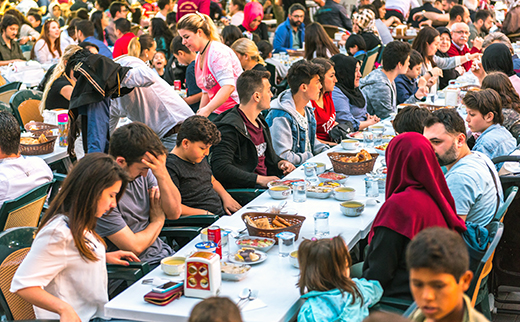
One of the Ramadan practices that is most affected by the COVID-19 pandemic is what is called the Iftar. At sunset Muslim families and friends break the fast by gathering for a meal beginning with the eating of three dates reenacting Muhammad’s breaking of the fast by eating three dates. They then say prayers (Maghrib), after which they share a large meal. Sometimes these iftars include large banquets that can include hundreds or even thousands of diners.
The quarantine that the world finds itself in during the pandemic has forced Muslims, especially here in the U.S. to resort to videoconferencing to replace in-person meals and prayer gatherings. Koloud Tarapolsi, a Seattle based art teacher and blogger, said, “Zoom is just not cutting it! The best part of iftars are the smells. Hugging and sharing that Ramadan joy, seeing all my family and the community, I’m going to miss that. We’re having to readjust it all.”
We wish our local Muslim friends a Ramadan Mubarak, or blessed Ramadan. As our local Jewish community learned with Passover and Christians throughout South Jersey experienced with Easter, our call to holy living transcends any limitations forced upon us by COVID-19.
Father Joseph D. Wallace is director, Ecumenical and Inter-religious Affairs, Diocese of Camden.




 at the bottom and then tap “Add to Home Screen”
