





When you are reading this column, you’ll likely be situated squarely between two moveable solemnities (the highest type of feast days) which lie at the very heart of our faith, Trinity Sunday and Corpus Christi. Because they are tied to Easter and Pentecost, they are not celebrated on the same date each year, like Christmas or your favorite saint’s memorial. It’s important to note that both venerate doctrines which are not explicitly scriptural, though they are more than implied in the Catholic interpretation of the texts.
The word “trinity” does not appear in the Bible, though there are a multiplicity of Old and New Testament texts which the Church Fathers and Mothers interpreted as pointing out the co-eternal relationship between Father, Son and Spirit that defines the quintessence of the Godhead for Christians. Though of course Catholics were reflecting on this reality long before the decision, Pope John XXII (1316-34) promulgated the universal feast of Trinity Sunday to follow Pentecost every year, making it 56 days after Easter.
Corpus Christi celebrates the transubstantiation that takes place at the Eucharist, when the bread and wine change into the body, blood, soul and divinity of Jesus Christ. Again, the technical word does not appear until well after the biblical texts were composed and used by Christian communities. In many ways, it celebrates themes familiar to us on Holy Thursday, and frequently uses some of the same hymns and prayers written by Thomas Aquinas, but in a less somber tone. Tradition says that Saint Juliana of Cornillon (1193-1258) convinced her contemporary Pope Urban IV to dedicate a special memorial to the Body and Blood of Christ sacramentally present in the Eucharist. The customary processions with the host already occurred at other times of year, but became an integral element of the feast. I have many times processed, alongside with thousands of others, with the pope on the traditional route from Saint Giovanni Laterano to Santa Maria Maggiore in more sanguine summers. Corpus Christi, too, was intentionally tied to the Paschal season, and occurs 60 or 63 days after Easter, depending on whether it is regionally celebrated on a Thursday or the following Sunday. The Texas city of the same name was discovered by the Spanish-speaking explorer Alonso Alvarez de Pineda, when he arrived on the gulf coast on the feast day in 1519 (over a hundred years before the English-speaking settlers arrived to Plymouth Colony).
These celebrations speak to us about a number of important realities: First, popular piety that grows out of a communal grassroots experience of holy men and (in Corpus Christi’s case, in particular) women, whose lives have been transformed by Christ and who then have their pre-existing expressions of prayer and fidelity authenticated by bishops, popes, and theologians, not the reverse. Second, the development of doctrine, when our radically historical faith adapts to face challenges, gaps and needs in different centuries and eras. And third, a sacramental imagination that allows Catholics to see divine truths reflected and incarnated in lo cotidiano, the every-day experiences at the lived contextual intersection of the contemplative and the practical, the other-worldly and the mundane.
Any attempt to posit the faith as static, ethereal or removed from the vicissitudes of generational, personal or epochal shifts renders it impotent to transform hearts and souls in the current moment. For ours is a God of the living, not of the dead; a God of the camino, not of the museum; a God of the present and the future, not (only) of the past. Via many frank and warm conversations, few shepherds have made this clearer to me than my fellow Camden Catholic alum and Son of Ignatius, Bishop George Murry, S.J. Please say a prayer for his eternal soul in this season, that he may now appreciate with cloudless eyes the triune God that he proclaimed from the pulpit, partake of the heavenly banquet that he so often savored merely in foretastes, and intercede for a church and society that he loved tirelessly and yet longed to see bettered.
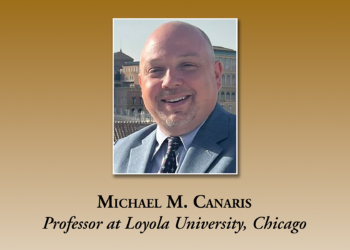
Originally from Collingswood, Michael M. Canaris, Ph.D., teaches at Loyola University, Chicago.



 at the bottom and then tap “Add to Home Screen”
