
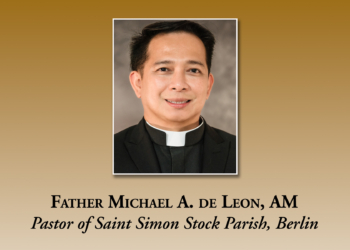



Throughout the world, Jews and Catholics recently celebrated the 55th anniversary of the groundbreaking document from the Second Vatican Council, “Nostra Aetate,” which called for an end to anti-Semitism. I remember 30 years ago having been ordained five years and being appointed as ecumenical director for the Diocese of Camden. That year I met Mr. Alan Respler, who was at that time the executive director of the Jewish Community Relations Council of Southern New Jersey. Alan Respler suggested that we jointly celebrate the 25th anniversary of “Nostra Aetate.” It was the beginning of a long, cordial and friendly relationship between the Jewish and Catholic communities here in Southern New Jersey.
Five years ago to mark the 50th anniversary of “Nostra Aetate” here in South Jersey, Bishop Sullivan was invited to be the guest speaker at Temple Emanuel in Cherry Hill. Bishop Sullivan addressed a packed synagogue, saying that it was a pleasure “to continue to celebrate the close ties of friendship and respect that Catholics and Jews share here in South Jersey,” in which “Nostra Aetate,” “inaugurated a new era of positive relationship and engagement.”
“May we continue the good work begun in interfaith rapprochement by ‘Nostra Aetate’ and bring it to fruition in the Kingdom of God,” he said.
Given the restrictions due to COVID 19, a gathering to celebrate is almost impossible locally. Even internationally, a plan to celebrate the 55th anniversary in Sao Paolo, Brazil was forced to cancel due to the pandemic. However, Cardinal Kurt Koch, president of the Vatican Commission for Religious Relations with the Jews, and Rabbi Noam E. Marans, chair of the International Jewish Committee for Interreligious Consultations, made remarks on Oct. 28, the date of the promulgation of “Nostra Aetate.”
In his remarks, Cardinal Koch called “Nostra Aetate” a “milestone document articulating the promise of a new and better era in Christian-Jewish relations.” He added, “Yes, even if we are not able to meet personally, our contact remains steadfast, attesting to the fact that our friendship is stable and strong. Let us give thanks to God, the eternal and almighty, for these bonds of friendship and for all that has been achieved in the last decades of Jewish-Catholic dialogue.”
He explained that for Catholics, our reaching out to dialogue with our Jewish neighbors is not just a nice thing to do, it’s not something “external to the life of the church, nor is it optional,” but it is intrinsic to a self understanding of the “mystery of the church” itself. He explained that “we are inseparably linked in the essential foundation of faith in the God of Israel, and we are united by a rich common spiritual heritage and the legacy of a longstanding shared past. Christianity has its roots in Judaism; the latter constitutes the nucleus of its identity.”
In response Rabbi Marans said, “Jews have welcomed the church’s outstretched hand and created the religious, communal and academic structures and responses necessary to partner with Catholics in an era that transformed two millennia of enmity into a blessing of amity.” He added, “We have experienced and affirmed in our encounter a shared belief that human beings are created in the divine image and our destinies are inextricably linked. As we battle a pandemic that does not distinguish between its victims, these values draw us closer as guideposts for our religious lives.”
Rabbi Marans thanked Pope Francis for speaking out against anti-Semitism, especially since there seems to be an uptick in Europe and around the world. He remarked, “At a time when anti-Semitism is on the rise and the physical threat to Jewish communities and individuals is very real, we are grateful for the steadfastness of Pope Francis, who has forcefully and repeatedly spoken out against this scourge.”
He repeated Pope Francis’ words in 2013: “Due to our common roots, a Christian cannot be anti-Semitic!” He added, as Jews, “we stand in solidarity with our Christian brothers and sisters as they face serious religious freedom infringements, discrimination and persecution in a number of non-democratic countries across the globe.”
Let us pray that the first verse of psalm 133, prayed in both synagogues and churches, will continue to come true for Jews and Catholics, “How good it is, how pleasant, where the people dwell as one!”





 at the bottom and then tap “Add to Home Screen”

