

Pope Francis’ selection of cardinals has certainly impacted his pontificate in remarkable and long-lasting ways, ones that will undoubtedly outlive his time as pope. But to be candid, this has touched the broader universal Church around the globe more than here in America, unless you interpret his decisions along a sort of via negativa: that is to say, the most direct consequence here is who he has not named, and the diminishment of the overall influence of the United States in the sacred college, at least statistically in terms of traditional cardinalatial sees. In his 10 years as pope, he has named 24 cardinals from nations that have never had one before. But today, only seven U.S. cardinals lead a diocese here: Newark, N.J.; New York; Washington, D.C.; Boston; Chicago; Galveston-Houston, Texas; and San Diego. (Ten Americans serve in other capacities or are retired.)
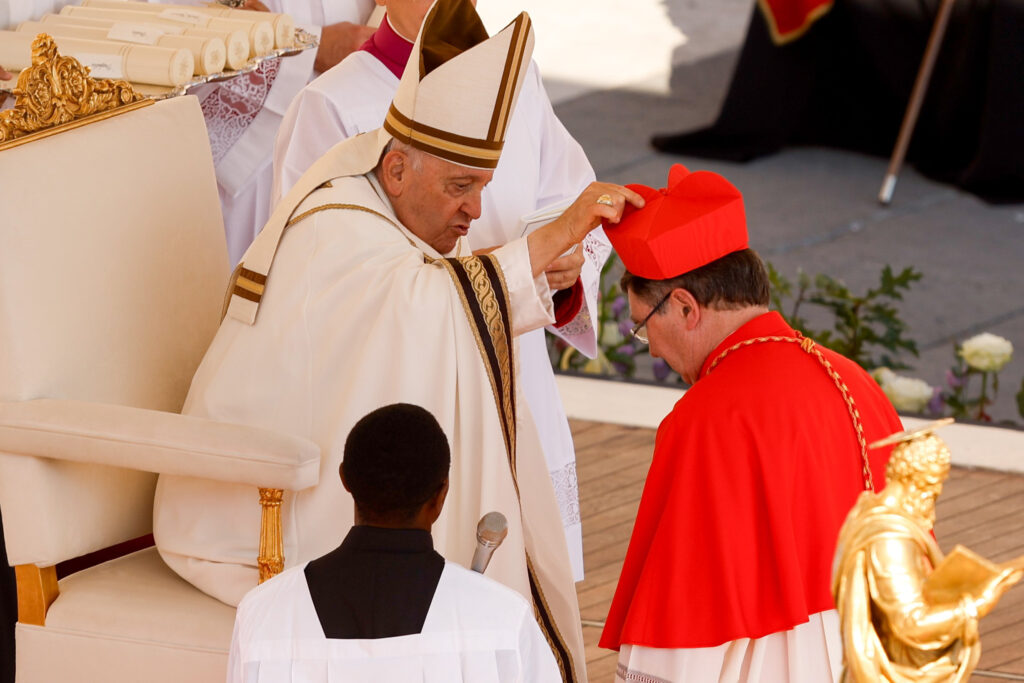
In a recent consistory ceremony held Sept. 30, two of the new cardinals he chose had ties to the United States, but neither were traditional heads of dioceses in our country. Cardinal Robert Prevost, OSA, was born in Chicago and studied at Villanova University, but after living in Peru for many years, now heads the Vatican’s influential Dicastery for Bishops. And the French-born Cardinal Christophe Pierre is the current apostolic nuncio the United States, a position that warrants some explanation to the vast majority of people in the pews.
An apostolic nuncio is a diplomat of the Holy See who serves as the permanent representative to a nation or international organization while in office. The post is basically the ecclesial equivalent of an embassy’s chief ambassador. Since official diplomatic ties between the United States and the Holy See were established in 1984, there have been six ordinaries to hold this post: Pio Laghi, Agostino Cacciavillan, Gabriel Montalvo Higuera, Pietro Sambi, Carlo Maria Viganò and now Christophe Pierre. (Laghi and Cacciavillan were technically “pro-nuncios” as the relationship was established and developed). Because of a clause in the Vienna Convention on Diplomatic Relations, many states give precedence to the nuncio as the dean of their entire diplomatic corps.
The word “nuncio” is related to the Latin word “nuntius,” for envoy or messenger. It is etymologically related to our word “announce.” The chief obligation of the nuncio is to promote good relations between the Holy See and the civil government in a particular place, as well as to report on the overall state of Roman Catholicism in the region. Though he personally represents the pope, the office is diplomatic and not strictly ecclesiastical in nature, though there are spiritual and pastoral components to the job. They often speak to human rights concerns, the promotion of peace, advocacy for the impoverished and other moral issues, and play an integral role in proposing candidates for episcopal ordination, in terms of ordinary or auxiliary bishops in a given land. Thus, eventually a short list with the next bishop of Camden on it will at the very least likely pass across the desk of the nuncio.
In 2019, Pope Francis offered what he called a “Decalogue for Nuncios.” These 10 commandments for those called to this service are worth citing in full. The pope exhorts those holding the role to be: (1) a man of God, (2) a man of the Church, (3) a man of apostolic zeal, (4) a man of reconciliation, (5) a man of the pope, (6) a man of initiative, (7) a man of obedience, (8) a man of prayer, (9) a man of industrious charity and (10) a man of humility.
As one can plainly see, Cardinal Pierre’s selection will have a significant effect on the American Church, even if he himself is not a citizen here or heading one of our local dioceses. He is one of the voices being called to represent what Pope Francis called “an ever more symphonic and synodal Church” in his homily to the new members of the sacred college. The cardinals he has called to collaborate in his Petrine ministry should be, as he puts it, “evangelized evangelizers, not functionaries.” That includes both the chief shepherds in local churches, and those in diplomatic missions representing the Church to various states and bodies around the globe.
An alumnus of Camden Catholic High School, Cherry Hill, Michael M. Canaris, Ph.D., teaches at Loyola University, Chicago.



 at the bottom and then tap “Add to Home Screen”
