




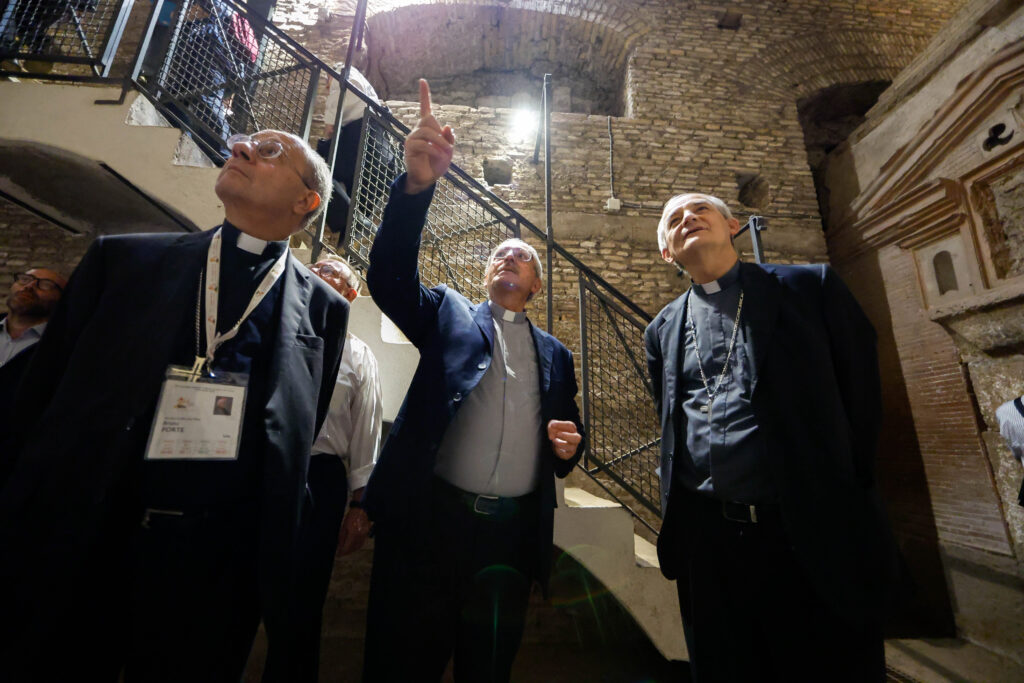
When bishops make their regular “ad limina” visits to the Vatican, they are traveling to the “threshold” of the tombs of the early disciples, as the Latin phrase for the practice suggests. This last took place for Bishop Dennis Sullivan, along with others in New Jersey and Pennsylvania, in 2019.
On Oct. 12 of this year, the participants in the ongoing synod similarly made a collective pilgrimage not to the tombs of St. Peter and St. Paul (as they are now found in basilicas), but rather to the catacombs of St. Sebastian (where local tradition holds those remains were once hidden for at least a few generations) to memorialize both the many martyrs and the hundreds of thousands of believers who are buried in the series of underground tunnels throughout Rome. While there, they recited the ancient Apostles Creed and were led in spiritual mediations about the witness offered by these early ancestors in the faith.
While it was not part of the formal presentation, one of the texts they were given to ponder in the printed materials was the Pact of the Catacombs. Though not in any way an official text of the Second Vatican Council, this event and document are part of what is sometimes referred to as the “para-council,” meaning the informal conversations, experiences and proceedings that occurred when the bishops were gathered from 1962-1965, but not formally in the sessions. The meetings that took place in Piazza Navona between Catholic leaders and the non-Catholic official observers to the council is one commonly cited example. The Pact of the Catacombs is another.
On Nov. 16, 1965, as the end of the Second Vatican Council approached, a number of bishops, mostly from Latin America, met in the catacombs of Domitilla to make a vow to live in closer solidarity with their people. Forty-two of these bishops signed a 12-point document pledging, among other things, to “try to live according to the ordinary manner of our people in all that concerns housing, food, means of transport and all which springs from this,” to “renounce forever the appearance and reality of riches,” and whenever possible, to “entrust the financial and material administration in our dioceses to a commission of competent laity, conscious of their apostolic role, so that [the bishops] may become less administrators and more pastors and apostles.”
In all of these promises to relinquish privilege, pomp and ostentation, the signatories were attempting to reimagine a just social order in line with the Gospel. They stirringly close the text by pleading: “May God us help us to be faithful.”
In 2019, Brazilian Cardinal Claudio Hummes, who reportedly hugged Pope Francis upon his election in 2013 and reminded him never to forget the poor, led the signing of a new document inspired by the original one titled the “Catacomb Pact for Our Common Home.” This more recent text called for a “poor and serving, prophetic and Samaritan” Church.
The synod participants currently in Rome are gathered in a collective discernment process, one in which guidance from the Holy Spirit is heartily prayed for, about how the Church should be reading the signs of our times, and responding with renewed vigor in the proclamation of Christ’s message to the nations. Recent events in the Middle East, Ukraine, Myanmar and Mali make clear that the world is in dire need of such a message from a God who remains faithful and steadfast “though the mountains be shaken and the hills turn to dust.” (Is 54:10)
If the atrocities of the 20th and 21st centuries have taught us anything, it is that a God removed and aloof from the anguish and agony that humans can inflict upon one another is not one that people in good conscience can today adore, venerate or hope to appease. Rather, the compassionate and co-suffering triune God is always “close to the brokenhearted” (Psalm 34:18), and “raises up the poor from the dust, and lifts the beggar from the dunghill, to set them among princes and to make them inherit the throne of glory.” (1 Sam 2:8, cf. Psalm 113:7)
The Pact of the Catacombs, long forgotten in the floods of ink spilled regarding the interpretation and implementation of Vatican II in the modern world, is now rightfully taking its place in terms of the spiritual interrogation and moral inventory it lies not only at the feet of clergy, but also of theologians and the entire lay faithful. “May God help us to be faithful.”
An alumnus of Camden Catholic High School, Cherry Hill, Michael M. Canaris, Ph.D., teaches at Loyola University, Chicago.




 at the bottom and then tap “Add to Home Screen”
