



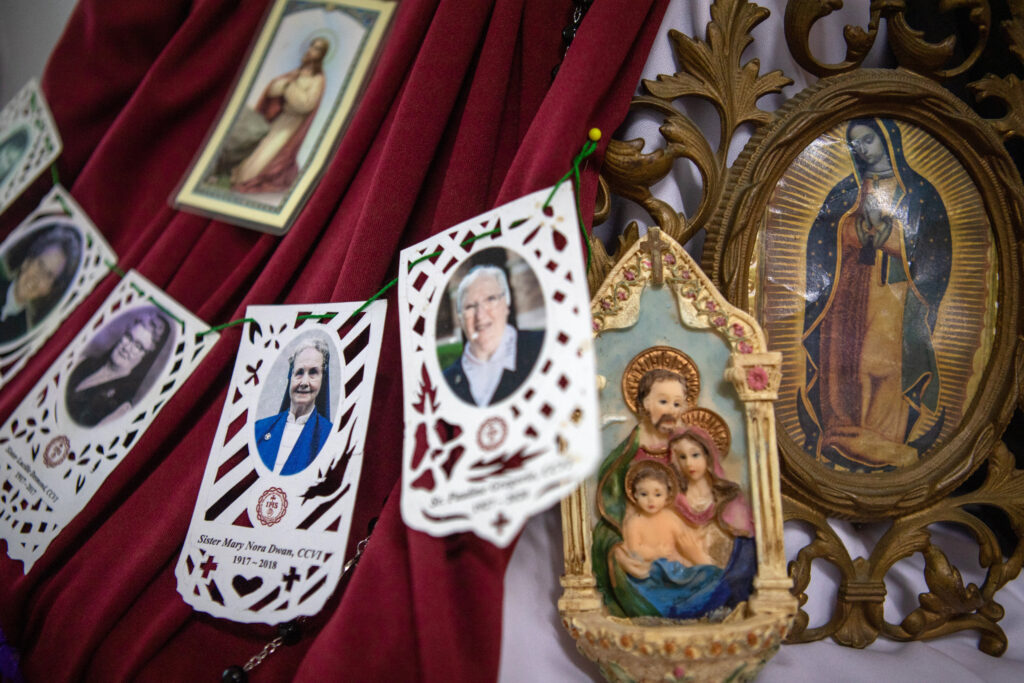
The “Catechism of the Catholic Church” makes a bold claim, stunning in both its simplicity and its ramifications: “The communion of saints is the Church.” (#946) Unbroken Christian tradition from the time of the catacombs to our own has maintained that a real and authentically dialogical relationship exists between sinful believers on earth and those who have gone before us in the faith. Thus, we both pray for the dead and we seek their intercession here on earth – because the statement obviously doesn’t mean that only saints belong in or to the community.
The Church marks this exchange in a special way in November. Pope Gregory III dedicated a Vatican chapel to all the saints in the eighth century, building on a pre-existing tradition involving the “baptism” of the Pantheon, where the worship of pagan gods and goddesses was replaced with veneration for Christian saints. This all eventually led to a universal feast, and today’s sort of Triduum of Halloween, All Saints’ Day and All Souls’ Day. During this time of year leading into Advent, which has long been my favorite liturgical season even decades before I studied ecclesiology, I cannot help but think of C.S. Lewis’ observation: “How monotonously alike all the great tyrants and conquerors have been; how gloriously different are the saints.”
Two hymns undeniably define this time of year in the Church in the United States, though I also love the Litany of the Saints, which is more common elsewhere. But here, if you attend Mass with musical accompaniment at all this month, you will almost certainly hear one or the other, and very likely both.
The first is “For all the Saints,” composed by William Walsham How, a former Anglican Bishop of Wakefield in Yorkshire, England. As the congregation memorializes in song those who now “from their labours rest,” they are called to ponder their own involvement in the arc of Church history and the great commandment given to all believers. They recognize its evident difficulties: “We feebly struggle, they in glory shine.” Yet, the hymn reiterates the hope that our “Captain in the well-fought fight” will lead us in victory on the other side of the quickening “golden evening” and into the breaking of a “yet more glorious day.”
The second unofficial Catholic anthem of November is another British contribution to our liturgy, “Faith of Our Fathers,” written by Frederick William Faber in 1849 to celebrate the martyrs in England, Scotland, Wales and Ireland. Interestingly, when used in contemporary worship there, the lyrics are set to a different tune than the familiar one for us in the United States. But both communities venerate the memories of those who have suffered for the faith through “dungeon, fire and sword.” And yet, the congregation makes a vow to remain true to the faith “till death,” because such a relationship with the divine collectively expressed itself is “living still.” Contemporary translations now often add updated verses acknowledging the mothers who are so integral to passing the torch of Christianity from generation to generation.
To use technical language, our experience of Church is both synchronic and diachronic. The first means that it is connected to all corners of the globe at a given moment in time – that we have something in common with Christians living today not only in Camden and Chicago and Clearwater, but also in Ghana, and Guatemala and Gaza. But at this time of year, even more important for us is the second. Diachronic Christianity, literally “through time,” means that we are connected in very real ways with the intergenerational handing on and receiving of the faith across the centuries and millennia. When we pray the Creed, or celebrate the Eucharist, we gather with the great cloud of witnesses who have chosen to follow Christ in every era. Thus, the season of the día de los muertos makes visible and present a very animate, organic, flesh and blood faith in the God not of the dead, but of the living. Todos los santos y santas de Dios, Rogad por nosotros.
An alumnus of Camden Catholic High School, Cherry Hill, Michael M. Canaris, Ph.D., teaches at Loyola University, Chicago.




 at the bottom and then tap “Add to Home Screen”
