



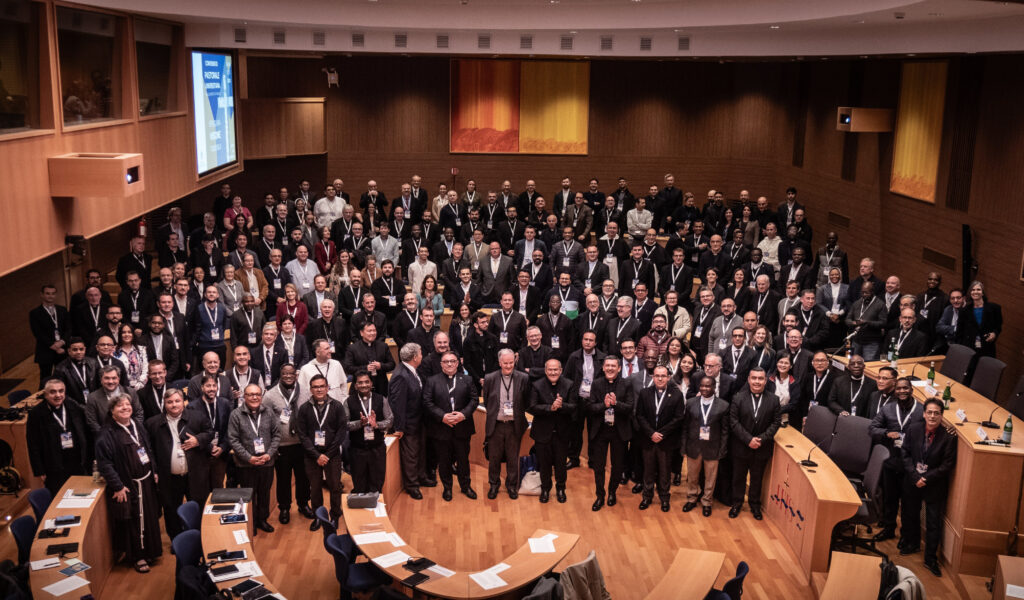
Over the Thanksgiving holiday, Portuguese Cardinal José Tolentino de Mendonça, the Prefect of the Vatican’s Dicastery for Culture and Education, invited representatives from 44 nations to meet in Rome and discuss the future of pastoral ministry on college campuses.
I was delighted to have been included along with a priest friend, Father Joe Wagner, from my university. Participants came from both Catholic and secular universities to address the theme of working together “Towards a Polyhedric Vision,” as the gathering was titled. It was undoubtedly an inspiring and worthwhile experience.
First, to the title of the conference: I threw a multi-sided die from the game Scattergories in my bag to bring. As I later explained to the group, I keep one on my desk at all times because I find it to be the simplest, concrete example to show students the geometric figure of a polyhedron that has become so crucial for Pope Francis’s ecclesiological vision. I used it as an aid during our sessions, where we met grouped by language, and then re-gathered for plenary presentations with simultaneous translation into a variety of languages. Pope Francis has used the image to argue that both society in general and the Church in particular are less like a smooth, homogenized sphere where difference is eradicated, and more like the multi-dimensional shape that includes a variety of faces, and even as he has put it, “the sharp edges” of reality.
Second, the meeting was not a strictly academic affair. As should be considered integral to a Catholic congress of this type, it included spiritual components, collective prayer, and liturgies in the Church of the Holy Spirit in Sassia (Rome), and in St. Peter’s Basilica, beneath Bernini’s marvelous sculpture venerating the physical “chair” of Saint Peter.
Thirdly, the structure of the Dicastery itself is an important testimony to the witness of the Church in intellectual and societal exchange. When Pope Francis reorganized some elements of the Roman curia in the recent document “Praedicate Evangelium,” he combined the previously distinct offices of culture and Catholic education under one common banner and administrative office. It is clear that both “culture” and “education” serve in concert to epitomize the practical means by which evangelization of the world takes place (as no human person is “a-cultural” or unqualifiedly “un-educated” regardless of the academic degrees that they may or may not have attained. Think for example of a Peruvian artisan, an African seamstress, or a Vietnamese village fisherman who have their own profound depth of learning). Thus, culture and education are both ways by which we can articulate the Church’s authentic impulse to recognize the sacredness of the human experience in its diverse and multifaceted expressions.
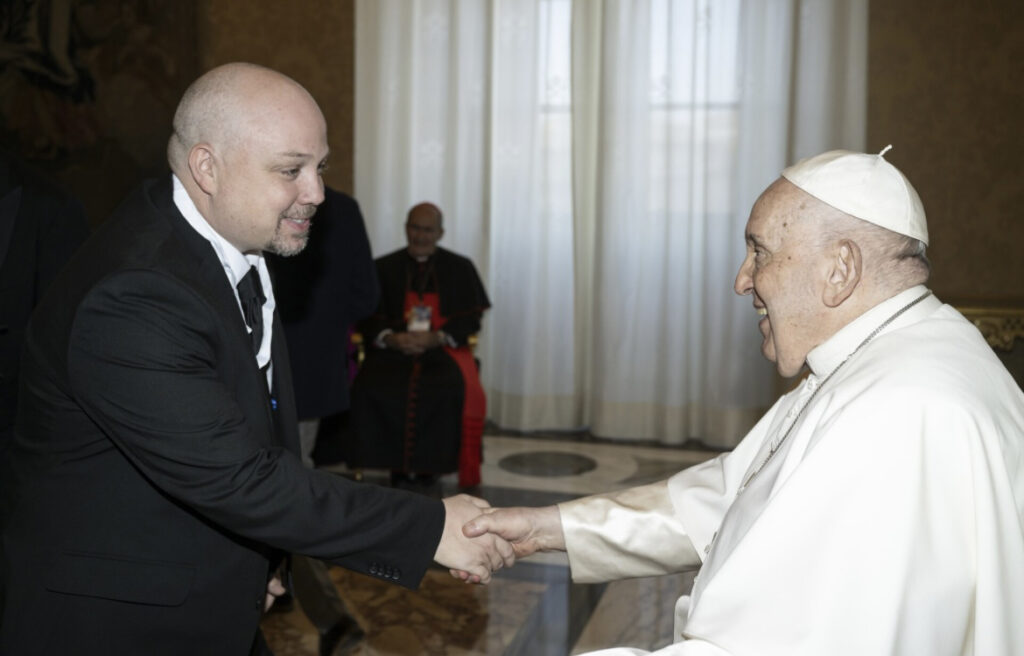
Cardinal Tolentino de Mendonça, Irish Bishop Paul Tighe and even the Holy Father himself in his address to us all struck similar chords in discussing the indispensable role pastoral formation plays in the process of genuine human and Christian formation in the quest for wisdom and understanding. As the pope said to us during our private audience with him in the Apostolic Palace, those of us engaged in the formation of pastoral identity, theological disciplines or campus ministry on university campuses should be willing to be courageous and unabashed in our applications of an unwavering commitment to accompaniment when engaging students. Igniting the imagination, both of students and of those in inter-generational roles in university environments themselves, came up often over the days of discussion.
Of course, as is natural in an international dialogue of this kind, not everyone had the same experiences, local challenges or unanimity in ideas about how best to accomplish the shared student-centered goals. But a genuine sense of community and camaraderie evolved over our time together, one that I personally know I will be continuing to draw strength and longstanding relationships from in the difficult work ahead. As Pope Francis told us, we should not have fear, but rather trust that our work helps prepare the People of God for a fuller and richer reception of the Gospel, and that those of us in more privileged positions of resources must continue to both share with and learn from those in other contexts, as the conference prioritized from its inception, even in its financial organization.
So while I missed the turkey and stuffing with my family back in the States, instead enjoying rigatoni con cinghiale (pasta with wild boar) with new friends in Rome on that sacred Thursday this year, the wider vista of the work that is unfolding on our collective network of campuses around the globe continues to galvanize me to move beyond my sometimes limiting, strictly American horizons and to set off into the deep with conviction and trust in the Lord. Deo Gratias!
An alumnus of Camden Catholic High School, Cherry Hill, Michael M. Canaris, Ph.D., teaches at Loyola University, Chicago.




 at the bottom and then tap “Add to Home Screen”
