




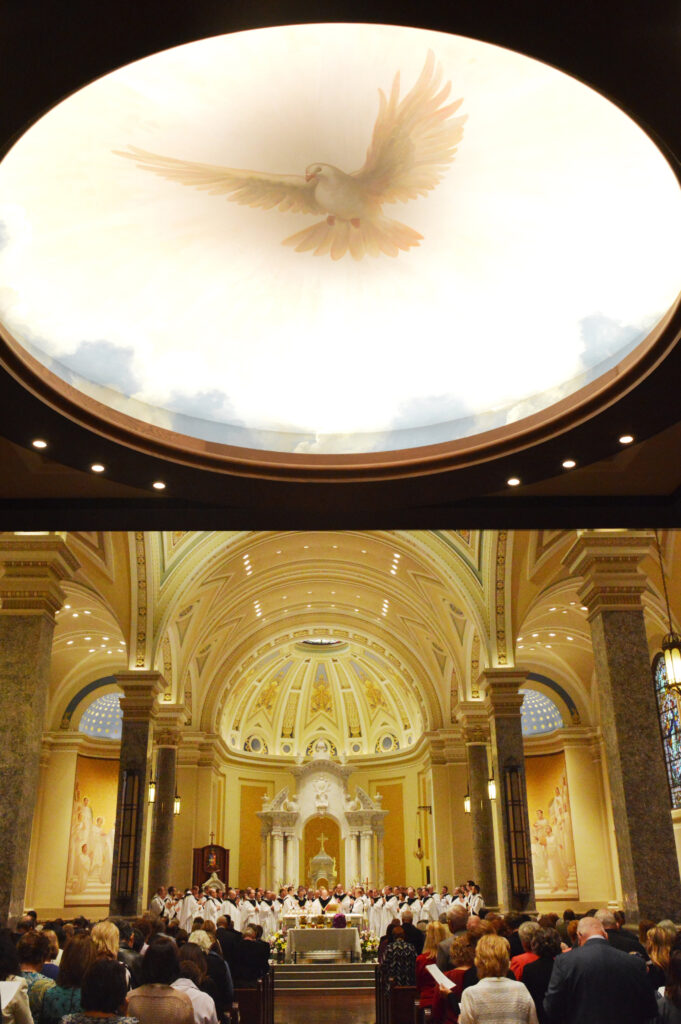
As the Church in these weeks ponders the post-Resurrection narratives and the dramatic paschal victory achieved on Easter morning, we are rapidly approaching Pentecost and the Ascension, where our attention as a people shifts a bit.
Never discounting the Christocentric focus of the entire ecclesial community, the coming season enables us to foreground the Holy Spirit in profound ways, given the relative and restricted “Real Absence” after the Incarnation that leads, as it were, to the need for and recognition of the “Real Presence” found in the Eucharist. For there is of course an authentic paradox at play in a Church that can recognize both the truth that “Where two or three are gathered in my name, I am there among you” (Mt 18:20) and yet cry full-throatedly “Maranatha, Come, Lord Jesus!” (cf. Rev 22:20)
The Spirit has long been the most mysterious and the most understudied element of the Trinity, at least in the Christian West. Sometimes fumblingly represented with doves and flames, God’s passionate, irrepressible, uncontrollable and hyperactively devoted reality as Spirit is both less familiar and somehow more frightening to us than even the sometimes graphic crucifixes adorning our churches and homes.
The Ruach, or outwardly rushing breath of God, “blows where it will,” renovating human existence in every generation. This manifestation often unsettles us – as we cannot truly fathom this unpredictable and inexpressible power that relativizes every attempt to define, manipulate or ultimately claim to understand the divine as anything other than Absolute Mystery – and plunges us headlong into defacto idolatry. “If you think you’ve comprehended something, what you have comprehended is not God,” to paraphrase Saint Augustine.
And yet the Spirit saturates the world, “greening” it (viriditas), as Hildegard of Bingen – whom Pope Benedict XVI declared a Doctor of the Church – puts it. The Spirit permeates all of created history, renovating not only the idyllic pastures in which the Lord gives us repose (cf. Psalm 23), but also the chaotic social and structural realities of contemporary life.
It’s not only farmers and monks and conservationists who cry to the Comforter to fill the hearts that God has made, and to come renew the face of an interconnected and globalized earth. This is likely a particularly challenging feat in a country such as ours that produces on average three times the amount of refuse and landfilled waste per person as any other on the planet and soils our common home with among the largest carbon footprints. No real wonder the Spirit “groans” unto God with unutterable sighs (Rom 8:26), both advocating for us (Jn 14:26) and convicting the world concerning its sin (Jn 16:8).
Early Catholic saints in Syriac and Egyptian communities often used maternal imagery to describe the Holy Spirit, referencing frequently the “brooding” described in Genesis’ first allusion to the Spirit of God at creation as a hen hovering over her eggs (Genesis 1:2). Poet Gerard Manley Hopkins venerates such a portrayal: “There lives the dearest freshness deep down things; and though the last lights off the black West went. Oh, morning, at the brown brink eastward, springs – Because the Holy Ghost over the bent World broods with warm breast and with, ah! bright wings.”
This complements the many feminine images joining pneumatology (the study of the Holy Spirit) with the Sophia tradition in the Old and New Testament (Wisdom personified as a woman or queen). “For her thoughts are more abundant than the sea, and her counsel deeper than the great abyss” (Sirach 24:29). She is often contrasted with Lady Folly, whose “house is a highway to the grave, leading down to the chambers of death” (Prov 7:27).
Thus, the fruits and gifts of the Holy Spirit are always more than a test of rote memorization in a pre-confirmation class. As hip-hop poet and theologian Jim Perkinson puts it: “The Spirit cannot be chained in a word; its historical manner is ever the moan, the first blush of bloom in the desert when rain comes, the shiver in newborn flesh of shark, the jolt of joy when a jazz note finally leaps off the map of meaning into the improvisational nowhere of ‘insanity.’ It is before language and after time. That is the subtext in the Bible – rudimentary in the beginning (Gen 1:2) or bellowing unrequited at the end (Rev. 22:17). Its mode is ever mourning or mesmerization, trauma or trace-of-titillation. Of course it is shy of theology! It is the Great Question, the Matrix of Meaning before the pen flits of the pixel pimps. Its voice will always be that of the Ghost.”
Come Holy and Hallowing Ghost, kindle in us the raging fire of God’s unbridled and profligate love, recreating us and renewing the face of the earth to evermore mirror yours, the very visage of mercy to a world in need of it.
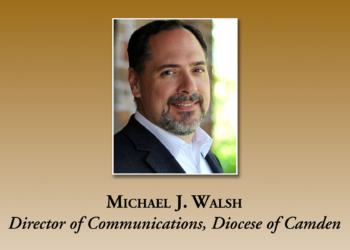
An alumnus of Camden Catholic High School, Cherry Hill, Michael M. Canaris, Ph.D., teaches at Loyola University, Chicago.




 at the bottom and then tap “Add to Home Screen”
