







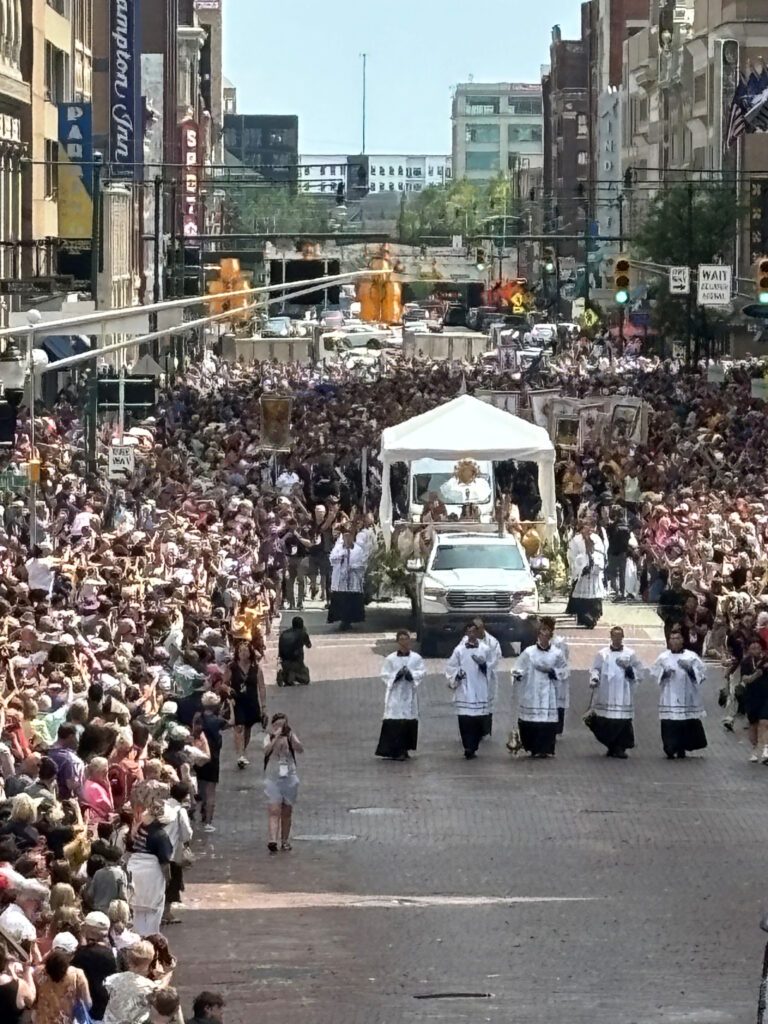
Now that the Eucharistic Revival has culminated in the Eucharistic Congress in Indianapolis, many will begin to ask: What was it all about; where do we go from here?
A solid starting point for such a reflection is the 42nd verse of the second chapter of the Acts of the Apostles: “They devoted themselves to the teaching of the apostles and the communal life, to the breaking of the bread and prayers.” (New American Bible translation)
As one ponders this verse about the early Church, we might ask why they would be devoted to, or persevering in, the “breaking of the bread”? After all, the teaching of the Apostles about Jesus leads to a development of faith in him. Through their teaching, the community comes to know Jesus and how to live as his disciple.
Further, the members of the early community supported one another in their faith in Jesus while living in a religiously hostile environment. Prayer assisted them in growing in the Spirit, strengthening them to live as disciples of Christ.
That the early community dedicated themselves to the “breaking of the bread” informs us that this “breaking of the bread” is more than just a gathering together for a common meal. Saint Luke, the author of the Acts of the Apostles and the Gospel that bears his name, used this same phrase, “breaking of the bread,” in his 24th chapter. The disciples on the road to Emmaus relate to us how Jesus was made known to them in the “breaking of the bread.” The early community was devoted to the breaking of the bread because they were encountering Jesus.
Saint Jerome, in his Latin translation (the Vulgate), translated this passage as follows: “Erant autem perseverantes in doctrina Apostolorum, et communicatione fractionis panis, et orationibus”; “They were persevering in the doctrine of the apostles, and in the communication of the breaking of the bread, and in prayers.” (Douay-Rheims) This translation gives an insight as to where the Eucharistic Revival should lead.
The connection between the “communal life” and the “breaking of the bread” is highlighted, a connection too often overlooked. The breaking of the bread supports and animates the communal life. Further, by communicating, that is partaking in or consuming this bread, the community of the faithful grows and matures as the bonds of charity between members are strengthened.
This communal life can only flow from the breaking of the bread if Jesus is truly present. The presence of Jesus is ultimately understood to be substantial; that is, the body, blood, soul and divinity of Jesus is substantially present under the species of bread and wine. Partaking in the Eucharist is a participation, not just in the Death, Resurrection and Ascension of the Lord, but in the very life of Jesus the Son of God.
Pope Benedict XVI stated that “through the Eucharist, the disciples become his (Jesus’) living dwelling place, which as history unfolds, grows like the new and living temple of God in this world.” (Homily, Feast of Ss. Peter and Paul, 29 June 2006, as found in “Heart of the Church,” p. 59) Recall that Jesus identifies himself as the temple in the Gospel of Saint John. (cf. Jn 2:19-21) Here, the evangelist is referring back to the prologue: “The word became flesh and dwelt among us.” (Jn 1:14) Jesus, because he is divine, is God’s dwelling in the world. The community of disciples, that is the Church, being made one with Jesus through the sacraments, becomes God’s dwelling on earth.
Unlike the Temple in Jerusalem and the spectacular churches present in the world today, this dwelling is not made of lifeless stones taken from the earth. Rather, this dwelling is made of “living stones built up, a spiritual house, a holy priesthood, to offer up spiritual sacrifices acceptable to God through Jesus Christ.” (1 Peter 2:5)
If the Church is God’s temple upon the earth due to its participation in the life of Jesus, then truly, by that same participation, the Church is the Body of Christ. This is the understanding of Saint Paul. He reminds the divided Corinthians that they are the Body of Christ, all united as a body, each being members of one another. (cf. 1 Cor. 12) This reminder comes after Saint Paul had stated that “we, being many, are one bread, one body, all that partake of one bread.” (1 Cor. 10:17)
(What is this bread? The Eucharist! In the breaking of the bread, the new and ever-lasting covenant is renewed. In the breaking of the bread, the bonds of charity are renewed. The communion we receive strengthens and reinforces the union of the disciples with one another in Christ. Being now one body, the members care for each other, providing for their needs, carrying those who have fallen, and assisting one another in Christian living.
The union of the disciples is in Jesus Christ. The members of the Church participate now in the life of Jesus. The Church, as the New Temple and Body of Christ, truly becomes the Sacrament of Salvation. The Council Fathers put this teaching forth in “Lumen gentium,” teaching that “Christ, when he was lifted up from the earth, drew all people to himself. (Jn 12, 32, Greek text); rising form the dead (Rm 6, 9), he sent his lifegiving Spirit down on his disciples, and through him he constituted his body which is the church as the universal sacrament of salvation.” (LG, 48, as found in Tanner, “Decrees of Ecumenical Councils,” v. II).
The Church is a sacrament, in so far as she is a tangible reality, an instrument (cf. LG,1) through which God bestows grace upon the world. She is made up of living stones who bestow the grace of Christ upon all peoples: through her preaching, administration of the sacraments, through the corporal and spiritual works of her members.
So where does the Eucharistic Revival lead us? To a renewal of the Church as the Body of Christ, the Temple of God, the Sacrament of Salvation, through which evil is conquered by the outpouring of Christ’s healing grace, leading all people to be reconciled to God the Father in Jesus Christ.
Father Jason Rocks is chancellor for the Diocese of Camden and pastor of Holy Eucharist Parish, Cherry Hill.




 at the bottom and then tap “Add to Home Screen”
