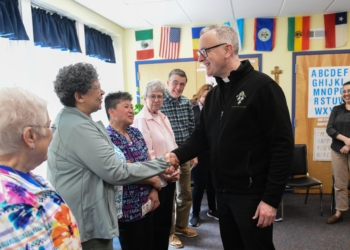



Last week I had the privilege of attending the Episcopal Diocesan Ecumenical and Interreligious Officers (EDEIO) annual meeting at their beautiful retreat house, Duncan Conference Center in Delray Beach, Fla. I represent the Catholic Association of Diocesan Ecumenical and Interreligious Officers (CADEIO) as liaison to EDEIO. I attended the meeting this year with the president of CADEIO, Father Don Rooney, and met with the executive committee of EDEIO, led by their president, The Very Rev. Daniell Hamby.
EDEIO is the national network of those designated by their diocesan bishops of the Episcopal Church to foster and encourage the search for wider visible unity among Christian churches and collegial relationships with members of other religions. EDEIO provides support and training for diocesan ecumenical and interreligious officers of the Episcopal Church as it encourages ecumenical activity within parishes and dioceses, enhances communication on anything ecumenical or interreligious. EDEIO also supports ecumenical and interreligious activity through educational events in Episcopal parishes, dioceses, provinces and other ecclesial bodies. It regularly hosts ecumenical guests and dignitaries at their Annual General Convention, where its presence serves to focus attention on ecumenical issues.
CADEIO is the national network of those delegated as Ecumenical/Interreligious Officers in each Catholic Diocese in the United States, to whom is given the care of Christian unity and understanding among faiths. The purposes of CADEIO are to stimulate the exchange of ideas, experiences and networking among the ecumenical officers of the dioceses in union with Rome. To promote programs which further the work of Christian unity and interreligious cooperation. To work with the Bishops’ Committee for Ecumenical and Interreligious Affairs of the United States Conference of Catholic Bishops (USCCB) and other ecumenical and interreligious agencies.
One of the more interesting and controversial discussion at this year’s meeting centered around the various “full communion agreements” that the Episcopal Church has entered into with other Christian denominations, as well as those soon to be celebrated. Part of the discussion centered on the various problems being experienced with the reception of these full communion agreements on the grassroots levels. As the deadline for agreement with the United Methodist Church draws near for Episcopalians, some major differences in their self understandings of validity of orders, real presence in the Eucharist and a number of other issues need to be ironed out before the hoped for date of a 2015 signing. The executive board of EDEIO will respectfully suggest to their judicatory heads to contemplate a postponement of signing an agreement until a consensus can be reached, perhaps by 2018.
Another discussion of interest was a controversial plan for this year’s National Workshop on Christian Unity in April to be held in Columbus, Ohio. One of the most painful aspects of Christian division is the inability of all Christians to share the Eucharist at one table. The Roman Catholic Church holds the view that Christians cannot share the Eucharist until there is full visible unity. Many other Christian bodies hold the view that sharing “Holy Communion” among Christians of different denominations will increase and quicken this long hoped for full visible unity. At the National Workshop, Roman Catholics join to have Liturgy together, while Episcopalians, Lutherans, Methodists and other Christian denominations join separately for their Eucharistic gathering. This year’s National Workshop will attempt to experience the pain that this powerful division causes all those who hope for Christian unity. At the Roman Catholic Eucharist to be held at St. Joseph’s Cathedral in Columbus, those who are not Catholic will be invited to attend and during the reception of communion they will stand in place praying for the day when we all can share together at the Lord’s Supper. We Roman Catholics will be invited to the Eucharist to be held at Trinity Episcopal Church, we will likewise stand at communion time praying for our shared hope.
While many at the meeting shared that this may cause some consternation among participants of the National Workshop because it will be uncomfortable, the consensus was that it is good to share this pain of separation so that we may redouble our efforts to work for the unity that Christ desires for all his faithful.
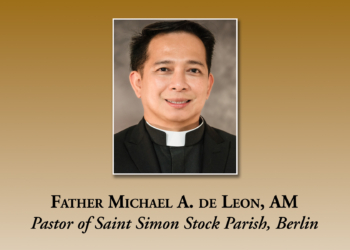
Father Joseph D. Wallace is coordinator, Ecumenical and Inter-religious Affairs, Diocese of Camden.




 at the bottom and then tap “Add to Home Screen”