




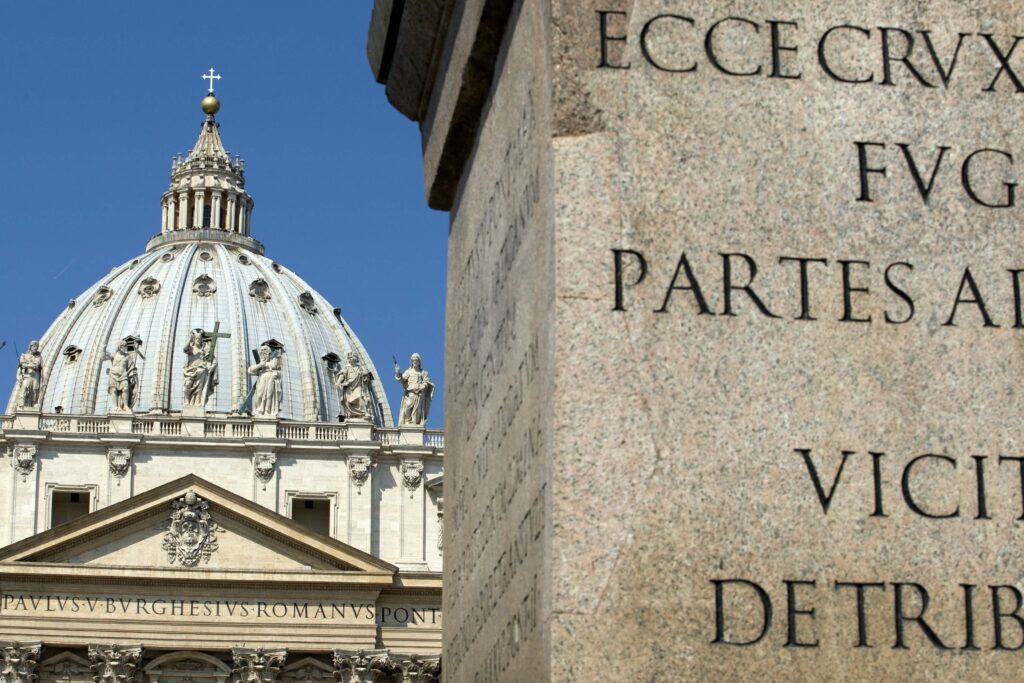
During Pope Leo’s recent jubilee address to ecclesial movements, associations and new communities, I sought a sliver of shade from the blazing afternoon sun in Rome’s Piazza San Pietro. A thin spire fell from the center of the square, and so a few students and I situated ourselves there. Looking up, I saw that our refuge had come from the obelisk long referred to as one of a series of “Cleopatra’s Needles.” This monument is believed to have been a silent witness to Peter’s martyrdom in the Circus of Nero.
As I gazed up at it, I took note of the Latin words inscribed on its western base, obviously drawing my attention because the new pontiff was set to pass directly by us and then pray with us in the next few minutes. “Ecce Crvx Domini, Fvgite Partes Adversae, Vicit Leo De Tribv Ivda” – “Behold the Cross of the Lord. Take flight hostile ranks. The Lion of the Tribe of Judah has Conquered.”
The red granite obelisk, standing 130 feet tall with its base and estimated by some to weigh close to 1 million pounds, was, according to the Roman author/naturalist Pliny, originally situated in the ancient Egyptian city of Heliopolis. In 40 AD, the emperor Caligula had it brought to Rome, more or less to prove that he could, since Rome’s glories were intended to surpass all previous empires and competitors. It stood first in his and what would become Nero’s circus, and eventually on their ruins there near the burgeoning site of pilgrimage to the Prince of the Apostles – until 1586, when Pope Sixtus V charged his favorite architect, Domenico Fontana, to move it to the center of the piazza. It is a task that is said to have required a year of planning, 907 men, 145 horses and 70 winches. The stony landmark has stood there ever since.
One may wonder what exactly the inscription on its base means. Of course, the Lion of the Tribe of Judah has biblical roots. Jews still use it frequently since Jacob refers to his son as a “Gur Aryeh,’” a young lion, when blessing him in Genesis 49. The seal of the city of Jerusalem has the king of the beasts on it for this reason. In Christian parlance, it has come obviously to refer to Jesus. The Book of Revelation connects the image with the Root of David in describing Christ’s victory over evil. The fleeing spirits of darkness mentioned on the carving mark what is one of the holiest sites of Christianity, outside of Golgotha and the Holy Sepulcher, held to be the terror of demons and testament to the Light of the World. But perhaps less obvious is the obelisk’s direct connection the Cross.
The phrase about beholding the Cross alludes to the mother of Constantine, Saint Helen, and her quest to bring so many instruments of the Passion narrative, including even soil itself from the Holy Land, to Rome. A sliver of the True Cross, which she is believed to have found, is kept in a reliquary at the top of the monolith. The apocryphal legends recount that when a corpse was once laid on that same Cross from which the piece atop the obelisk is taken, to verify its authenticity after three centuries of veneration, the fortunate dead person sprang back to life. This scene is depicted on the apse of the church of Santa Croce in Gerusalemme.
All of this flitted across my mind in the piazza as I waited to see our new Pope Leo, the 14th man to use the title in his office as successor to the murdered Galilean fisherman.
Most of the attention on the former Cardinal Prevost’s choice of name has rightly revolved around his numerous references to “Rerum Novarum” and Pope Leo XIII. But, as with so much in Rome and our tradition, there are always layers of significance and nods to the storied history of the Church hiding in plain sight. Vicit Leo De Tribv Ivda, Viva Papa Leone.
An alumnus of Camden Catholic High School, Cherry Hill, Michael M. Canaris, Ph.D., teaches at Loyola University, Chicago.




 at the bottom and then tap “Add to Home Screen”
