


Editor’s Note: The Solemnity of the Most Holy Body and Blood of Christ (Corpus Christi) is June 7.
In 1264, Pope Urban IV inaugurated the feast of Corpus Christi (the Body of Christ) for the universal Church. In preparation, he asked both Saint Thomas Aquinas and Saint Bonaventure to compose readings, prayers, and hymns for the Mass and Divine Office (Liturgy of the Hours). When Thomas read his finished work to the Holy Father and Bonaventure, they were both brought to tears by the sublime beauty of the angelic doctor’s composition. Bonaventure immediately tore up his own work.
Some of the hymns he composed are still familiar to us today. “O Salutaris, Tantum ergo,” and “Panis angelicus” are the most frequently still heard.
For all the beauty of Aquinas’ work, he himself was unimpressed with it. In the end, he believed human language was totally inadequate to express the depth of the mystery of the Holy Eucharist – and indeed it is.
Consider that the Catechism of the Catholic Church clearly teaches that the Eucharist is “the source and summit of the Christian life.” (1324) The same paragraph goes on to explain why. All of the other sacraments are oriented toward it, along with all of the ministries and apostolates of the Church, because the Eucharist contains “the whole spiritual good of the Church, namely Christ Himself.” Since the Eucharist is Christ, whole and entire, Body, Blood, Soul, and Divinity, it is no wonder that it is often called the Most Blessed Sacrament. It is thus rightly referred to as both source and summit of Christian life.
To compensate for what Aquinas saw as the utter inadequacy of human language to convey the true reality of the Holy Eucharist, he gave up on intellectual pursuits and instead turned to prayer. The result was a work he composed for himself for private meditation in the presence of the Blessed Sacrament. The prayer is known as the “Adoro te” (I Adore Thee).
The humble adorer finds himself in the presence of the consecrated elements of bread and wine on the altar. His knee bends and his mind and heart fall down in adoration. None of the five senses can detect anything of the Divine there. So, the adorer must rely solely on the words of Christ who is Truth itself: “This is my Body. This is my Blood.”
The adorer reflects that Christ on the Cross could at least be seen in His humanity. In the Eucharistic elements, however, Christ cannot be detected in either His humanity or His divinity. In fact, it is only by faith that Christ the God-Man can be perceived at all on the altar. The adorer prays for a confirmation and strengthening of his faith in that great mystery and for trust in God.
Aquinas refers to the celebration of the Holy Eucharist in his prayer as the “blest memorial of Our Lord’s own dying.” This is quite appropriate as we recall that the Last Supper anticipated in an unbloody manner that which would be enacted in a very bloody manner indeed on the Cross on Good Friday. Paradoxically, however, that dying Body becomes life-giving bread to the mind that grasps it, the soul that receives it.
In Aquinas’ prayer, the striking poetic image is evoked of a pelican without food for her young, who nourishes her starving chicks instead with blood pecked from her very breast. This beautiful image is sometimes artistically depicted on tabernacle doors. It is Christ nailed to the Holy Rood, of course, who is that nourishing pelican feeding famished souls with blood flowing from His precious wounds.
Finally, the adorer states that Christ is hidden, veiled on the altar under the appearances of bread and wine. He eagerly looks forward, however, to the day when he shall enter heaven and see the unveiled Christ clearly coming into view in His very body. Then he will finally find rest in the beatific vision.
The following is a poetic version of the “Adoro te,” painstakingly committed to memory in the eighth grade at Saint James School, Ventnor. Thank you very much, Sister Mary Magdalita, Dominican religious of Sinsinawa, Wis.
O hidden Godhead, humbly I adore Thee, who truly art beneath the forms before me.
To Thee I bow the heart and bend the knee, all failing quite contemplating Thee.
Sight, touch, and taste in Thee are each deceived.
The ear alone most faithfully is believed.
I firmly hold whatever God’s Son hath spoken.
Than Truth’s own word, there is no truer token.
God only on the Cross was hid from view, but here hides Deity and manhood too.
And I in both professing firm belief, make mine the prayer of the repentant thief.
Thy wounds as Thomas saw I do not see, yet Thee confess my Lord and God to be.
My faith confirm and child-like trust impart, and may I love Thee with all my heart.
O blest memorial of Our Lord’s own dying, O living bread to mortals life supplying,
Become indeed the life of my own mind, so that in Thee I may all sweetness find.
O pelican self-wounding on the Rood; me, unclean sinner,
Yet cleanse me with Thine own blood, of which a single drop for sinners spilt,
Can purge this wicked world of all its guilt.
O Jesus whom at present veiled I see, what I so thirst for grant to me,
That I may see Thy blessed self unfolding, and find rest Thy glory in beholding,
World without end. Amen!
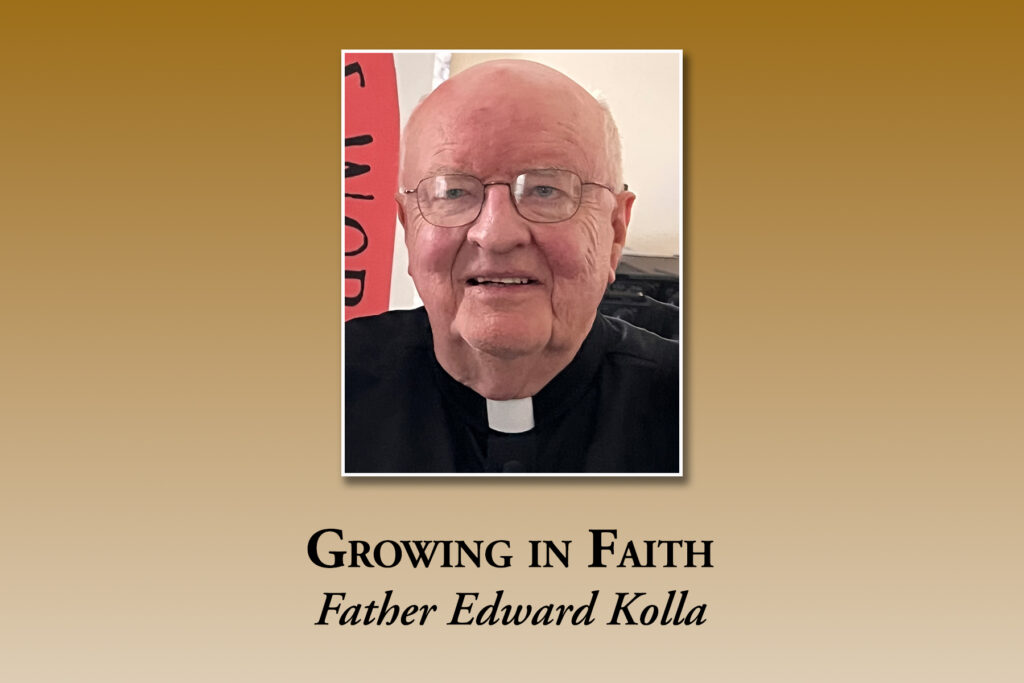
Father Edward Kolla is a retired priest of the Diocese of Camden.




 at the bottom and then tap “Add to Home Screen”
