



The conciliar Fathers at Vatican II unambiguously claimed, “In the sacred rite [of baptism] a oneness with Christ’s Death and Resurrection is both symbolized and brought about.” (“Lumen Gentium,” §7) Thus, the council was seen as recovering a baptismal ecclesiology that serves as the chief sacrament through which “disciples of Christ, persevering in prayers and praising God, should present themselves as a living sacrifice, holy and pleasing to God” (§ 10).
Believing this to be true, my wife and I recently celebrated our second daughter’s baptism here in Spain, as we did with her now 4-year-old sister. Her parish church of Sant Jaume (local dialect for James) was just opening the weeklong celebrations, parades, fireworks and townwide banquets for the parish (and national) patron, culminating on his feast day of July 25. Jaume/Sant’Iago/James takes on particular relevance here on the island of Mallorca, because in addition to the apostle, one of the most important figures in the history of local Christianity is King James I, in Catalan “Jaume el Conqueridor.”
As evidenced by the troublesome nickname, Jaume was a central agent in the “Reconquista,” when Muslims were forced to convert, practice their faith in secret or be expelled from the Iberian lands. It is still a controversial symbol of Islamophobic Spanish nationalism in some quarters, at odds with contemporary efforts by the global Christian community to engage in sincere inter-religious dialogue, as all the recent pontiffs have promoted. But, as with many figures of the past, there are light sides as well as shadows to his life. King Jaume’s deep Marian piety was, as an example, unquestioned.
Arising from this devotion to the Blessed Mother is the island’s chief patronage to Mary, under the title of La Mare de Déu de la Salut, loosely translated into English as “Our Lady of Good Health.”
The most famous Madonna associated with this title is an alabaster statue in Palma, which you see replicated elsewhere throughout the region, including in Saint Jaume’s parish church. I have seen countless Spanish abuelitas lovingly touch or kiss the statue’s feet when leaving Mass. Legends suggest that Jaume venerated an image of Mary under this title during storms upon his approach to the island, then an Emirate of the Umayyad Arabic dynasty. He obviously survived and eventually re-Christianized the archipelago of the Balearics, along with much of the Spanish peninsula. For this reason, the Spanish royal family still have their formal summer residences on the island, including La Almudaina and the Palacio of Marivent (The Palace of “Sea and Wind”). Queen Emerita Sofía, the mother of King Felipe VI, spends most of her time there now.
Mary is also revered under the patronage of Our Lady of Good Health in other places like Southern India and Venice. Of course, this devotion can never be confused with transactional pseudo-spirituality, where all of life’s sufferings and hardships are whisked away by incantations as if by magic.
Pope Leo says something similar in his recent encyclical: “Everything that appears as a ‘limit’ – incapacity, illness, old age, suffering, vulnerability – tends to be seen primarily as a defect to be corrected, rather than as a reality through which our humanity matures and opens itself to relationship. And yet we must remember that humanity flourishes not despite limitations, but often through them. The light of faith offers a perspective on reality that helps us recognize what we call the ‘contingency’ of the things of this world. … It is precisely within our limitations that the following find a place: compassion, as well as a sincere concern for the needs of others; a generosity that can emerge even in the midst of darkness and failure; spiritual experience and the worship of God. We see this at many moments when our limits become tangible: when we face rejection, when we suffer the illness or loss of a loved one, when we encounter our own weakness or failure. Mysteriously, it is precisely in such moments that we can discover a new wisdom, tangibly experience the closeness of others and encounter the presence of the Lord.” (“Magnifica Humanitas,” 118-119)
It is certainly not wrong to pray for health for ourselves and our loved ones. Mary undoubtedly models constant discipleship, notwithstanding the challenges human beings face physically, emotionally or spiritually. But, as with baptism itself, the “salud” that she both symbolizes and helps bring about – one we often nod toward when toasting a few glasses of wine or cervezas – is ultimately one that entrusts us to the hands of a loving and protective God, even in the midst of devastating diagnoses, debilitating accidents or natural decline. It is much the same as we do to one another when we casually say “adios,” which is itself a shortened version of “a Dios vos acomiendo” – “I commend you to God.”
And in the end, that’s what baptism does to the children of a Father who unfathomably loves the little one even more than a parent ever could, which surely is a stunning claim.
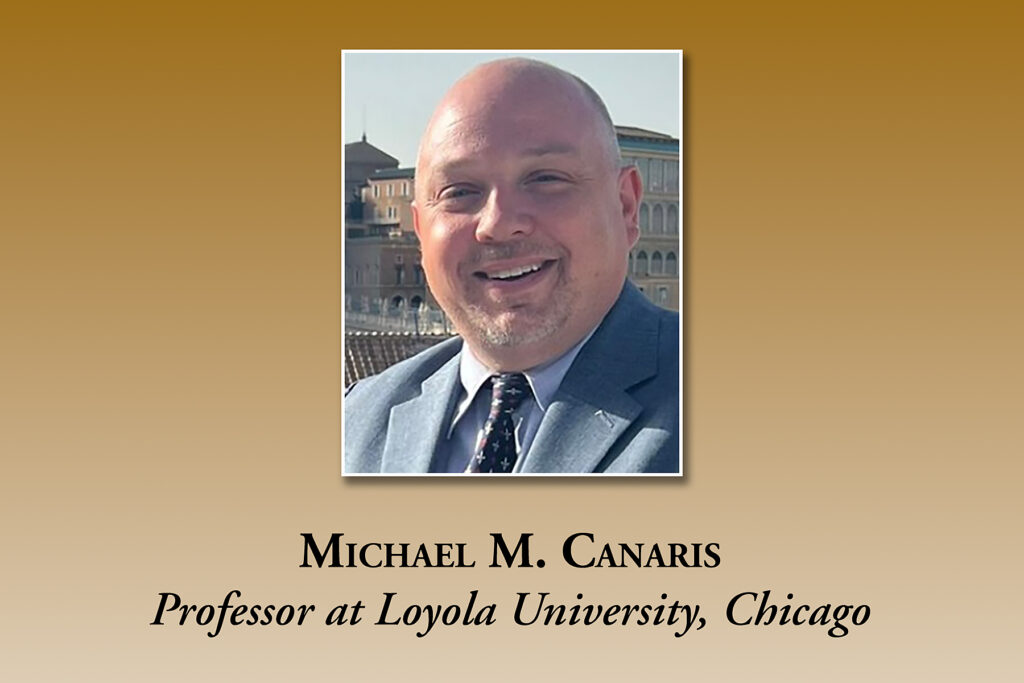
An alumnus of Camden Catholic High School, Cherry Hill, Michael M. Canaris, Ph.D., teaches at Loyola University, Chicago.




 at the bottom and then tap “Add to Home Screen”

