



Since the election of Pope Leo XIV, outreach to the Orthodox Church has continued with renewed energy. As you may remember, much of the Christian world marked the 1,700th anniversary of the Council of Nicaea last year. Catholics and Orthodox Christians saw the anniversary as another valuable opportunity to deepen dialogue and advance toward full visible unity.
For example, Dr. Paul Gavrilyuk, president of the International Orthodox Theological Association and Aquinas Chair of Theology and Philosophy at the University of St. Thomas in St. Paul, Minn., organized a conference last summer at the Pontifical Angelicum University in Rome titled, “Nicaea and the Church of the Third Millennium: Towards Catholic-Orthodox Unity.”
He explained, “When we speak about the Church of the Third Millennium, the hope and expectation was that this would be a Church that in fact would enjoy, especially as far as Catholics and Orthodox are concerned, full communion. And that of course means partaking of the Body and Blood of Christ at the same table.”
Recent efforts toward Catholic-Orthodox unity have built on milestones – such as Pope Saint John Paul II’s return of the relics of Saints Gregory the Theologian and John Chrysostom to Istanbul in 2004. (These two men are among the most important saints in the Eastern Orthodox Church, playing a pivotal role in the early Church).
Another milestone was the 2014 meeting in Jerusalem between Pope Francis and Patriarch Bartholomew, which marked the 50th anniversary of the historic 1964 encounter between Pope Saint Paul VI and Patriarch Athenagoras. The 1964 encounter was the first formal meeting of a pope and ecumenical patriarch since 1438.
In 2024, the Joint International Commission for Theological Dialogue Between the Catholic Church and the Orthodox Church also established specialized subcommittees to address longstanding points of tension, including the Filioque controversy – the Western addition of “and the Son” to the Nicene Creed – and the issue of papal infallibility. The commission also planned to discuss how the pope’s global authority and primacy relate to the Orthodox traditions of conciliarity and synodality.
Catholic and Orthodox bishops met July 13–15 in Washington, D.C., for a conference aimed at advancing dialogue toward full visible unity between the churches. The gathering, held at the retreat house of the St. John Paul II National Shrine, was organized by the Orientale Lumen Foundation. Jack Figel, an Eastern Rite Catholic who founded the organization, named it after St. John Paul II’s apostolic letter expressing hope for Christian reunification.
Participants included Archbishop Flavio Pace, secretary of the Vatican Dicastery for Promoting Christian Unity; Metropolitan Tikhon Mollard, primate of the Orthodox Church in America; Cardinal Sean Patrick O’Malley, retired archbishop of Boston; Greek Orthodox Bishop Anthony Vrame; and Romanian Catholic Bishop John Michael Botean.
Their conversations reflected a shared desire to listen, learn and walk together more faithfully. Participants considered how the ancient synodal practices of the Orthodox churches resonate with the Roman Catholic Church’s renewed emphasis on synodality. They also addressed enduring questions, including papal infallibility and the Filioque, while seeking to move beyond academic discussion toward a more visible common witness through works of mercy, lay collaboration and shared prayer. In particular, they explored ways Catholics and Orthodox Christians can grow together at the grassroots level by serving those in need and grounding their unity in charity.
At the meeting, Metropolitan Mollard urged participants to work together to seek unity in Christ and consider the structures that could make such unity more formal. Cardinal O’Malley encouraged joint prayer and study sessions, shared pastoral letters and statements, and collaborative works of charity. Many participants also emphasized that dialogue and relationship-building should extend to the laity, describing prayer, conversation and charitable service at the grassroots level as another path toward unity.
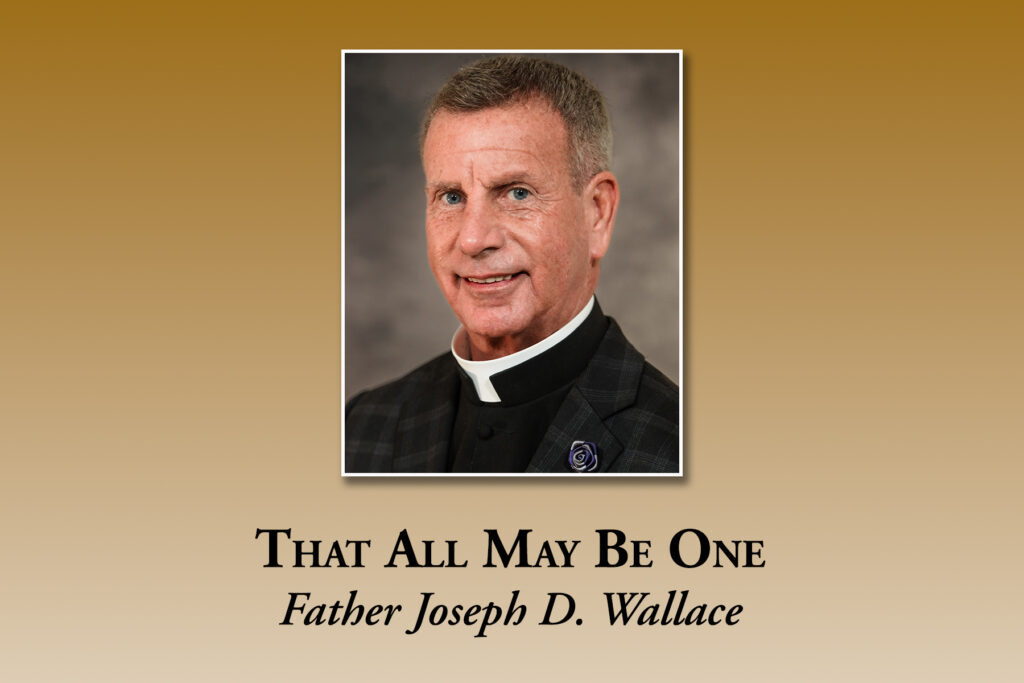
Father Joseph D. Wallace is diocesan director of Ecumenical and Inter-religious Affairs and pastor of Christ the Redeemer Parish, Atco.



 at the bottom and then tap “Add to Home Screen”

