








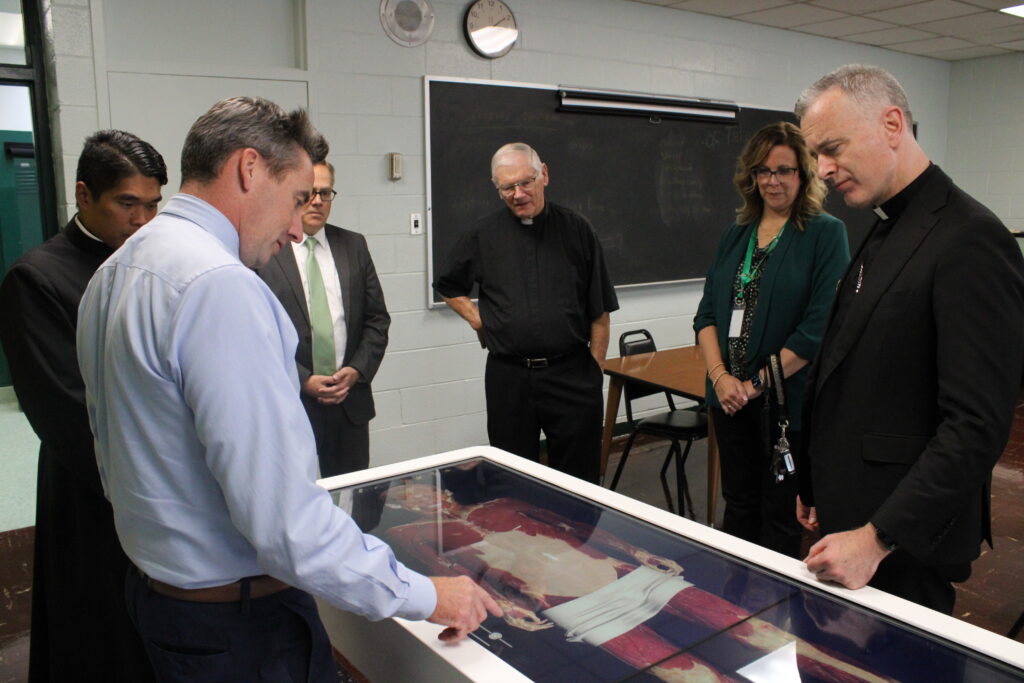
Thanks to some generous contributions, Camden Catholic High School has added a state-of-the-art educational tool to the classroom to make anatomy and physiology classes even more realistic.
The school is the first in the region to acquire an Anatomage Table, a technological platform that provides learners with access to digitized human cadavers and realistic three-dimensional anatomy experiences.
“The table provides advanced 3D medical visualization technology,” said principal Heather Crisci. “In a time where we would often rely on diagrams and pictures, we can now show students real visual representations of the human body systems and how they work.”
Already being used in anatomy and physiology classes, and with wider access planned for the future, the table allows students to explore the human body layer by layer, analyzing complex organ structures and observing simulations of bodily functions like heartbeats and blood circulation.
“Our new Anatomage Table is a unique learning tool that high school students would not normally have access to,” said Crisci. “Our students have expressed strong interests in the STEM fields, and this will provide them with virtual lab experiences that they will see at the university level. As technology advances, we need to embrace learning opportunities that will shape our students’ experiences and prepare them for their future careers.”
School leadership worked with science faculty to identify the best version of the Anatomage Table to purchase, which was made possible through a large donation from an alum and board member, as well as an annual grant the school received from Healthcare Quality Strategies, Inc.
“Without the support of the HQSI Foundation and our generous alum and board member, the table would have remained a dream educational device,” said the school’s president, James Hozier. “Their generosity allows us to be able to offer this experience to our students, preparing them even more for their futures.”
When senior Sean McGettigan first heard about the new Anatomage Table, he was eager to explore the tool precisely because of his future ambitions.
“I was excited by how much it would elevate my education and deepen my understanding of anatomy and physiology,” he said. “As someone who aspires to become a physical therapist, using this technology has changed the way I learn, as it is typically only available to graduate students.”
McGettigan has already been able to learn more about the human body.
“The table has taught me about the different bones in the body and their functions, how the body digests food, and how each of the body systems work together,” he said. “Now, I feel more prepared for college and more confident to excel while pursuing physical therapy.”
Anatomy teacher Matthew Crawford has seen the positive impact of the technology for all of his students.
“It allows students to get real-life experience with the human body’s structures and functions. It is a great tool for students who are looking to further their education in health science,” he said. “Even the students who are not interested in health science can learn about the human body in an exciting fashion.”
He noted that the tool doesn’t replace traditional learning, but rather it helps reinforce what students can learn and adds a strong visual learning opportunity to the curriculum.
“Students seem to gravitate towards visual learning, and the new Anatomage Table aligns with this style of learning,” he explained. “The table has already made a big impact on our current students and we look forward to sharing all of its capabilities with future students.”
For Crisci, this cutting-edge learning tool is part of the school’s broader efforts to prepare students for success after graduation, and to quench their thirst for STEM education.
“As we see more students interested in STEM-related careers, specifically in the medical field, this table provides them with an educational experience that is unique to Camden Catholic High School,” she said. “We know that we are educating students for jobs that do not exist today, so we are consistently looking at ways to evolve and expand opportunities for students so they are prepared for experiences that they will see in college.”





 at the bottom and then tap “Add to Home Screen”
