
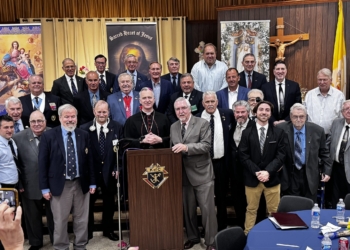




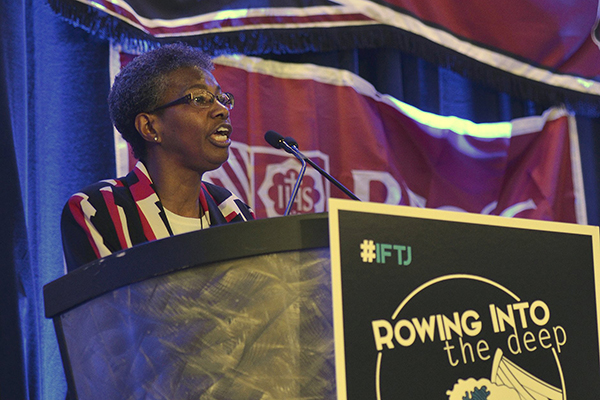
WASHINGTON D.C. – Hundreds of clergy, ministry leaders and laity gathered in Washington, D.C., last month for the 2023 Catholic Social Ministry Gathering.
The theme of this year’s event was “Blessed are the Peacemakers” (Mt 5:9) through living out Catholic social teaching in action. Catholic social teaching is often coined the Church’s best kept secret because many Catholics, unless deeply involved in ministry or diocesan work, are largely unaware of the social doctrine.
The conference, which was primarily organized by the U.S. Conference of Catholic Bishops’ Department of Justice, Peace and Human Development, along with other USCCB departments and 20 national Catholic organizations, recognized “the call to heal in a world broken by conflict, division, and inequality.”
In the opening plenary, “Blessed are the Peacemakers,” keynote speaker Sister Patricia Chappell, a Sister of Notre Dame de Namur, said Catholic social teaching principles “aren’t known because they aren’t heralded” enough by the Church’s communities. “We need to unlearn to relearn what we think we know. [We must] listen to hear, listen to learn. Not to debate, deny or negate.”
As one of three panelists discussing “Salt and Light Plenary: Building Peace by Helping Women and Children,” Ogechi Akalegbere, director of youth and young adult ministry at Saint Rose of Lima Church in Maryland, said Catholic youth are often surprised to learn what Catholic social teaching principles actually represent.
One youth asked, “If Catholic social teaching is the Church’s best kept secret, how much longer can it be kept a secret?”
Akalegbere paused to let the question sit with the audience before saying, “The youth are watching us. They know when we aren’t walking the talk. They see our missteps and our contradictions” in living out the social doctrine as Catholics. “The more united we are, the more effective we are.”
All sessions during the four-day conference aimed to further educate attendees on the importance of putting Catholic social teaching principles into action, primarily how to live through the Holy Spirit’s call to discomfort by supporting those who live in the margins; listening to learn, advocating on behalf of those in need, putting aside differences and receiving diversity as a gift; and coming to understand every human life is worthy of love and dignity.
During an advocacy training session, Chris West, senior trainer at Catholic Relief Services, said, “Today we are not Team Democrat. Today we are not Team Republican. Today we are Team Catholic.”
Katie Hagan is marketing manager for Catholic Charities Diocese of Camden.
Catholic Social Teaching
The foundations for Catholic social teaching lie in Pope Leo XIII’s 1891 encyclical letter, “Rerum Novarum,” and the Industrial Revolution, a time when many people were living in poverty, working long hours and receiving low wages in return. While some called for communism as a means of justice for the working class people, Pope Leo XIII proposed a less-polarizing option – a call to solidarity, living responsibly and building a just society based on Biblical teachings. The seven principles of Catholic social teaching are as follows:
• Life and dignity of the human person: The Catholic Church proclaims that every human life is sacred. Every person is precious, people are more important than things and the measure of every institution is whether it threatens or enhances the life and dignity of the human person.
• Call to family, community and participation: We believe people have a right and a duty to participate in society, seeking together the common good and well-being of all, especially the poor and vulnerable. How we organize economics and politics, in law and policy, directly affects human dignity and the capacity of individuals to grow in community.
• Rights and responsibilities: The Catholic tradition teaches that human dignity can be protected and a healthy community can be achieved only if human rights are protected and responsibilities are met. Therefore, every person has a fundamental right to life and a right to those things required for human decency.
• Option for the poor and vulnerable: Our tradition recalls the story of the Last Judgment (Mt 25:31-46) and instructs us to put the needs of the poor and vulnerable first. A basic moral test is how our most vulnerable members are faring.
• The dignity of work and the rights of workers: The economy must serve people, not the other way around. Work is more than a way to make a living; it is a form of continuing participation in God’s creation.
• Solidarity: We are one human family whatever our national, racial, ethnic, economic, and ideological differences. Our love for all our sisters and brothers demands that we promote peace in a world surrounded by violence and conflict.
• Care for God’s creation: We are called to protect people and the planet, living our faith in relationship with all of God’s creation. We show our respect for the Creator by our stewardship of creation. It is a requirement of our faith




 at the bottom and then tap “Add to Home Screen”
