




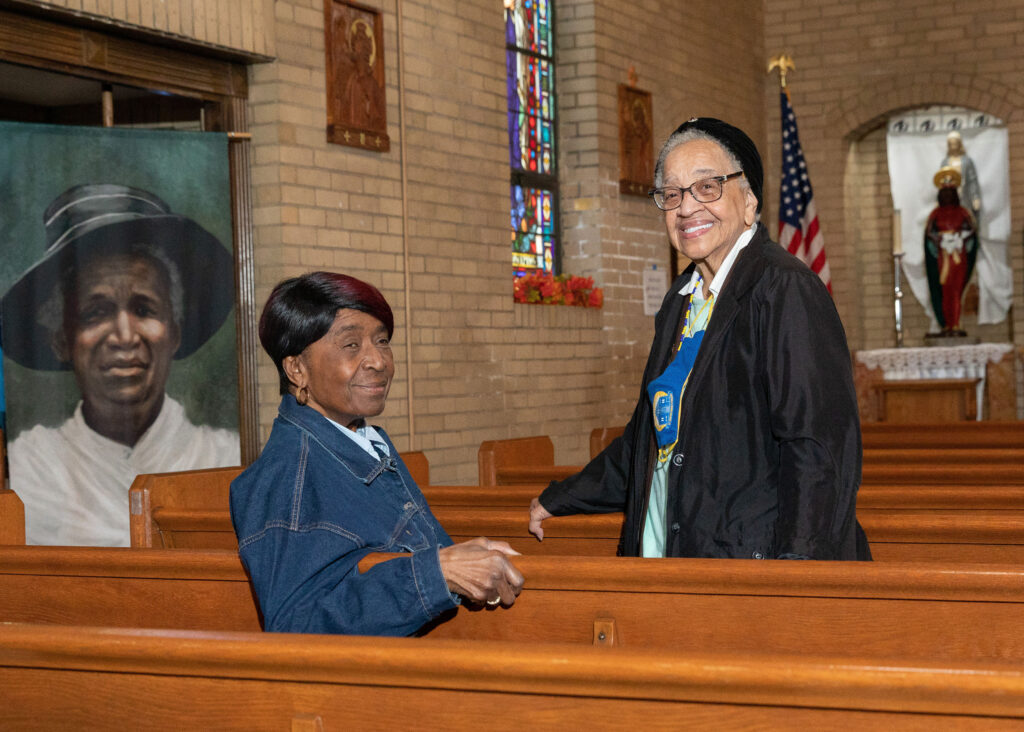
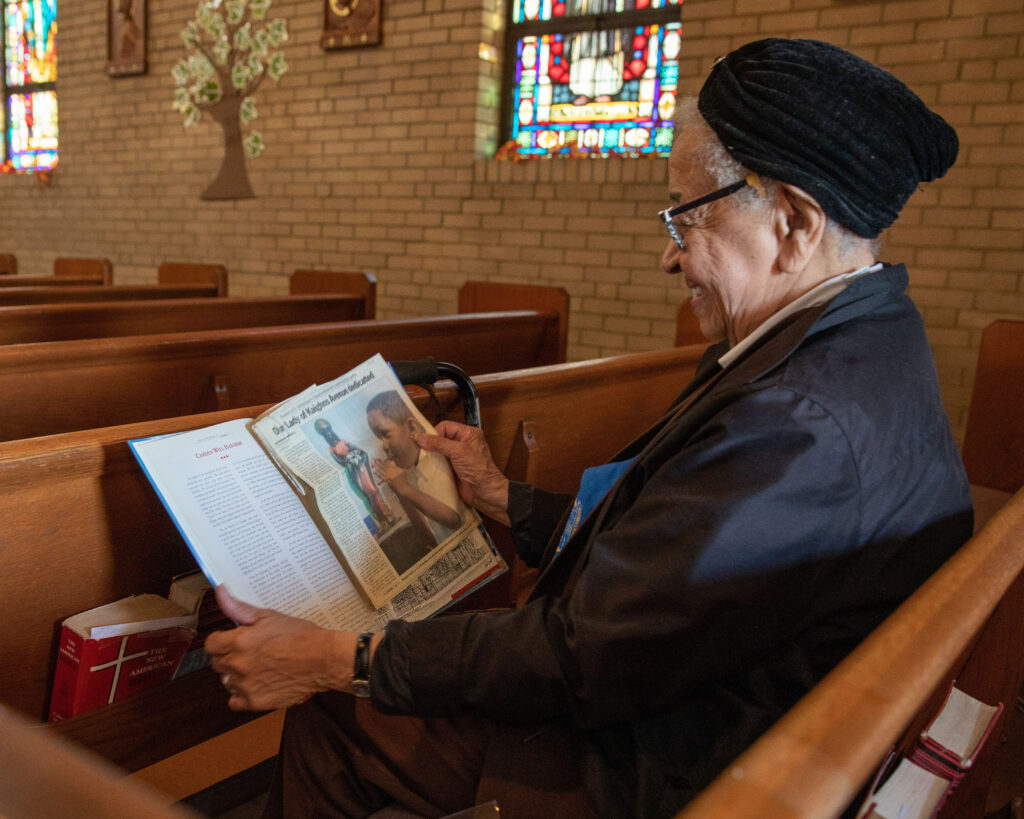
On a recent morning in November, Ruth L. Wilkerson sat in Camden’s Saint Bartholomew Church, flipping through an old pamphlet and stopping on a black-and-white photograph.
In the photo, a younger brother stands with about 15 fellow first-graders, all of whom are holding chairs they had carried from the church basement cafeteria to the classroom next door. It was the early 1940s, and Camden’s first Black Catholic school was still awaiting the delivery of desks.
“The establishment of Saint Bartholomew School helped the community grow; it was good for the neighborhood,” said Wilkerson, who was 12 at the time. “I was so glad to meet other Black Catholics. We knew they were out there, but we hadn’t had much contact.”
Wilkerson, 92, is a parishioner of Sacred Heart Parish, Camden, of which Saint Bartholomew Church is now a worship site. She is among the remaining few who remember its beginnings, when the Kaighns Avenue church was established as a mission of the city’s Cathedral of the Immaculate Conception.
With November being Black Catholic History Month, several parishioners reflected on the history of Black Catholicism in Camden, and the importance of recognizing the role of African Americans in the Church.
When it was announced in the late 1930s that a church for Black Catholics would be built, “My parents were ecstatic,” Wilkerson said, explaining that her father would work a full day for the railroad company and then join men from the community in helping construct the church.
“From the beginning, the church was family,” she said. “The community came together to do whatever needed to be done. Everybody was part of the building of Saint Bart’s.”
Both Wilkerson and fellow parishioner Katherine Bowman, 86, look fondly on the figures key to establishing the church: the Diocese of Camden’s first prelate, Bishop Bartholomew J. Eustace, D.D., and the church’s first pastor, Father Joseph T. Hanley, assigned in 1940.
They recall both men being dedicated to the Black Catholic community, with Father Hanley opting to live in small rectory quarters in order to accommodate the school, church and convent that would be established for the Sisters of the Blessed Sacrament.
Bowman, born and raised in Camden, was six when she met the sisters and their founder, the now-Saint Katharine Drexel.
“I was outside playing, and this woman came up to me and said, ‘Little girl, what’s your name?’” Bowman recalled. “I said my name is Katherine. She said, ‘Guess what? So is mine.”
At the time, the sisters were going door to door in areas of Camden that predominately housed the Black community, inviting families to the church and school. And if families needed help, they would help with that, too.
“It was real evangelization,” said Wilkerson, who was also born and raised in Camden.
That was especially meaningful to Bowman, who was in the school’s first class and remembers experiencing racism in the city. Children were told not to cross specific street borders and stay out of certain parks. Black Catholics, she said, were not welcome at area houses of worship.
“The sisters protected us and never made us feel different,” Bowman said. “After school, they would walk us [to our neighborhoods], through areas we felt unsafe in.”
As the years went on, the families of both Wilkerson and Bowman made it a mission to give back to the church and school. Bowman’s mother would help cook for parish events, with Bowman and her siblings helping out. The school offered a full lunch every day, and parents took turns volunteering to cook for the students.
“I’ve been here from the very beginning, and I’ve had a happy life here,” Bowman said. “I love being a Catholic, and I love helping people. I try to do all I can. My mom was the same way.”
Of Saint Bartholomew Church, Wilkerson said, “You feel like you’re welcome here, and everybody is happy to see you.”
Feeling welcome is part of the Church’s mission, she said. “When I turn on the TV and watch the Pope in Rome praying – I look for a Black face in the crowd. If it’s a Catholic, Universal Church gathering, I expect to see me [represented] in there someplace.”
Along the same line, those at the church feel it can only build solidarity for all in the faith to learn more about the history, contributions and lives of Black Catholic leaders.
“This month is important because it recognizes Black Catholics who, for years, went unknown, like [Venerable] Father Augustus Tolton,” said Cherryl Summers, choir director, parishioner and former coordinator of Black Catholic Ministry for the Diocese of Camden. Born into slavery, Father Tolton went on to become America’s first Black Roman Catholic priest. He is among six Catholics of African descent being lifted up as candidates for sainthood.
Summers, who received all of her sacraments at Saint Bartholomew and was married there, said the church gives Black Catholics a presence in Camden’s history. “It was [a refuge] when there were churches in the city that were not accepting of Black Catholics. Bishop Eustace established this place so that we could worship and be welcomed. It’s a home away from home.”




 at the bottom and then tap “Add to Home Screen”
