





After several months of listening sessions and outreach efforts led by delegates at parishes around the Diocese, the collective feedback gathered during this initial phase of the worldwide Synod of Bishops is now being organized into a draft report for review at the diocesan deanery level.
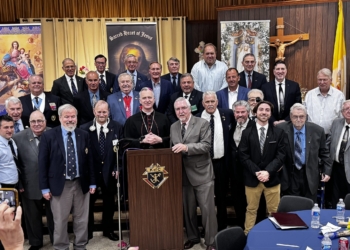
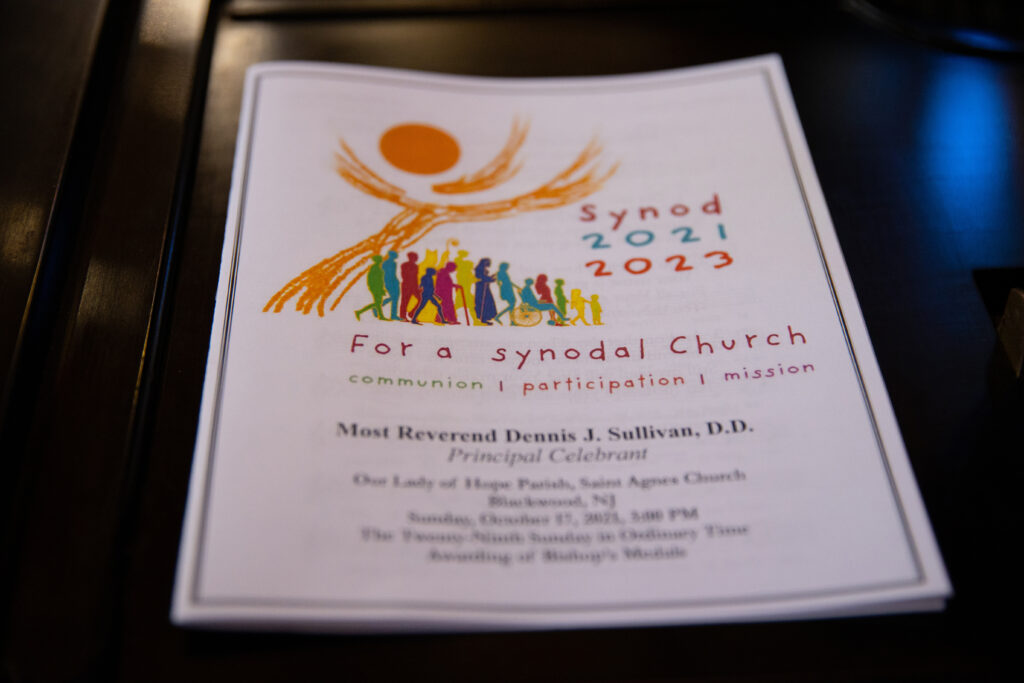
Earlier this year, Pope Francis called the Church to synod, with the theme, “For a Synodal Church: Communication, Participation and Mission.” On Oct. 17, Bishop Dennis J. Sullivan celebrated the diocesan opening Mass of the Synod at Saint Agnes Church, Our Lady of Hope Parish, Blackwood. The Mass kicked off the first phase of the synod, which begins with listening sessions at the parish level as the Vatican seeks to hear from every Catholic.
“The Holy Father has asked that Catholic Christians BE a synodal people,” says Father Robert Hughes, diocesan Vicar General and Moderator of the Curia. “The word ‘synod’ is different from the more commonly used word ‘meeting.’ When we attend a ‘meeting’ we generally expect to receive information. The word ‘synod’ implies a much more dynamic environment – one in which people both share, listen, reflect and then share again. We believe that this ‘dialogue’ is the very life of the Trinity … and created in the image and likeness of God, we are ‘caught up’ in this dynamic.”
Donna Ottaviano-Britt, diocesan head of the secretariat for pastoral outreach, praised the process and its grassroots efforts. “The Holy Father wants to hear from everybody. Everyone is important, everyone has a voice, everyone has an experience.”
Delegates lead local listening sessions
Over the past few months, delegates, the majority of them laity, have led these local efforts – and Ottaviano-Britt says they have fully embraced their charge.
“They have created amazing plans, they did live listening sessions, Zoom listening sessions, online surveys, paper surveys … they made efforts to go out into their communities,” she says.
The Vatican identified 10 themes, and the Diocese added an additional theme centered on the Eucharist, with a total of 46 questions provided to parishes. Feedback has included both positive and negative comments and experiences.
“I think it is important for us as a Church to hear what our people are saying,” says Ottaviano-Britt, noting they have sought to learn from lifelong Catholics, Catholics who have left the Church and since returned, and those who are on the margins of the faith.
In addition to soliciting submissions from the Vietnamese, Spanish and deaf communities, delegates also reached out to college students who were home for the holidays. There was also outreach to recipients of support from parish ministries like food banks, as well as contact with other Christian and non-Christian faith communities.
“I would say there was a relatively high level of engagement in this phase of the synod,” Father Hughes says. “Overwhelmingly, delegates report that they were privileged to listen to so many who wanted to be heard by the Church.”
Developing a draft report
Listening session reports and written submissions have since been provided to the Diocese – to the tune of more than 110,000 words – for the compilation of a draft report that will be reviewed by delegates in each of the diocesan deaneries in the coming days.
As was part of the listening session process, Ottaviano-Britt says the diocesan team has similarly called on the Holy Spirit to help reveal what needs to be revealed through the synod.
“They are capturing the things that are good, and they are capturing the things that need our attention, and our focus and our heart,” she says. “And I think that only happens because the Holy Spirit reveals it.”
The deaneries will provide input to the diocesan team, which will assemble a final report – limited to 10 pages – to submit to the U.S. Conference of Catholic Bishops. The USCCB will then develop a national summary, which will be submitted to the Vatican to be studied alongside global submissions.
“It will be interesting to see where we, the Diocese of Camden, stands in terms of the rest of the country and Catholics around the world,” says Father Hughes. “I suspect that we will find much of what has been said at listening sessions here to be reflected in what is said across the U.S., and perhaps to a lesser extent worldwide.”
Father Hughes hopes that the synod will encourage Catholics to grow deeper in their faith.
“Hopefully, the process that we undergo will enable the Diocese and parishes to strategize in response to what we have heard in order to both encourage Catholics and challenge them,” he says. “Our faith isn’t just something we celebrate for a few minutes on Sunday; it must be a living experience that we embrace throughout every day.”
‘A big step forward for the Church’
Leo Flynn, a member of Saint Thomas More Parish, Cherry Hill, served as a parish delegate.
“This could be a big step forward for the Church,” says Flynn. “For an organization to open up like this, to engage its members so deeply, takes a lot of courage. It has the potential to be transformative.”
Flynn says he was “moved by how much love people expressed for their faith, even where there are frustrations. There is great desire to see the Church heal and grow.”
He looks forward to the next phases of the synod, and to seeing the critical themes “come into real focus” at the national and global levels.
“A key takeaway I found is that people are simply hungry to be engaged,” he says, “to share their thoughts, to hear from others, to figure out the best way forward, and to get to work on it.”
Eileen Farabella served as a delegate for Our Lady of the Blessed Sacrament Parish, Newfield.
“The more people let us know how they are doing makes for a better experience for everyone,” she says. “We can bring things back to our individual parishes and try to address what we heard and really follow through with it.”
Want to know more about the synodal process in the Diocese of Camden? Check out the “Synod Update” Talking Catholic podcast at camdendiocese.org/talkingcatholic





 at the bottom and then tap “Add to Home Screen”
