





CHERRY HILL – The election of Pope Leo XIV has shed light on the mission of his namesake predecessor, Pope Leo XIII, a champion of workers’ rights and social issues during the 19th century pontificate.
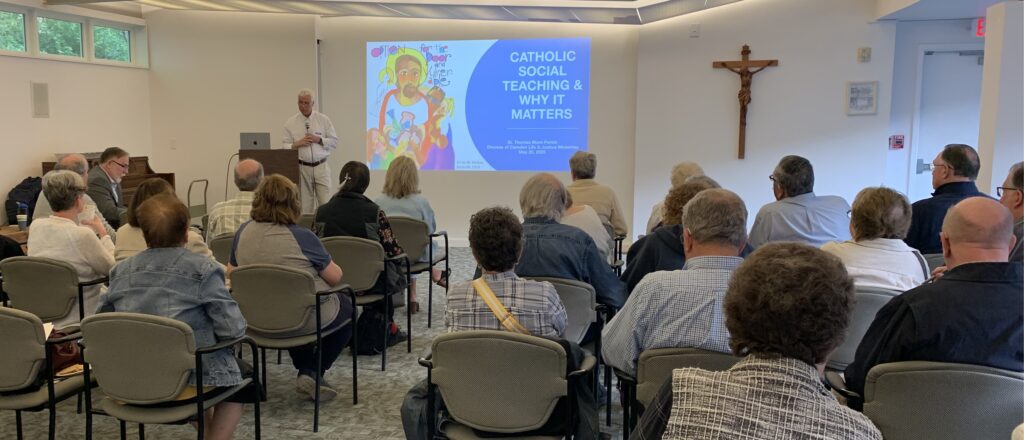
To better understand the foundational tenets of these issues, about 50 people came together recently at Saint Thomas More Parish for a presentation on “Catholic Social Teaching And Why It Matters.”
“[This teaching] strives to foster a living faith that leads to loving action in the world” by building up social structures that “make visible the reign of God,” said Dr. Beth Ford McNamee, director of the Sisters of Saint Joseph Center for Justice, Peace and Integrity of Creation in Philadelphia.
To accomplish this, “we must be aware, keep our eyes open, and read the social, political, economic and cultural signs of the times – and where there are dangers to human flourishing and where is it happening,” she argued, as it pertains to core principles such as the life and dignity of every person; caring for the poor and vulnerable; solidarity and commitment to one’s neighbors; the dignity of workers; the social commitments of family and community to the common good; and the care for God’s creation.
Catholic social teaching “calls all of to our true vocation, to be Christ’s disciples to all, co-laboring with God’s spirit for transformative action,” Dr. Ford McNamee said.

In forming one’s Christian community and conscience, and breaking through the apathy and blindness that society can have for social concerns, change can take place, she noted. “It can be possible that people have enough food to eat, that people can have housing, people can have the things that they need in life for full human flourishing.”
“This is what we’re called to, on earth as it is in heaven, here and now,” Dr. Ford McNamee continued, noting pope writings over the years, such as Pope Leo XIII’s “Rerum Novarum” (“On the Condition of Labor,” 1891); Saint John Paul II’s “Evangelium Vitae” (“The Gospel of Life,” 1995); and Pope Francis’ “Laudato Si’” (On Care for Our Common Home, 2015).
Quoting the U.S. bishops’ 2011 “Summary Report of the Task Force on Catholic Social Teaching and Catholic Education,” she said that “far too many Catholics are not familiar with the basic content of CST, or fundamentally, many Catholics do not adequately understand that the social teaching of the Church is an essential part of the Catholic faith.”
“This poses a serious challenge for all Catholics, since it weakens our capacity to be a Church that is true to the demands of the Gospel,” she said. “We need to do more to share the social mission and message of our Church.”
One of those challenged and inspired by Dr. Ford McNamee’s words was 22-year-old Saint Thomas More parishioner Joseph Pro.
“As a young Catholic, Catholic social teaching is something I know I need to learn more about – and be more passionate about,” he said. “Our faith goes beyond what we do inside the Church. We can’t keep it to ourselves; we have to take action and help make the world more reflective of what God desires.”
The May 20 event was co-sponsored by the Saint Thomas More Parish Faith and Justice Team and the Diocese of Camden’s Office of Life & Justice Ministries.
Dr. Michael Sims, director of diocesan office, said he was thankful for a night that “encapsulated what Catholic social teaching is and what it means to bring God’s friendship to the world in ways that take into account the political, social and economic realities of our time.”
He expressed optimism that by “educating and making people aware of these issues, they will begin and continue that work in our parishes.”






 at the bottom and then tap “Add to Home Screen”
