








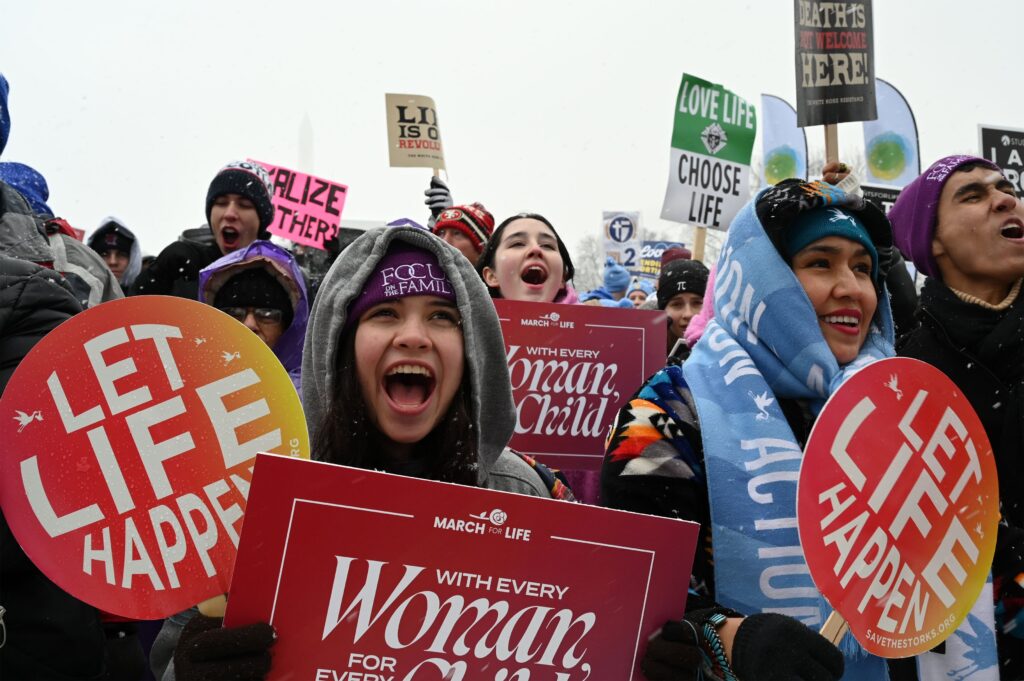
Abortion policies have continued to shift in the United States three and a half years since the Supreme Court overturned Roe v. Wade in its June 2022 Dobbs v. Jackson Women’s Health Organization decision.
In 2025, some states adopted new restrictions on abortion, while others expanded policies to increase abortion access. In most states, changes to policy were minimal, as many states already set their post-Dobbs abortion policies in the previous years.
At the federal level, strides were made to pull back funding for organizations that advocate for abortion access. At the same time, the U.S. Food and Drug Administration also approved a generic abortion pill and failed to further regulate chemical abortion drugs.
State-level results
In Texas, where nearly all abortions are illegal, lawmakers passed a bill that allows families to sue companies that manufacture or distribute chemical abortion pills. This comes as state laws related to chemical abortions often conflict, with states like New York enforcing “shield laws” that order courts to not cooperate with out-of-state lawsuits or criminal charges against abortionists within their states.
Lawmakers in Wyoming passed a law overriding a veto from the governor that requires women to receive an ultrasound before they can obtain an abortion. However, the law was blocked by a court and is not in effect.
In November, the North Dakota Supreme Court ruled in favor of the state’s near-total abortion ban after it was temporarily blocked by a lower court. Under the law, unborn life is protected at every stage in pregnancy in most cases, but it remains legal in the first six weeks in cases of rape and incest and for the duration of pregnancy when the mother is at risk of death or serious physical harm.
The U.S. Supreme Court ruled in June that a South Carolina policy to withhold Medicaid funding for Planned Parenthood could stay in place. This ruling also opened the door for other states to adopt similar policies moving forward.
In at least 10 states, lawmakers enacted bills to provide more funding for pro-life pregnancy centers, which offer life-affirming alternatives to abortion for pregnant women.
Alternatively, a handful of states in 2025 expanded their shield laws, which prevent courts from complying with out-of-state criminal or civil cases against abortionists. This includes new laws in California, Vermont, Massachusetts and New York. Several states expanded these laws by allowing pharmacies to provide chemical abortion pills without listing the name of the doctor who prescribed them to prevent out-of-state legal action.
About a dozen states expanded funding for abortion providers, such as California directing $140 million to Planned Parenthood to counteract federal defunding efforts. Maryland established a new program called the Public Health Abortion Grant Program, which offers abortion coverage through Affordable Care Act funds.
New laws in Colorado and Washington require emergency rooms to provide abortions when the procedure is deemed “necessary.” A law adopted in Illinois requires public college campuses to provide the abortion pill at their pharmacies. Connecticut removed its parental notification policy regarding abortion.
As of December, 13 states prohibit most abortions, four states ban abortions after six weeks’ gestation, two have bans after 12 weeks, and one has a ban after 18 weeks. The other 30 states and the District of Columbia permit abortion up to the 22nd week or later. Nine of those states, including New Jersey, allow elective abortion through nine months until the moment of birth.
Federal-level shifts
Abortion policy at the federal level shifted shortly after President Trump took office, with the administration reinstating many policies from his first term that had been abandoned under President Biden’s administration.
For example, the Mexico City Policy was reinstated during President Trump’s first week in office, which requires foreign organizations to certify they will not perform, promote, or actively advocate for abortion in order to receive U.S. government funding. In June, the Centers for Medicare and Medicaid Services rescinded guidelines that had required emergency rooms to perform abortions when a pregnant woman had a life-threatening emergency to stabilize her condition – even in states where abortion is otherwise banned.
Other changes within federal departments and agencies included rescinding a Department of Defense policy that provided paid leave and travel expenses for abortion, and a proposed rule change to end abortion at Veterans Affairs facilities.
The Department of Health and Human Services also withheld Title X family planning funds from Planned Parenthood. Trump signed a spending bill that withheld Medicaid reimbursements from Planned Parenthood. Federal tax money was not spent directly on abortion before those changes, but abortion providers did receive funds for other purposes.
Nearly 70 Planned Parenthood abortion clinics shut down in 2025 amid funding cuts.
Although the administration announced it would review the abortion pill, the Food and Drug Administration approved a new generic version of the drug mifepristone.
Did You Know?
• The 52nd annual March for Life will take place Jan. 23 in Washington, D.C. This year’s theme, “Life: Why We March,” aims to remind all that every human life – including the unborn and their mothers – has unique dignity and is worthy of protection.
• The annual “9 Days for Life” novena begins Jan. 16. Go to respectlife.org/9-days-signup.
• The U.S. Catholic bishops call for all faithful to observe a nationwide prayer vigil Jan. 22-23 “to pray for an end to abortion and a greater respect for all human life in post-Roe America.”
• The opening and closing Masses for the annual National Prayer Vigil for Life will be livestreamed from Washington’s Basilica of the National Shrine of the Immaculate Conception at nationalshrine.org/mass. EWTN will provide live television broadcasts, as well. The opening Mass will begin at 5 p.m. Jan. 22; the closing Mass will take place at 8 a.m. Jan. 23.






 at the bottom and then tap “Add to Home Screen”
