





People of the Book: Mary Magdalene
In addition to Phillies magnets and Corona bottle-openers, my refrigerator, like most people’s, has begun to collect various pictures and memorabilia that I have amassed over the years. One that I particularly value is a pocket-sized copy of an Eastern icon depicting a woman in scarlet with an outstretched hand preaching to a group of men, most of whom have long white beards and books in their hands and are listening intently to whatever it is she has to say. It is an artistic representation of Mary Magdalene, the “apostle to the apostles” informing the other disciples of the Resurrection. In all four Gospels, the women are the first to the tomb and so the first to spread the message of what had happened there to the others, and in some sense, to us. This icon was given to me by Professor Elizabeth Johnson at Fordham and I treasure it.
Perhaps no early church figure has been so commented upon in recent years (especially in the wake of a certain unnamed novel I’d bet you have heard of) as Mary of Magdala. Today most scholars agree that Mary has, to a greater or lesser degree depending upon whom you ask, been unfairly maligned throughout the centuries.
We know that Mary Magdalene and Jesus were close through at least some part of his public ministry and that according to the explicit testimony in Matthew and Mark, she was one of very few who stood by him at the cross when the other disciples had scattered like sheep, when the Shepherd was struck down (cf. Zech 13:7). Yet, there have been wild and unfounded rumors about her, and a “conflation” of various positive and negative strata, or layers, which have been superadded on to her historical personage through the years.
Most scholars believe the image of this Mary (as opposed to Lazarus’ sister Mary of Bethany, Mary the Mother of James, Mary the wife of Clopas, the Virgin Mary, etc.) was unfairly painted as the repentant sinner/adulterer/prostitute in Luke 7 and John 8. She was however cured of some sort of spiritual malady by Jesus, for Luke 8:2 describes her as the woman from whom seven demons had been cast out.
Much of the later confusion dates to Pope Gregory in the sixth century, who erroneously and for some unknown reason began to merge these various distinct accounts into one figure. In the 1969 Roman Missal, she was officially exonerated of these charges and changed from one to be venerated as a “penitent” to instead as a “disciple.” Unfortunately this restoration of her historical stature and position of eminence has not always trickled down to artists, authors and many of the faithful at large (the theological equivalent to Reaganomics doesn’t always work flawlessly. Just ask Sts. Francis of Assisi, Catherine of Siena or innumerable other leaders of grassroots movements within our storied history who respected the “ecclesia docens” while realizing that sometimes teachers’ horizons are expanded by pupils as well).
Numerous published efforts at dis-entwining Mary from these accusations have aided in the restoration of her as a true mother of the faith to whom we can look for inspiration, guidance and a deepening relationship with Christ, the King of mended hearts.
The English word “maudlin,” meaning tearfully sentimental, has its origin in Mary Magdalene’s overpowering grief at the tomb. Though she supposed him gone, her love for Jesus was undying, and her sadness not the final word. When Jesus approaches her in the grey dawn of the garden outside the empty tomb, she does not recognize him and supposes him to be the cemetery caretaker. (Along with the Emmaus account, Jesus’ passing through the locked doors of the upper room and Peter’s recognition from the boat before the charcoal breakfast on the beach, such a scene provides ample opportunity to meditate upon the mysteries surrounding the glorified body which we one day hope to share and upon the unfathomable and inextricable relationship between spirit and matter, for as Pope Benedict affirmed in an interview this week, Christians believe the latter too “is destined for eternity, that it is truly resurrected, that it does not remain something lost”).
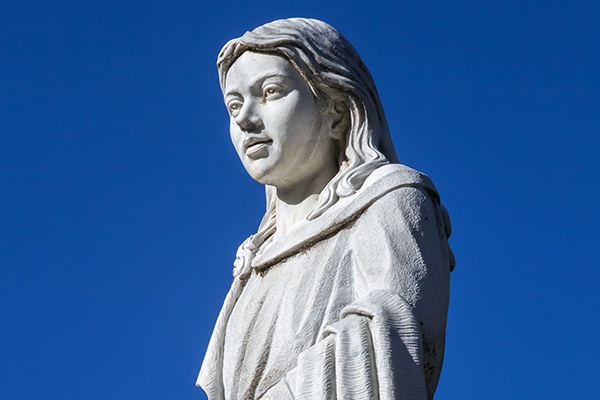
It takes only the iteration of her name, “Mary,” for her to recognize her Rabboni, and for the fear and gloom and sadness of the tomb to be shattered by this new and powerful reality bursting forth in a previously unimagined way, much in the same vein as the inner vitality and essence of life shattering the frail imprisoning cocoon of a colored egg (yes, that’s why!). Mary of Magdala models the life of discipleship for us and embodies in her person the Christian Passover from helpless sadness and the fraudulent power of death to unforeseen joy and unending life. For this we should continue to bless, venerate and defend her memory and to seek her intercession.
Michael M. Canaris of Collingswood is an administrator at Fairfield University’s Center for Faith and Public Life and is on the faculty for the Department of Philosophy, Theology, and Religious Studies at Sacred Heart University.







 at the bottom and then tap “Add to Home Screen”