





ATLANTIC CITY – On March 31, students from Our Lady Star of the Sea Regional School learned about the science of pathology, and put their observational skills to the test to diagnose disease in the human body.
Olivia Josephsen, a pathologists’ assistant at AtlantiCare Regional Medical Center in Atlantic City, spoke to the sixth, seventh, and eighth graders, sharing the work she’s dedicated herself to for the past three years.
Pathology is the scientific study of disease, she explained, and her profession involves looking for disease, such as cancer, in specimens removed during surgery or post-mortem (after death).
Josephsen noted the precision with which she examines these body parts.
She uses her eyes to “take note of [the specimen’s] size, weight, consistency, and color,” she said, as well as “determine if it’s an infectious disease, or cancerous.”
After confirming her findings under a microscope, she relays the information to a clinical team, if needed, who will use her findings to determine a proper course of treatment.
Her passion stems from the fact that she can study anatomy, work with her hands, and, most importantly, aid patients behind the scenes.
“I wanted to help them and make a difference, and found my work in the lab fulfilled those needs,” Josephsen said.
For those curious about following her path, she detailed the route.
“Graduate from a four-year college, ideally with a degree in the life sciences, such as biology, chemistry, and microbiology,” she began.
Following that, additional schooling to become a pathologists’ assistant is required, and includes classroom courses and clinical rotation.
Finally, one must pass the American Society for Clinical Pathology (ASCP) certification exam.
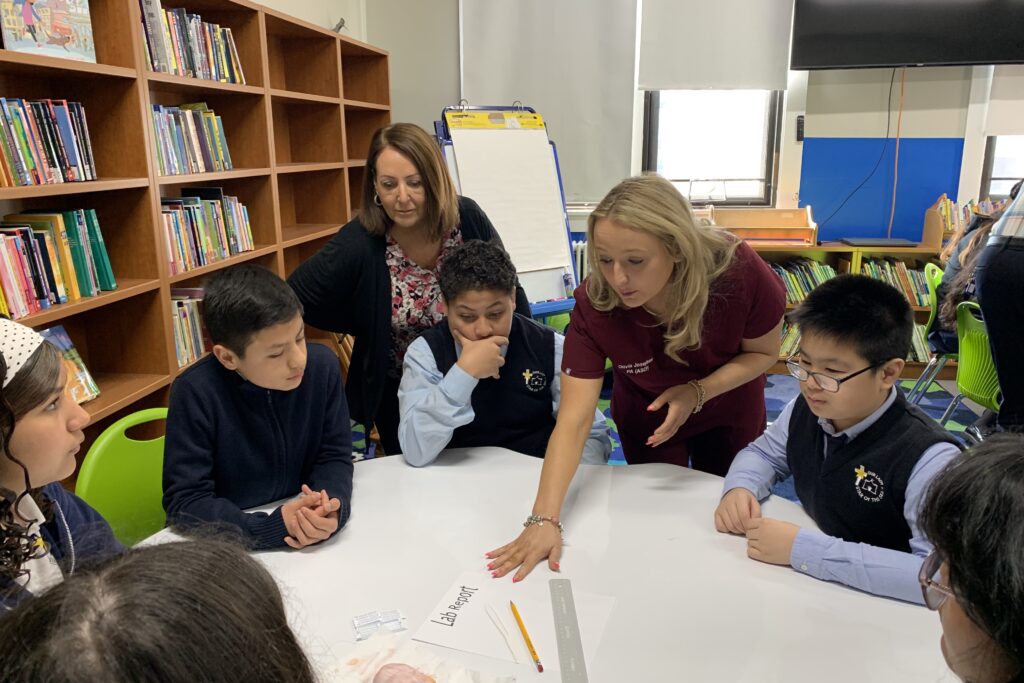
After her presentation, the 27 students moved into the library. Split into groups, they were tasked with examining clay organs for disease, which were noted by different colors, dissecting them, and writing lab reports.
Students noted the texture and measured the shape and size of the colored tumors on the organs.
Carol Garrett, Our Lady Star of the Sea science teacher for sixth- to eighth-grade students, noted that the presentation came at the perfect time for her classes.
“Since December, we’ve been learning about the human body, such as cells and the circulatory system, and organs, so this presentation is a good extension,” she said.
“It’s hands-on, and gets them moving and thinking and working with each other,” she continued.
At the same time, “It makes them think of a possible career opportunity in the future.”
For eighth grader Valentina Franco, a possible profession in the medical field isn’t far from her mind.
“It was fun to learn about [Josephsen’s] work, and think about a possible opportunity for me,” she said.
The clay liver that Fanco dissected in her group – other tables dissected an eyeball, lung, or kidney – was one of the most interesting parts during the presentation and activity for her.
“I appreciated the work and dedication that she brings to her work, along with her preciseness and confidence.”
“She inspired me, and makes me think I can do these things, too, in my own life.”
Our Lady Star of the Sea Principal Ramona Bregatta expressed pleasure “that students not only learn from someone outside their school, but get to hear about the opportunities in their own neighborhood,” as Josephsen works in Atlantic City.
“They don’t have to go far.”
Josephsen also has a connection to the school and parish community, Bregatta explained. Her mother, Francie, is a part-time ESL teacher at Our Lady Star of the Sea, and her father, Fred, is facilities manager at the Parish of Saint Monica.
Bregatta noted that during this exercise, the students were practicing observation and writing. “Hopefully, her visit sparked an interest in the sciences for these students.”





 at the bottom and then tap “Add to Home Screen”
