






People of the Book – St. Jude
So little is definitively known about St. Jude that Robert Orsi claims in his book “Thank You, St Jude” (Yale University, 1996) that second-generation daughters of immigrants and other American women were able to use the blank canvass of his life to appropriate and co-create their own narratives of trial, suffering and redemption through imaging (or imagining) a relationship with him. And while I do not agree with all of the conclusions Orsi draws, his mixed method study aptly traces the rise of devotion to the “Patron Saint of Hopeless Causes and Things Despaired Of” from its beginnings in a Mexican neighborhood of Chicago through its spread around the country during the Depression.
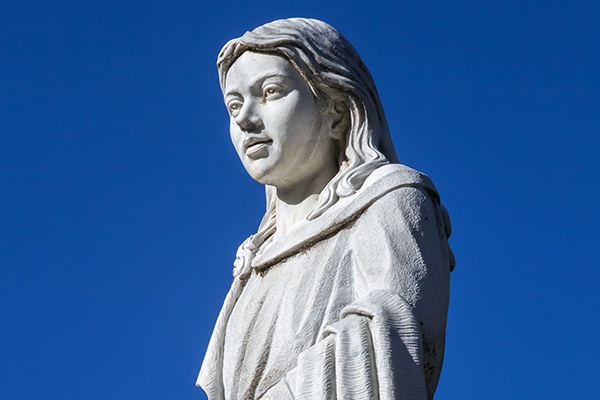
Most of us have at some point seen a parishioner bowed in petitionary prayer before a statue of St. Jude, murmuring supplications to the statue with a flame above his head and a club at his side to represent the manner in which he was bludgeoned to death. Without fail, the candles in front of Jude at the iconic Church & Friary of St. Francis on 31st Street in New York City always shimmer against the mosaic tiles more brilliantly than those of all the other monuments (including one created from a twisted iron beam of the World Trade Center).
Who is this “forgotten disciple” to whom so many turn for aid, comfort, intercession and support in the difficult moments of life?
In most languages other than English, there is no distinction made between the spelling of Jude and that of Judas, the betrayer. And while (the good) Jude’s nickname Thaddeus perhaps helped Christians try to draw a distinction between the two, for centuries his etymological association with Iscariot tempered people’s enthusiasm to discuss him publicly or pray to him privately. Judas and Jude are in many senses mirror images of one another, the embodiment of treachery and self-interest present in the one is inverted in the model of loyalty and amicable devotion in the other. Orsi even cites artistic portrayals where the two appear together, with Judas’s hand on Jude’s shoulder.
Jude is, however, an important figure in his own right, for the New Testament canon contains a letter which is ascribed to his pen. The Epistle of Jude is the shortest and penultimate book of the New Testament. In it, the Apostle warns of the various dangers of letting one’s faith be swayed by false teachers, those that “are grumblers and faultfinders, following their own desires, boasting about themselves and flattering others for their own advantage” (1:16). Rather, Jude calls on Christians to build themselves up in the faith and to “be merciful to those who doubt” (1:22).
Besides the Epistle and the places where the Twelve are named, Jude also appears briefly in John’s Gospel. Here we see “Judas, not Iscariot” ask Jesus a rather penetrating question: “Master, how is it that you reveal yourself unto us, and not unto the whole world?” (Jn 14:22). This inquiry is one I certainly grapple with in my own mind and heart. How is it that God chooses some but not all to carry his message to every generation, whether privately (catechists) or collectively (the Israelites)? How is it so clear to so many who this Child born in a manger was and is, and yet for countless others it remains “foolishness and a stumbling block”? Why does God allow our tradition to exhibit such a “scandal of particularity” both as individuals and as a community?
The gift of faith is undoubtedly a mysterious reality, an overwhelming font of consolation that carries with it an equally crushing responsibility. Yet reality demonstrates that not all are given it, at least explicitly, and so we that do recognize him gratefully assert “happy are all who are called to this Supper.”
Blessed John Henry Newman (1801-90) said the following about the “forgotten” saint, about whom so little is known: “Hence we draw an important lesson for ourselves: to do our duty without aiming for the world’s praise…[Simon and Jude] were not simply unknown to the world in their lifetime, but even hated and persecuted by it…Go on, then, contentedly in the path of duty, seeking Christ in his house and in his ordinances, and he will be your glory at his coming. He will own you before his Father. Let the world record in history the names of heroes, statesmen, and conquerors, and reward courage, and ability, and skill, and perseverance, with its proud titles of honour. Verily, these have their reward. Your names will be written in Heaven, with those of St. Simon and St. Jude, and the other Apostles. You will have the favour of him whose favour is life.”
The communion of saints allows us to strengthen our relationship with God through others not only synchronically (at this specific moment through people with whom we now walk the road of life) but also diachronically (across the tracks of time from generations past). Let us cultivate a friendship with Jude, and through him learn ever more about serving God through kenotically emptying ourselves to serve others.
Michael M. Canaris of Collingswood is an administrator at Fairfield University’s Center for Faith and Public Life and is on the faculty for the Department of Philosophy, Theology, and Religious Studies at Sacred Heart University.






 at the bottom and then tap “Add to Home Screen”