





MANTUA – You are Yeong, a 75-year-old woman. Your husband has passed away from cancer, and you live alone on the third floor of an apartment.
It is the first of the month, and your $930 rent is due. So is the $200 minimum payment of your maxed-out credit card. As well, your medication refills are in, and they cost $250.
On a limited income, with no savings, you have difficult decisions to make.
Do you pay for the medication and credit card, and delay a portion of your rent payment? Do you pay the rent and the credit card, and skip the medication? Or do you pay medication and rent, and skip the credit card?
Every choice comes with a risk: housing insecurity, medical complexities or increasing debt.
Stories like Yeong’s, and these daily decisions, are just one part of the “People of Hope Museum: Faith-Filled Stories of Neighbors Helping Neighbors” immersive experience that is traveling the United States. The Catholic Charities USA museum visited the Diocese of Camden from June 15 to 19.
Its first stop was a two-day visit to Church of the Incarnation, after which it arrived at Harrah’s Resort as part of the Catholic Media Conference in Atlantic City.
At Church of the Incarnation, Catholic Charities USA staff were welcomed by Bishop Joseph Williams, Father Jon Thomas, vicar general of the diocese, as well as Dr. Maria Elena Hallion, executive director of Catholic Charities of South Jersey, and its employees. In blessing the museum, Bishop Williams said he hopes this CCUSA initiative “opens eyes and hearts to the needs of our brothers and sisters.”

The museum, housed in an outfitted tractor-trailer, is on a 2 ½-year national tour that will continue through June 2028. In addition to the interactive stories that put visitors in the shoes of others, the exhibit includes an interactive map of the United States and state-by-state statistics on issues such as veterans’ needs, child poverty and food insecurity.
For instance, the map shows that 11.7% of children lived in poverty and almost 13,000 people were experiencing homelessness in New Jersey in 2024.
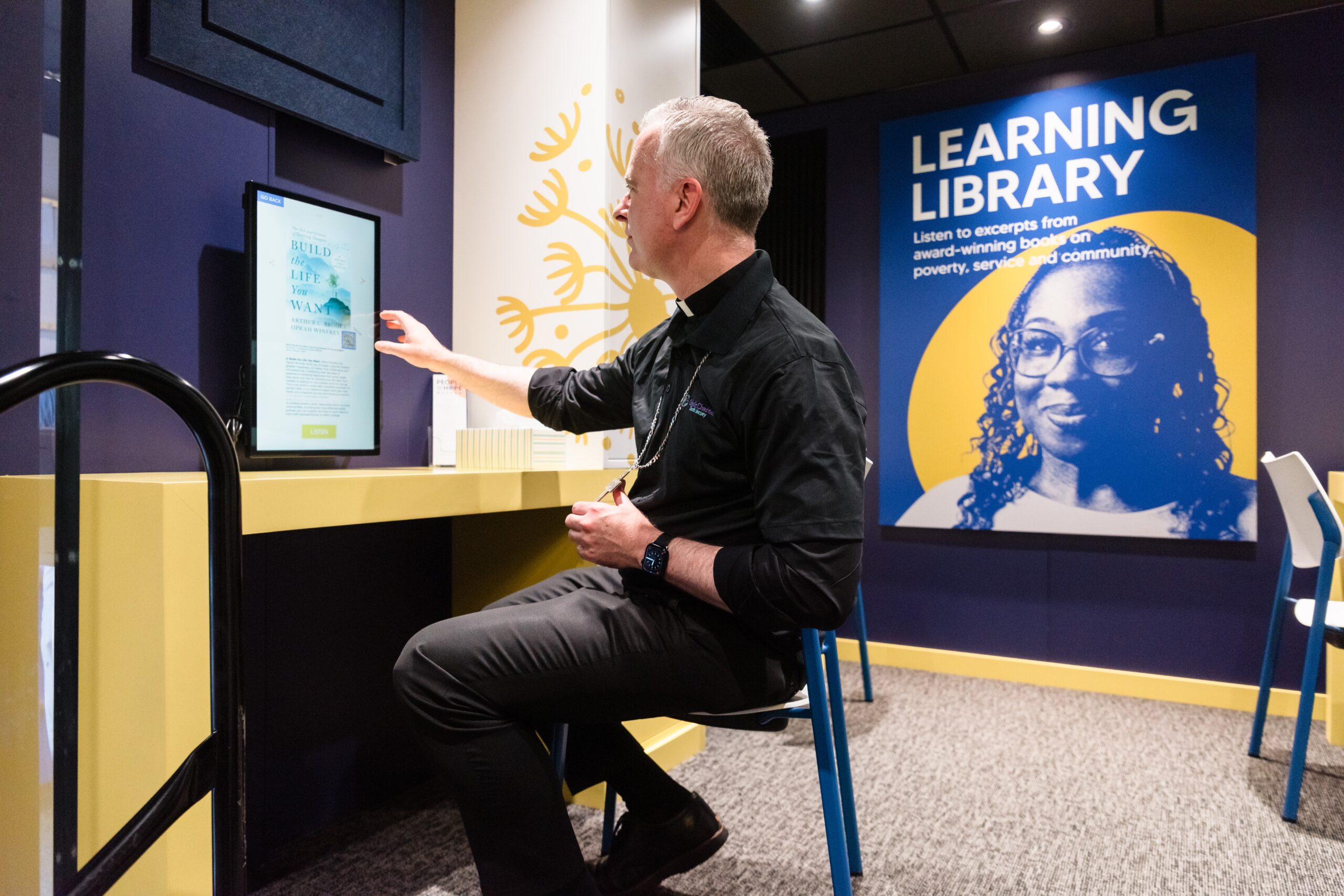
Visitors can also hear life-changing stories of those who’ve assisted others in need, and record a video of themselves to share their own stories of hope and service. There is an audio learning library, where visitors can listen to excerpts from powerful texts such as “Our Kids: The American Dream in Crisis” by Robert D. Putnam, and “Broke in America: Seeing, Understanding, and Ending U.S. Poverty” by Joanne Samuel Goldblum and Colleen Shaddox.
In addition, visitors are welcome to share their own notes of encouragement and advice on how to create a culture of service. There is also information on how to help one’s community.

Spending almost an hour in the museum, Bishop Williams was reminded what his grandmother always told him: “Never forget the poor.”
“Events like this put mercy back on the front burner,” he said. “In the midst of all [else] that’s being asked us, [this] turns our hearts and attentions to those most in need among us.”
He hoped visitors wouldn’t just leave what they learned at the tractor-trailer’s steel steps as they left the museum. “It’s one thing to move our hearts with compassion, it’s another to move our legs and hands to help,” he said.

Dr. Hallion said the museum allows participants the opportunity “to learn the heartbreak and crisis, but also the care and solution.” She added that some may feel intimidated by service work, as if it must be a five-day-a-week commitment, or nothing at all.
That’s not the case, she said. “Every little bit helps,” whether it’s making a contribution or taking a few hours a week to answer the phone or door at one’s local Catholic Charities office.

For more information on Catholic Charities USA’s People of Hope Museum, and its other stops, visit peopleofhope.us.





 at the bottom and then tap “Add to Home Screen”
