



In my more than 40 years as a priest, I have always felt uneasy about – and suspicious of – the term “Catholic culture warriors.” Some traditional Catholics view modern culture as inherently godless and evil, and they see themselves as fighting a spiritual battle to defend the values of Western civilization.
That outlook has never seemed compatible with Christian optimism. A warrior mentality often devolves into a political stance marked by confrontation and polarization, replacing the Gospel’s clear call to mercy, compassion and evangelization with division and political animosity.
That is why I was delighted by Pope Leo XIV’s election as Bishop of Rome. He carries the spiritual legacy of St. Augustine of Hippo. Augustine’s Christian optimism for human culture rests on his understanding of “creatio ex nihilo” (creation out of nothing) and the inherent goodness of creation, without minimizing the reality of original sin. St. Augustine rejected the radical dualism of Gnosticism and Manichaeism, which viewed the material world as inherently evil. He argued that all created things – including human social structures, languages and technologies – were inherently good because they originate from God. For Augustine, human culture provides a necessary, shared framework for humanity. He asserted that whatever truth, beauty or goodness exists in secular philosophy or culture rightfully belongs to God and should be refashioned by faithful believers.
I was also encouraged by Pope Leo’s recent call to reject polarization and culture wars, made during his ongoing reflections on the Second Vatican Council documents. At his general audience on Oct. 28 in St. Peter’s Square, he urged Catholics to engage modern culture through dialogue, charity and service rather than hostility. Drawing on the consistent ethic of life and solidarity championed by his predecessor, Pope Francis, as well as Cardinal Joseph Bernardin and Cardinal Blase Cupich (former and current archbishops of Chicago, respectively), the pope regards culture wars as a losing battle that undermines Christian unity. Instead, he emphasizes that the Catholic faith should enrich and transform society from within, not retreat into opposition to the modern world. He seems to be moving away from a rigid, centralized European model toward a more inclusive, diverse global Church that respects local cultures and traditions.
Recently, Pope Leo has questioned traditional frameworks such as just war theory in an age of artificial intelligence and a prevailing “culture of power.” He argues that faith cannot justify lethal force or political manipulation. He also stresses education, especially for women, urging Christians to deepen their scientific and cultural knowledge alongside their understanding of the faith. As he said, “The Church promotes culture because it is a good in itself; it is service to the human being and to the fulfillment of her vocation on earth.”
He added, “In this way, the Church draws from the various cultures all that is good, beautiful and true, in order to embody and transmit the message of the Gospel.”
Pope Leo emphasizes that, just as the divine Word became flesh, faith takes concrete form in human history, art, poetry and science. He envisions Christian unity not as a rigid uniformity, but as a communion that honors diverse cultural and spiritual expressions. His papal motto, “In Illo uno unum” (In the One, we are one), expresses a Christ-centered unity that transcends national, political and cultural divisions. For him, ecumenical reconciliation is not one church absorbing another, but a mutual “exchange of gifts” bestowed by the Holy Spirit on different Christian communities.
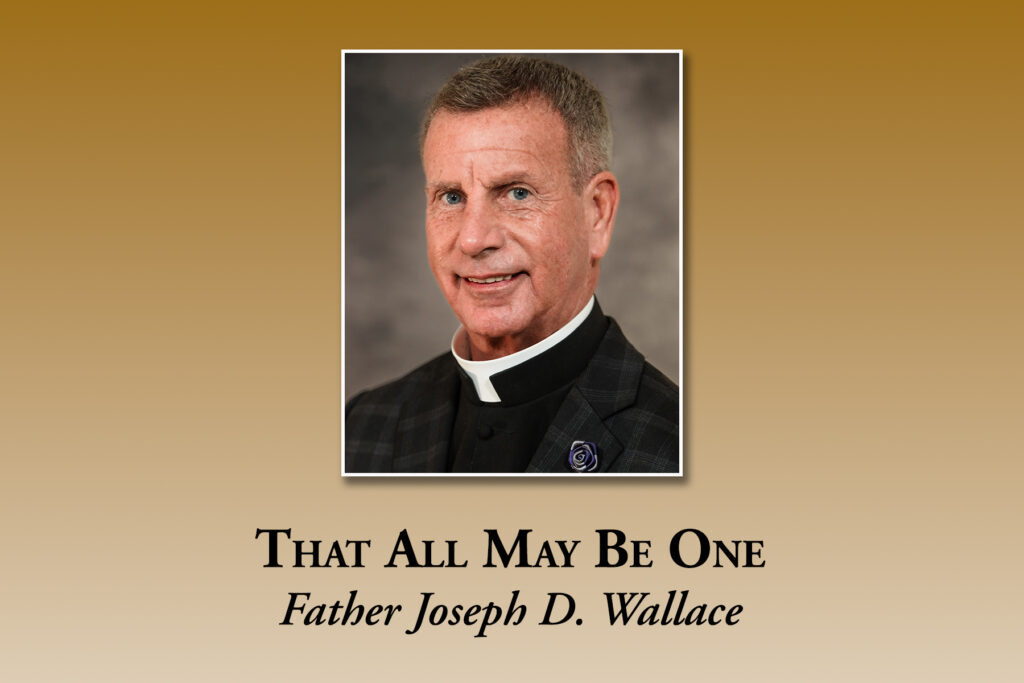
Father Joseph D. Wallace is diocesan director of Ecumenical and Inter-religious Affairs and pastor of Christ the Redeemer Parish, Atco.





 at the bottom and then tap “Add to Home Screen”
