




GLASSBORO – Rowan University hosted a lecture Jan. 22 by Dr. Stephen Barr, theoretical physicist, author of “Modern Physics and Ancient Faith,” and president of the Society of Catholic Scientists.
Sponsored by Rowan Catholic Campus Ministry, the presentation, titled “Science and Religion: The Myth of Conflict,” drew dozens of students to the university’s Student Center Ballroom eager to explore the relationship between faith and science.
For many, the lecture was not just an academic exercise but an opportunity for deeper self-reflection. The students’ meditations on his ideas illuminated the personal and intellectual challenges of reconciling faith and scientific study.
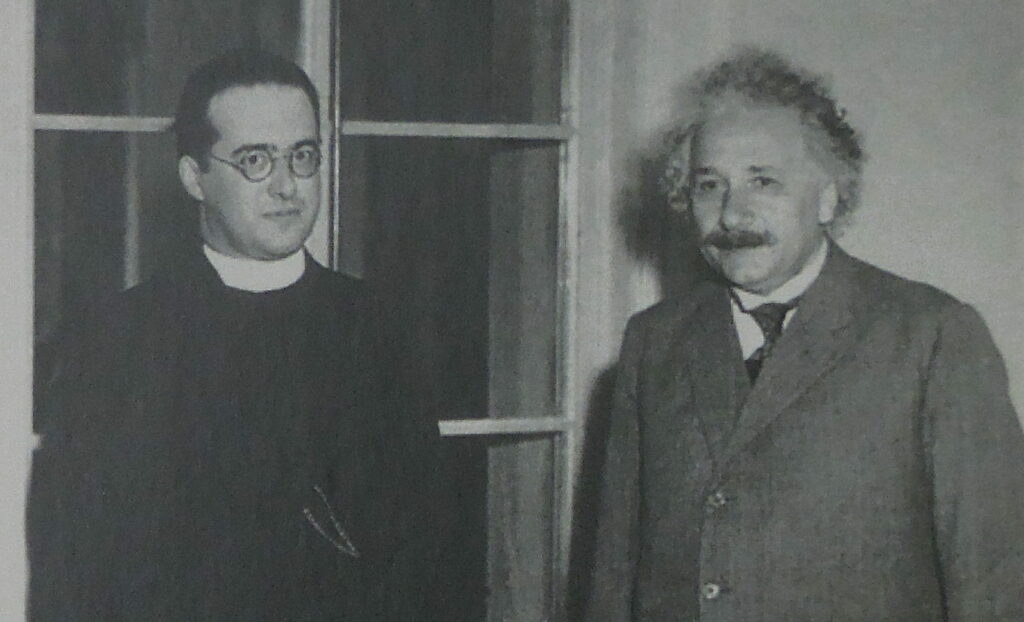
In his talk, Dr. Barr refuted the notion of a conflict between faith and science, emphasizing their complementary nature. He offered examples of the significant contributions of Catholic scientists to major discoveries. He further challenged the idea that science debunks Christianity, proposing that modern scientific discoveries align with Christian belief and suggest the existence of God.
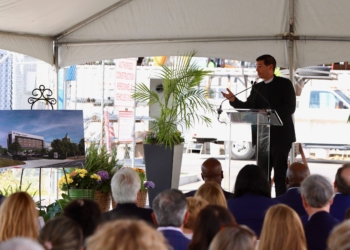
Photo Gallery: Dr. Steven Barr Lecture
“Many of the same things that make me a Catholic Christian make me a scientist – a sense of wonder, a desire to know the reason behind things, and a deep conviction that everything holds together in some coherent way,” Dr. Barr said.
This sentiment resonated deeply with the students in attendance, many of whom said they found the lecture affirming and thought-provoking. After the talk, students returned to the ministry’s Newman House, where discussions continued.
“True science reveals the beauty and details of God’s creation,” said Peter Gawason, a senior biophysics student.
Gawason, who grew up attending Catholic schools, said he has always been fascinated by the intersection of faith and science. A deeply devout student, he even blesses his exam papers, writing “Jesus, Mary, and Joseph” before handing them in.
He recounted how his organic chemistry professor, an agnostic, once expressed belief in a higher power due to the intricacy of life. “I found that the more I’ve learned,” he said, “the more I’ve actually grown in my faith – the more I believe that everything I’ve learned only makes sense if there is some author behind it.”
As such, Gawason said he was particularly struck by Dr. Barr’s discussion of free will. “As Catholics, we believe that God has plans for us. But we also have free will. It’s a little bit difficult to grasp. Are we able to deviate from God’s plans at all, or do his plans for us always come to be?”
Gawason said he’s interested in exploring these questions further and plans to research what the saints have to say on the subjects.
Sierra Finn, a junior studying biomedical engineering, described herself as having a “logical, problem-solving, managerial mindset.” She recalled struggling as a child to reconcile scientific concepts like the Big Bang Theory and evolution with her faith.
“I remember thinking, ‘If God created man, how did man evolve from monkeys?’ That was tricky because I was so interested in learning about it,” she said. “That’s something I still feel a little lost on, but it doesn’t change my faith – it just makes me think a little harder.”
For Finn, science is a way to observe God’s creation. “It’s so easy to see science as a separate study from God, but we need to look at science as the most intricate way of observing the world that God made.”
While many might believe that scientific advancement undermines Catholic belief, others, including Resty Mercado, a senior biomedical engineering student, found the opposite to be true.
As a lifelong Catholic, Resty has had moments of doubt when confronted by scientific knowledge. But the deeper he dives into advanced science, the more he marvels at its complexity. “I’ve gotten to advanced classes, and it’s kicking my butt, but within that storm, I’m like, ‘How could there not be a God?’”
Resty said he appreciated learning about Christian scientists who made significant discoveries in geology, astronomy and physics. He found comfort in knowing many saw evidence of God in their work. “It eases my heart that others in the faithful scientific community came to the same conclusion as me.”



 at the bottom and then tap “Add to Home Screen”
