





My wife, Valeria, and I welcomed our first child on the day I am writing this, a girl we named Fiorella Montserrat Canaris.
Fiorella means “little flower” in Italian, and so of course brings to mind Saint Thérèse of Lisieux (and the masculine version used by the former mayor of New York, Fiorello LaGuardia). While that choice may not be very familiar to English-speakers, her middle name is in many cases totally unknown.
Our Lady of Montserrat – or in the local dialect, Mare de Déu de Montserrat – is the Marian shrine in the Catalonia region of Spain that can best be translated as “serrated mountain.” It is, in some ways, reflective of the popular devotions to the Virgin that exist elsewhere: local venerations in places like Guadalupe, Lourdes, Luján, Fatima or Mount Carmel.
In addition to it being the name of the ship that brought my great-grandfather from Italy to the United States – and as someone who studies theologies of immigration married to a migrant that spoke profoundly to me – more important to us was honoring my wife’s Spanish heritage and my commitment to Ignatian spirituality and education. The shrine at Montserrat was where the Spaniard Iñigo spent a night in prayerful vigil before leaving his soldier’s trappings at the statue’s feet to found the Jesuits as Ignatius of Loyola. The sculpted fountain outside my undergraduate dormitory at the University of Scranton depicted Ignatius on his knees presenting his sword, and metaphorically his life, to Our Lady in this moment. Since Ignatius and Xavier were not live options for us to use, the choice of the name drew together in a unique way many of our shared life experiences from Mallorca to Rome to Scranton to Loyola University Chicago.
The shrine at Montserrat has been a place of worship since ancient times, due mostly to the stunning terrain surrounded by natural jagged mountain peaks.
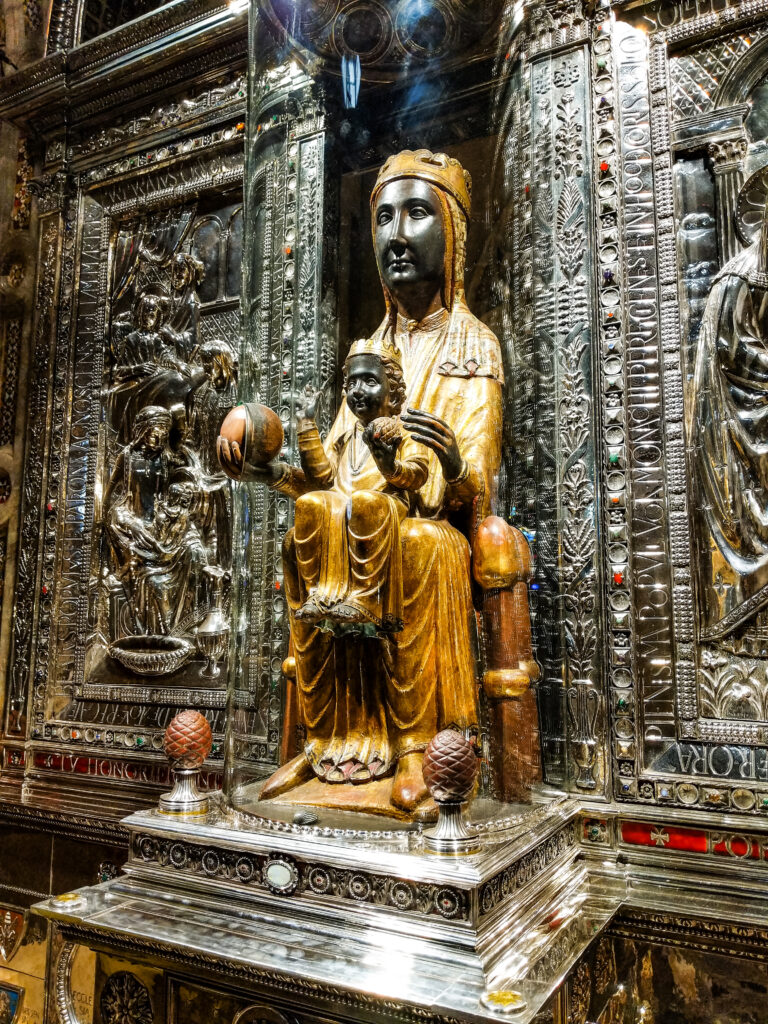
The Virgen de Montserrat is affectionately known as La Moreneta, “the little dark-skinned one,” since the timeworn carved statue has darkened with age due either to prolonged exposure to the soot from centuries of candles lit around her or other unknown chemical reactions. In 1881, Pope Leo XIII validated the centuries of popular piety celebrated by countless local generations, naming Our Lady of Montserrat the patroness of the Catalan region, which has close linguistic and cultural ties to both Barcelona and Valeria’s home on the island of Mallorca.
The image depicts Mary as the sedes sapientia, the “Seat of Wisdom,” holding the Christ child on her lap. It’s a rather Byzantine depiction, with the figures facing squarely forward, an orb representing Mary’s queenship over the cosmos in her hand. The young Jesus offers the world a benediction with his right hand and holds a pine cone in his left, symbolizing fertility and eternal life (since the trees that produce them are “ever-green”). She is surrounded in the shrine by Venetian mosaics and ornate silver lanterns.
The most famous hymn to her sung at noon each day, “El Virolai,” refers to Mary under this title as the Rosa d’Abril, the “Rose of April,” since her feast day is April 27. I close with an English translation of that poem chanted by countless pilgrims to Our Lady of Montserrat. And as it says in the song, for my new family “with her name, our story begins”:
“Rose of April, La Morena in the highlands,
You are the star atop Montserrat
Cast your light upon the Catalan land,
Guide us to Heaven.
With a gold saw, the little angels cut
Those hills, so as to build you a palace.
Queen of Heaven, taken to earth by the Seraphim,
Give us shelter under your blue veil.
Rising dawn crowned with stars,
City of God dreamed by King David,
The moon lies at your feet
While the sun dresses you with its rays.
You shall always be the Princess of all Catalan people,
And for the Spaniard you shall be the Star of the Epiphany;
Be, for the virtuous, a support in fortitude
And, for the sinners, a haven of salvation.
Give comfort to those who long for their homeland,
Unable to see the mountains of Montserrat;
Across both land and sea, listen to those who clamor to you,
Guide back to God those hearts that have abandoned His flock.
Mystical Fountain that gives the water of life,
Flow down from Heaven into the heart of my country;
Let your gifts and graces blossom in it;
Make of it, I beg you, your Paradise!
Blessed, oh Mary, are those eyes that look upon you!
Blessed is the heart that opens to your light!
Rosebush of Heaven, surrounded by the Seraphim,
Bless my prayer with your perfume.
Gentle Cedar, Crown of Lebanon,
Incense-Tree, Palm of Zion,
The Sacred Fruit given by your love
Is Jesus Christ, the Saviour of the world.
With your name, our story begins
And Montserrat is our Sinai:
Let all partake in the magnificent glory
Of those crags covered in rosemary!”
Amen, por los siglos de los siglos, Amen.
Originally from Collingswood, Michael M. Canaris, Ph.D., teaches at Loyola University, Chicago.



 at the bottom and then tap “Add to Home Screen”
