



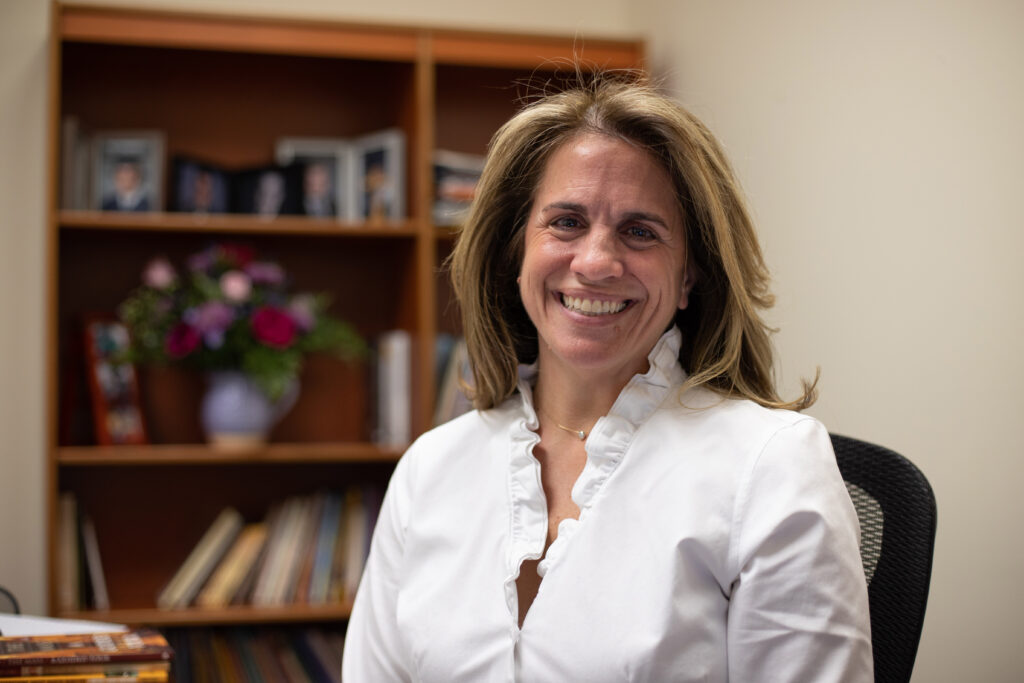
When it comes to religious education, Dr. Lee DelleMonache believes building communities and forming relationships are key to faith formation.
“I look at faith development the same way I look at spiritual development – it’s based on three important relationships: with self, with others and with the Lord,” said DelleMonache, the new director of religious education for the Diocese of Camden. “Any relationship, for it to be healthy and to grow, needs to be fed. It can’t be stagnant. That’s why it’s important to surround yourself with people who are healthy contributors to your world. Participate in activities and experiences that contribute in a positive way. And give yourself time to take whatever new knowledge comes in and reflect.”
Reflection, she adds, is a critical component to any learning process, as it results in retainability. “So give yourself the gift of five minutes of silence.”
DelleMonache – who with her husband, David, is a longtime parishioner at Mantua’s Church of the Incarnation – took on her new role in March, bringing with her nearly 30 years’ experience working with educational and service organizations.
“When people hear ‘religious education,’ people automatically think CCD,” she said. “But it’s more than that. Yes, sacramental preparation is crucial. We need to understand these signs of God present in our lives; we need to understand why Communion is important. What is the relevance of Confirmation, Penance?
“What’s also important is embracing formation as a lifelong process,” DelleMonache continued. “To truly embrace your faith, you have to constantly be learning. Too often we go to church thinking, ‘Oh I know the story of the loaves and the fishes. Oh, I know the story of the Wedding at Cana,’ and then we tune out. But if you are intentional about listening every time, you are going to learn something new. [Faith formation] is a never-ending well that we must keep filling. That’s why we need to think of different ways to supply that water.”
To that end, DelleMonache says she is looking forward to listening to and speaking with the parishes and schools in the Diocese in hopes of accompanying them in fostering communities of faith. As a mother to two sons – A.J. and Steve – who graduated from Saint Margaret Regional School in Woodbury, where she served as a parent volunteer and board member, DelleMonache knows the importance of recognizing each organization’s individuality.
“Our religious education leaders are a treasure trove of talent, passion and wonderful ideas,” she said. “The lessons of our faith are the lessons of our faith – they are not changing. But we need to be open to the fact that there may be different ways to deliver those lessons in a way that makes sense for our world today, and I look forward to discussing those ideas with parishes and schools.”
Such is a mission in which DelleMonache has experience. In her 16 years with the Neumann University Institute for Sport, Spirituality and Character Development – seven of which were as director – she helped pioneer a nationally and internationally recognized lay team chaplaincy program. Serving as a chaplain for the women’s basketball team and men’s lacrosse team at the Aston, Pa., school reinforced her belief on the importance of relationship building.
“We worked with coaches who embraced the mentality of relationships, how team bonding was important … and trying to understand how the values of the university came alive in their individual sports,” she said. “We noticed that the students who thrived were ones who were part of a community, had a relationship with someone who believed in them [and accepted that support], and had a belief system to make sense of the world.”
Teams are a ready-made community for such observations, she admits, but the personal connections and core values of the faith are the underlining similarities in parishes and schools, too.
“I have great passion for Catholic Identity, and I believe no other organization has been more misunderstood than the Catholic Church,” she said. “So if I can do anything to make clear to others the foundation for what we believe and why we believe it – I would love to contribute to that.”




 at the bottom and then tap “Add to Home Screen”
