








Editor’s Note: The Catholic Star Herald is asking known book lovers around the Diocese to recommend their favorite reads and explain what makes these not-to-miss tales. This is third in an occasional series.
For Carl Peters, the path from college to the rest of his life involved a lousy job, a peaceful park and three future-altering books.
Moving back in with his parents in Westmont after graduating from Virginia’s Lynchburg College in 1977, “I worked at a bank, and I hated it.”
After each draining workday, he would “decompress” at Cooper River Park and crack open a book.
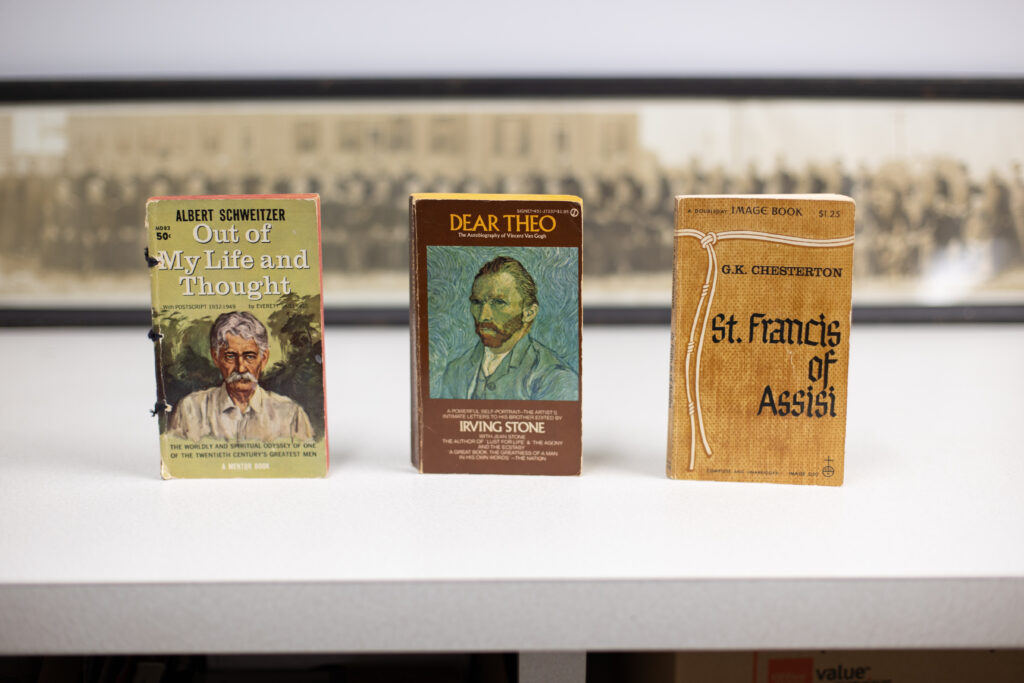
It was by these placid waters that he immersed himself in three books that have influenced the rest of his life: G.K. Chesterton’s “Saint Francis of Assisi,” Albert Schweitzer’s “Out of My Life and Thought: An Autobiography,” and “Dear Theo: The Autobiography of Vincent Van Gogh,” a collection of letters the famed artist wrote to his younger brother.
“Three lives, told three different ways,” explains Peters, former managing editor of the Catholic Star Herald.
Chesterton’s biography revealed that for Saint Francis of Assisi, there “was a long period of not understanding God’s will, and confusion.” Eventually finding joy and simplicity in “becoming one of the poor,” the 13th century Italian became founder of the Franciscan order, a lover of the Eucharist and patron of animals.
Albert Schweitzer – physician, philosopher, music scholar, writer and peace activist – “devoted his life to helping people through his intellect and compassion. Schweitzer sought to, as he said, ‘Make my life, my argument,’” Peters says.
In contrast, where the Saint Francis and Schweitzer books were intended to be read by the masses, Van Gogh’s was not. His private notes to his brother were only made public after the artist’s death.
Typically, books on Van Gogh’s life paint him as a brilliant, yet impoverished, artist whose desire for success tragically arrived only after his death. However, the collection of letters reveals Van Gogh, in his own words, as an “intelligent, passionate, kind, insufferable, impatient, sometimes ill-tempered” individual with a “tremendous longing for a spiritual and human connection,” Peters says. Van Gogh is “always a reminder to me that a person who is difficult can have a good heart; a person who can’t find their way to church can be very spiritual; and that there are people who cannot be self-sufficient, and yet still make it a better world.”
Three stories, one message
For Peters, in each of these reads, the subject “is trying to decide how to find a meaningful life; these books are very good at showing that it isn’t easy.”
At that time of his life, reading about others who both succeeded and failed as they navigated their lives was relatable to Peters. “Here I am, I have this college degree, but no idea what I want to do in my life.”
Though examining the lives of these remarkable people was not necessarily a cure-all for his post-college anxiety, “It was nice for me to be re-affirmed that what you do for a living is important, but not everything.” What he has learned over time is that “how you live, and your relationship to God, others and nature” is what can bring the calm.
As the months after college progressed, Peters brought his life into focus, and a year later he quit his job at the bank to enroll at the University of Louisville, Kentucky, where he earned a master’s degree in English. That decision led to a teaching position at Saint Jude Regional School, Blackwood, for several years, and then a 30-plus-year career at the Catholic Star Herald newspaper, where he could use his love of the faith and the written word.
Now retired, Peters looks back fondly on that year in the park, where he encountered Saint Francis, Schweitzer and Van Gogh – three signposts pointing the way to the good life. “The immersion [into their stories], and seeing the world through their eyes was challenging, yet freeing,” he says.
Other book recommendations by Peters:
• “Founding Brothers” by Joseph Ellis
• “The Death of Ivan Ilyich” by Leo Tolstoy







 at the bottom and then tap “Add to Home Screen”
