




“Racism is an evil which endures in our society and in our Church. Despite apparent advances and even significant changes in the last two decades, the reality of racism remains. In large part it is only external appearances which have changed.”
Brothers and Sisters to Us, U.S. Catholic Bishops Pastoral Letter on Racism, 1979.
“Despite the bold words of Brothers and Sisters to Us, we must conclude that racial justice is not now, and never has been, a passionate matter for most American Catholics. Indeed, the U.S. Bishops’ Committee on Black Catholics noted how Brothers and Sisters to Us aroused a “pathetic, anemic response” from most Catholics. The pastoral on racism has had little impact upon the consciousness and behavior of the vast majority of American Catholics.”
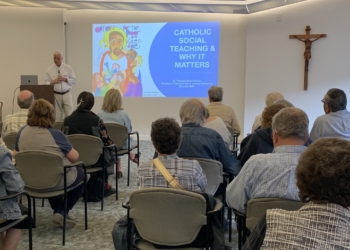
Father Bryan Massingale of Marquette University spoke these unsettling words during his keynote address before more than 330 people at the 10th Annual Romero Lecture Series on Friday, March 26, at Rutgers University, Camden. The evening keynote was preceded by a film and discussion at noon, followed by three workshops and a panel discussion, focusing on the theme of the day: “The Hidden Faces of Racism: Excluding the Other – in our Church, in our Society, and in Ourselves.”
Dennis Fisher, of Catholic Relief Services, said that he “really liked the session about Arab/Muslim perceptions and, of course, Bryan Massengale. Given the topic I think you did a good job of offering various perspectives on the issue of race.” Corlis Sellers, coordinator of the Racial Justice Commission for the Camden Diocese, commented, “The event was spiritually uplifting, intellectually challenging, dynamic, and very well organized.”
In the past, keynote speakers for the Romero Lecture Series have included peace advocate Bishop Thomas Gumbleton; death penalty foe Sister Helen Prejean; liberation theologian Father Gustavo Gutierrez; immigration advocate Dan Groody; Dr. Diana Hayes of Georgetown; Dr. Tony Campolo of Eastern University; Msgr. Bob McDermott, pastor of St. Joseph Pro-Cathedral, Camden, and founder of the Romero Center; and Jack Hogan, former director of the Peace Corps.
The Romero Lecture Series challenges us to examine the pressing issues of our times under the lens of both our biblical and Catholic teachings. With humble, open, and receptive hearts and conscience, these challenges help us to interpret ourselves, our society, and our institutions, leading us to much needed repentance, conversion, and compassion.
“Compassion,” Father Massingale stated, “gives rise to solidarity, that key virtue in Catholic social thought that leads us to recognize our responsibility for one another and how we are really given to each other’s care.”
Father Massingale echoed the profound moral perspective of Pope John Paul II, who defined solidarity as a “‘firm and persevering determination to commit oneself to the common good.’ This is our hope and communal call.”
In that light, Father Massingale reminded us of the compelling words of Pope John Paul II, during his 1999 pastoral visit to the United States. While in St. Louis, challenging Catholics to be “unconditionally pro-life.” John Paul said a great challenge facing us in the new millennium is “to put an end to every form of racism, a plague which is one of the most persistent and destructive evils of the nation.”
Romero Center Ministries thank God for the discomforting, cleansing, and hope-filled message of Father Bryan Massingale. We thank God for all those who participated in this year’s Romero Lecture Series. We share the reflection of attendee Shirley Howe of Tabernacle, N.J.: “Yesterday was a wonderful although disquieting experience. We had the opportunity to truly cross the borders between what we are used to and into others’ lives.”
For those interested, we will re-convene on May 1, at 9 a.m., at the Romero Center to further reflect on and act upon Father Massingale’s message. Call 856-964-9777, if you plan to attend.
Larry DiPaul, Office of Life and Justice, Diocese of Camden.






 at the bottom and then tap “Add to Home Screen”