



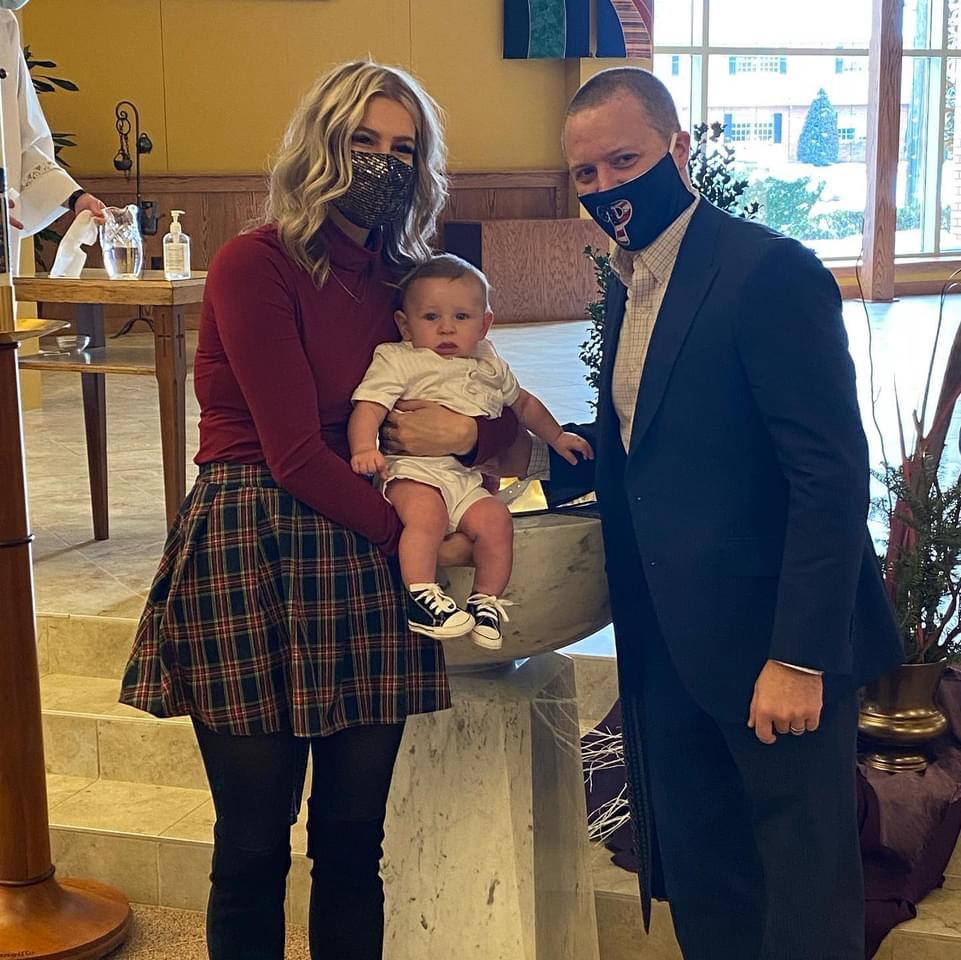
Young Reid Joseph Lipinski after his baptism last month at Christ Our Light Parish in Cherry Hill, with proud godparents Erin Lipinski and Steve Chambers.
Pope Francis has made two recent decisions that have practical pastoral consequences for many of the faithful, and speak to this week’s liturgical and journalistic theme of baptism.
In a “motu proprio” letter titled Spiritus Domini, the pope has ordered that canon law (specifically Cn. 230§1) be changed to normalize doctrinally what has been common practice in many places already: that all laypersons of suitable age and appropriate gifts be eligible to serve the ministries of acolyte and lector. What this means in simple language is that all people, whether male or female, can serve in these ministerial roles for the good of the church.
Interestingly, the Holy Father roots this vision explicitly in the sacrament of baptism, where all persons participate in the “regal priesthood,” which is for him “essentially distinct” from the sacrament of orders. Thus, this development of doctrine and practice, while welcome to many, should not be interpreted as an incremental step toward the priestly ordination of women — though this is common in many other Christian denominations.
It is in the shared and foundational experience of baptism, whether by water, blood or desire, that believers first come to embark fully and consciously in the divine mysteries, though God speaks to and wills the salvation of all, whether members of the visible church or not (cf. Tim 2:4). The Second Vatican Council’s call for “full, active, conscious participation” in the liturgy has led the church in many ways to be more inclusive in its approach to which and how the lay faithful can participate in “the public work of the church,” which is the literal meaning of liturgy.
The second set of changes are minor ones to the Italian translation of prayers used during the Mass, many of which are now closer to what we say in English already (e.g. “and to you my brothers [and sisters]” in the Confiteor, “Blessed are those who are called to the Supper of the Lamb,” etc). These are in fact official approvals of changes in translation, and not arbitrary decisions made by the pope himself. The most substantial of these involves the Lord’s Prayer.
The Our Father (Padre Nostro) in Italian will now change from saying “lead us not into temptation” (“non ci indurre in tentazione”) to instead “do not abandon us to temptation” (“non abbandonarci alla tentazione”). The Catechism (no. 2846) makes clear the difficulty in translating the ancient word at the heart of this petition into any modern language.
This is not unique. For instance, English speakers say “forgive us our trespasses” while other languages use the equivalents of offenses, debts or sins. If you are not praying the text in the original ancient language (which, by the way, is not Latin), then you are already engaged in approximating its meaning in a new system of linguistic “codes.” Even if you are using the original text, not everyone will agree on one static meaning. (For instance, “All men are created equal” implies at least some divergent opinions about the historical definitions of the terms “all” “men” and “equal”). The word sacrament itself was first an attempt by Tertullion to capture in Latin the essence of the Greek word mysterion. These translations always reveal some contours of the original’s meaning, while concealing others.
And it’s quite clear that what Christians name as God could neither lead us to sinfulness, nor be tempted to sin. So we are in fact asking God “not to allow us to take the way that leads to sin.” This is again a baptismal reality, for we who were sanctified in the waters of life are asking God to help us persevere in what we have begun to be, as Saint Cyprian puts it.
Pope Francis clarifies: “We have to exclude the possibility that God is the protagonist of the temptations that loom over mankind’s journey. As if God himself were lurking with hidden pitfalls and snares for his children. One such interpretation contrasts first and foremost with the text itself, and is far from the image of God that Jesus revealed to us. … Let us not forget: the ‘Our Father’ begins with ‘Father.’ And a father does not lay snares for his children” (General Audience, May 1, 2019).
These changes, which I understand are disconcerting for some, call us to a greater commitment and a deeper immersion into the mysteries of our baptismal faith in the God of surprises, that nameless and unfathomable Absolute Mystery to whom we unceasingly abandon ourselves in awe and self-negation. This is a process that is never at its terminal point of completion on this side of death, and perhaps continues even beyond that.
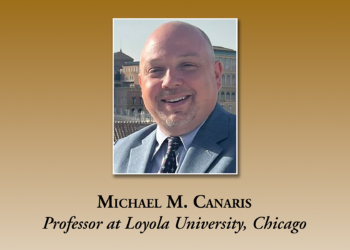
Originally from Collingswood, Michael M. Canaris, Ph.D., teaches at Loyola University, Chicago.




 at the bottom and then tap “Add to Home Screen”
