




Pope Leo XIV is set to release his first encyclical, “Magnifica Humanitas” (Magnificent Humanity), on May 25. It will undoubtedly serve as a programmatic text guiding the agenda and interpretation of the current Holy Father’s time as supreme shepherd and helmsman of the universal Church, in much the same way that “Evangelii Gaudium,” the Lampedusa visit, and his reflection on the 50th anniversary of the creation of the Synod of Bishops did for Pope Francis. We saw early on signs of Pope Francis’ priorities, and there are indications that we can expect the same from Pope Leo now.
While it will not be a document exclusively centered on artificial intelligence, it will explore the challenges and opportunities of this seismic development in some intentional way. Pope Leo himself has tied this moment in Church history with its revolutions in technology and social contexts to that of Pope Leo XIII, who 135 years ago this very month launched the Church’s engagement in modern social realities through his promulgation of the foundational Catholic Social document, “Rerum Novarum.”
In the past week, Pope Leo impaneled a new Interdicasterial Commission on Artificial Intelligence. This is Vaticanese language meaning that while its coordination takes place through the Church’s office dedicated to the Promotion of Integral Human Development, it will include delegates from a wide body of curial offices: Doctrine of the Faith, Culture and Education, Communication, and the Pontifical Academies for Life, Sciences, and Social Sciences.
The implications here are clear. First, the Church needs to address this quantitative leap in human history, what I have seen described as less like the transition from the telegram to email, and more akin to our species’ discovery of fire or development of written language – which ushered in new eras in our evolution. As with all elements of history, the Church’s mission entails not only the care of souls after death, but also full human flourishing while here in life amidst these new realities.
Second, this change and its potential consequences are so immense that it takes a diverse array of specialists to think meaningfully about it. It’s certainly not only technology that will be affected. Every element of our lives from economics, politics and intellectual formation, to relationships, medicine and the arts will undoubtedly undergo massive changes. It’s ridiculous to think that evangelization, ministry and our life of faith will elude its reach. We are still seeing what the relatively short-term impact of the pandemic was to Church membership in a digital age. By nearly every account, including Pope Leo’s, the shifts in the coming decades will be much more dramatic and far-reaching.
Third, we learn here about the clear-eyed nature of the former mathematics and physics teacher-turned-pontiff. We ought to believe him when he says: “In order to live eternally, we do not need to cheat death, but to serve life, by caring for others in this, our time together. That is the supreme law that is prior to all society’s rules and gives them their meaning.”
It is the ineradicable nature of human dignity that will frame his, and accordingly hopefully the entire Church’s, response to the “signs of our times” – which are markedly different from those of 1962-1965, when that phrase rose to prominence. Society’s response must be rooted in moral commitment, and not simply utilitarian expediency. There will need to be transnational voices making this case, and Pope Leo certainly plans to be one of them.
AI is not a “tool,” in much the same way that social media doesn’t stop affecting our political, commercial and inter-personal lives when we power down our computers. It is significantly different than when we lay aside the hammer and nails or shift our cars into park. These realities are much more akin to the water in which a fish swims, or the air that we breathe, or – dare I say with obvious and essential due differences – that in which we live and move and have our being, as the pre-Christian pagan philosophers once put it, inspiring Saint Paul. They are extensions of our very selves.
Setting these realities always in contact with the ineffable God of the living is perhaps the chief task of our day, and will almost undoubtedly be a defining dimension of the current pontificate for years to come.
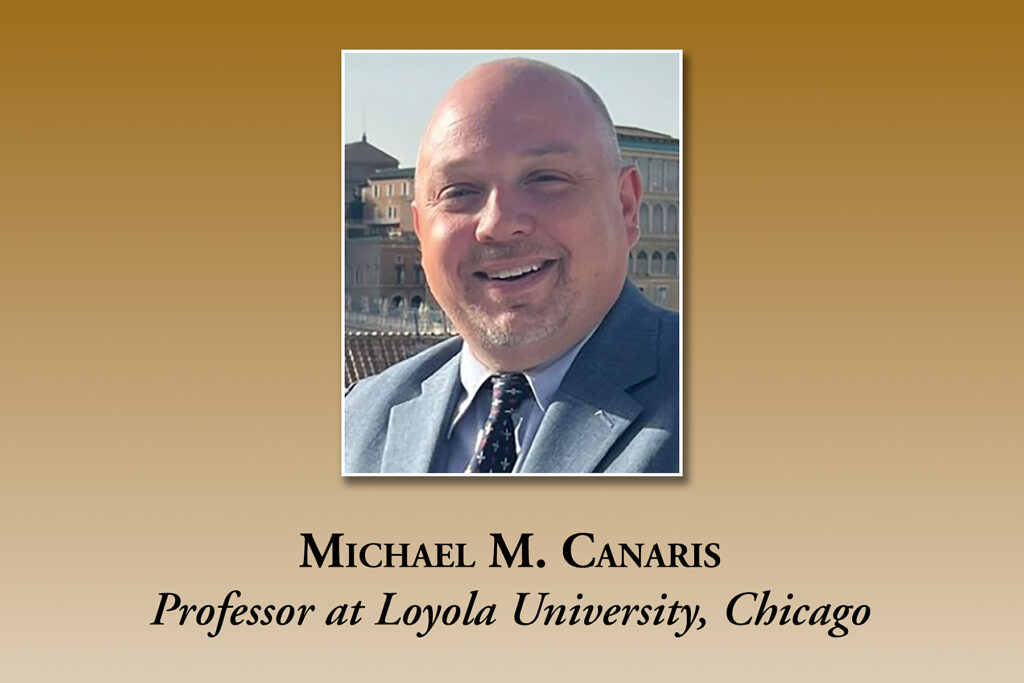
An alumnus of Camden Catholic High School, Cherry Hill, Michael M. Canaris, Ph.D., teaches at Loyola University, Chicago.



 at the bottom and then tap “Add to Home Screen”
