





Aug. 24 marks what would have been the 103rd birthday of Cardinal Avery Dulles, S.J. A few years ago, Fordham University celebrated the centenary of his birth with a number of pre-pandemic events, Masses and conferences. I was excited to participate in these various remembrances, given the fact that I was the cardinal’s last doctoral student and graduate research assistant.
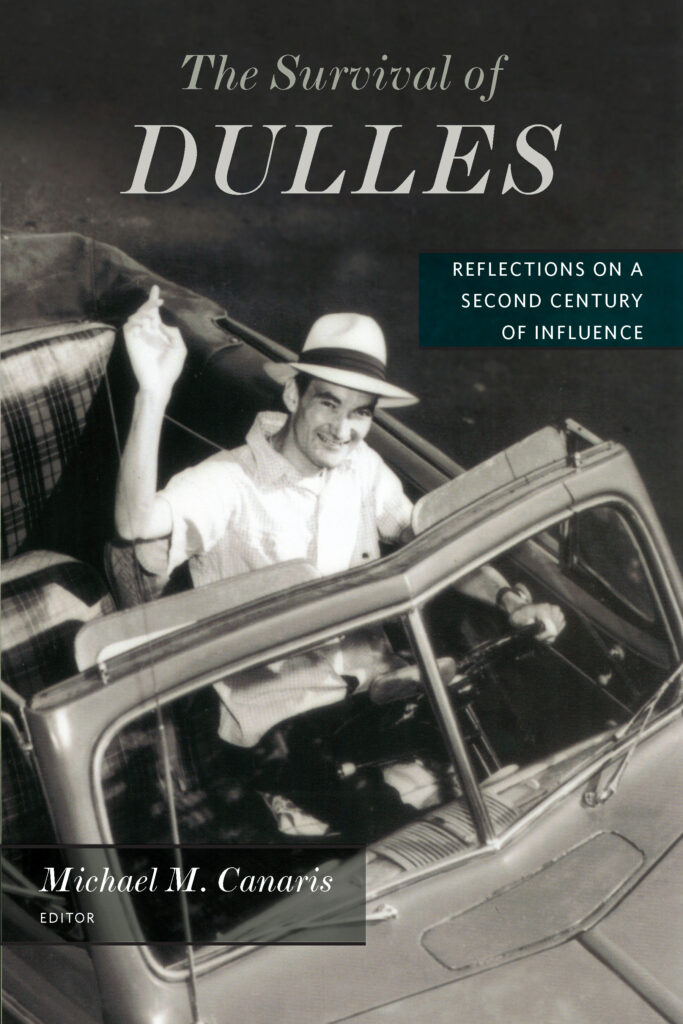
I was even more honored when Fordham President Joseph McShane, S.J., and other representatives of the Jesuit community and Theology Department there asked me to edit a volume of contributions from scholars who were former peers, colleagues and students over his long and astonishingly productive career. That labor of love has now come to fruition.
In 1982, Dulles published a groundbreaking series of essays as a book titled “The Survival of Dogma,” which is a more nuanced and engaging work than might appear at first blush. It was not a counsel simply to return to a doctrinaire institutional vision of Christianity, but a holistic approach seeking to live the Church’s teachings fully and meaningfully in the modern world. Since a number of speakers at the university events referenced this book – along with his more famous ones like “Models of the Church” and “A Testimonial to Grace” – Fordham University Press and I collectively decided to play with that concept a bit, titling the new volume “The Survival of Dulles: Reflections on a Second Century of Influence.” It is now available at FordhamPress.com and wherever online books are sold.
I was humbled to include a piece among such a prominent list of both established and emerging scholars, seeking to critically but enthusiastically carry the legacy of Dulles’ theological contributions forward to future generations. The list of authors includes Sister Anne-Marie Kirmse, O.P.; Father Patrick J. Ryan, S.J.; Father Joseph T. Lienhard, S.J.; Peter C. Phan; Sister Elizabeth A. Johnson, C.S.J.; Bishop James Massa, auxiliary bishop of the Diocese of Brooklyn; H. Ashley Hall; Terrence W. Tilley; Stephanie Ann Y. Puen; Mary Beth Yount; Katherine G. Schmidt; Father Vincent L. Strand, S.J., and Father Michael C. McCarthy, S.J. I am grateful that Charles E. Curran and Nicholas Rademacher offered positive pre-publication reviews for the book’s cover and marketing purposes.
My chapter deals with the twilight of the cardinal’s life, when he underwent the devastating effects of post-polio syndrome in a Via Crucis that mirrored in many ways the much more public suffering of Pope Saint John Paul II, from whom Dulles received the red hat in 2001, along with two other Jesuits: the former director of Vatican Radio and a largely unknown Argentine archbishop named Jorge Bergoglio.
All of the thinkers involved in this book continue in various ways to be indebted to His Eminence’s (or, in many cases, their longtime friend “Avery’s”) theological vision and encyclopedic fluency in the ecclesiological developments of the post-conciliar Church, even if they sometimes challenged certain iterations of his viewpoints or interpretations, as is part and parcel of the ecclesial and academic vocation of a theologian.
Though focused more on Catholic and ecumenical affairs than inter-religious ones, the volume is intentionally outward-facing and strives to make clear the diverse and pluralistic contours of the cardinal’s nearly unrivaled impact on the North American Church, which truly crossed ideological, denominational and generational boundaries. While critically recognizing the limits and lacunae of his historical moment, it serves as one among a multitude of testaments to the notion that the ripples of Avery Dulles’ influence continue to widen toward intellectually distant shores.
Originally from Collingswood, Michael M. Canaris, Ph.D., teaches at Loyola University, Chicago.




 at the bottom and then tap “Add to Home Screen”
