




In the past few weeks as I observed my golden anniversary of ordination to the priesthood, May 29, 1971 – May 29, 2021, a number of people have asked me about these 50 years. The truth of the Latin phrase Tempus Fugit (Time Flies) is my experience. In response to these inquiries, I decided to write a reflection on the past 50 years of my priesthood. It will appear in THE CATHOLIC STAR HERALD in a few installments.
This is the sixth.

In 1995, 45,000 pounds of ornate vaulted ceiling composed of thick 19th century plaster collapsed into the main body and sanctuary of Saint Teresa Church on the Lower East Side. It penetrated through into the lower church. Both the upper and lower churches were off limits to the public.
A team of engineers inspected the integrity of the stone structure of the 1842 building and concluded that while the building was sound, decades of delayed maintenance on the roof and interior of the upper church, as well as deterioration from water damage, ultimately led to the roof collapse. The parishioners from the time of World War I on were poor people of limited means, and parish income was not directed at maintenance projects.
In a very large room on the first floor of the rectory we prepared a daily Mass chapel that could accommodate about 50 people. What to do for Sunday Masses? I knew that Educational Alliance – a neighborhood social service agency two blocks up from the church – had a beautiful theater. I made an appointment and met with the director of the agency, with whom I had a relationship from various neighborhood projects on which we collaborated together. “Could we use the theater for three Sunday morning Masses? How much would it cost?”
Marian Lazar, the director of Edgies, as it is known in the neighborhood, looked across her desk at me and said, “Father, your people are my people.” She quoted her Bible, the Jewish Bible, which we call the Old Testament. Many of our parishioners, adults and children, were enrolled in programs at the Alliance. That agency was founded by wealthy uptown Jews to care for poor downtown Jews, but it served all in the neighborhood. About cost, Marian lifted her eyebrows and said, “You have money?” The parish used that theater for Sunday Masses from mid-August until Ash Wednesday the following year at NO cost. Cardinal O’Connor would delightfully publicly say, “A Jewish lady saved a Catholic parish.”
A series of meetings with archdiocesan officials took place to determine the future of the old church building. It was decided that money would be loaned to the parish to clear out the plaster and to fortify the ceiling in the lower church. The upper church would be closed, and the sacramental life of the parish would be conducted in the lower church. My pastoral goal during the crisis was to keep the parishioners together and to make the best of our situation. A large ramp was constructed to provide easy access into the lower church for bringing down coffins for funerals and for our seniors. Weddings were held in a nearby parish. The lower church was painted and decorated with religious art and statues of saints that were not destroyed in the collapse. The sacramental life of the parish continued in the lower church, and all the other parochial activities went on as usual.
I invited the Cabrini Sisters to minister in the parish and live in the parish convent. I met the provincial at the dedication of street signage in the neighborhood to Saint Frances Xavier Cabrini and asked her if Mother Cabrini’s daughters would consider returning to where their foundress began her labors among Italian immigrants in the United States. Four sisters came and in one of our parish buildings opened Cabrini Immigrant Services –an organization faithful to the charism of their holy foundress to care for immigrants. To this day, that organization continues its multi-faceted work on behalf of immigrants and the poor. The sisters were a visible presence in the parish and neighborhood and involved in many parish programs.
The archdiocese began to study the need for 21 parishes on the east side of Manhattan below 14th Street. Most of those parishes had their roots in the different Catholic ethnic groups that immigrated to New York City in the 19th century. Each parish formed a committee to evaluate the need for the parish. Lots of emotion accompanied those discussions. Within blocks of Saint Teresa’s were four other parishes, and we had a church building with issues.
Saint Teresa was unique in its pastoral ministry to Chinese immigrants, which began in the 70s as the traditional boundaries of New York’s Chinatown expanded. In the early 90s, many Chinese immigrants arrived from the Fujian province, which had a larger concentration of Catholics than other areas of mainland China. The Fujianese speak their own language but also Mandarin, the national language. Their growing presence in the parish necessitated a bilingual Chinese Mass on Sundays – Cantonese and Mandarin.
Another unique aspect of Saint Teresa’s was the age of the building and its connection to New York City history due to its location in Lower Manhattan. The Rutgers family built the original 1798 Presbyterian church on their farmland. The New York City Landmark Commission became involved as did the New York City Historical Commission. After a few years of discussions and evaluations, the decision was reached that the parish was to remain and that the church building had to be restored for use. The monies to do this would come from the sale of valuable properties the parish owned. I insisted that our parishioners, the majority of whom were poor, had to participate in the fundraising campaign. Cardinal O’Connor permitted me to sell the property, which was contrary to archdiocesan policy. All of a sudden, we had money!
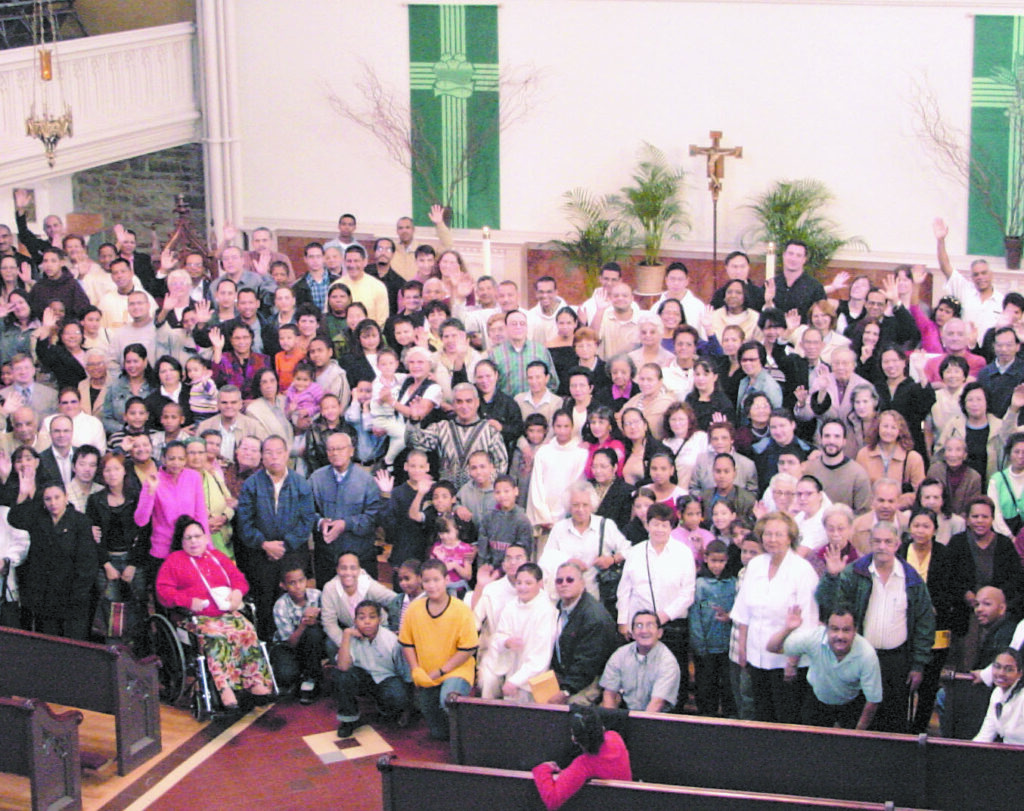
Plans were executed for the renewal of the interiors of both the upper and lower churches, a new roof and pointing of the stone building. All massive projects took a few years to accomplish. As this was finally nearing completion, 9/11 happened and the project came to a standstill. Trucks were not allowed into Lower Manhattan. Finally, in December 2001, His Eminence Edward Cardinal Egan came to the parish for the consecration of the new marble altar, ambo, baptism font and Blessed Sacrament chapel, all created from the rescued marble of the old sanctuary. That evening was one of tremendous joy. Huge crowds filled the church and the streets around the parish. A traditional Chinese lion dance led His Eminence into the restored church, and the Mass continued using the four languages of the parish: Cantonese, Mandarin, Spanish and English.
Not only was the restoration project very time-consuming, it also required constant shifting of parish programs and limited use of the lower church for sacramental celebrations. The necessary parish studies of the Lower East Side that the archdiocese had undertaken also required lots of attention. No one wants to see their parish church eliminated. I learned so much about the love of people for their parish, but also, I learned about the needs of the archdiocese.
The huge mural that extends over the entire sanctuary was painstakingly restored. It is a copy of the Crucifixion, painted by Constantino Brumidi; the original is found in the sanctuary of the Church of Saint Stephen, Manhattan. It is a stunning work. Brumidi, an Italian artist, painted the famous and stunning murals in the U.S. Capitol in Washington D.C., including the Apotheosis of Washington. The Crucifixion mural is loaded with color and expands across the entire sanctuary. Its colors dominate the church, which was painted colonial white.
Two large murals are at each side of the Crucifixion. A mural of Saint Patrick, on the left side of the sanctuary, is dated to the 19th century, when Irish immigrants were coming into the Lower East Side. It is one of the only depictions of the national apostle of Ireland converting an Irish chieftain and his tribe. The stunning mural of Saint Teresa of Ávila, on the right side of the sanctuary, addressing her nuns during an inspirational instruction was a gift from the Ursuline Sisters when they left the parish to open the College of New Rochelle. The details of the mural restorations took months. The goal of the restoration in which liturgical consultants were involved was to restore the interior of the building to its Presbyterian simplicity and blend in the Catholic elements using whatever was salvageable from the collapse of the ceiling.
As all of this was going on, I knew it was time for me to move on. I had been there 21 years with the permission of my bishops! Because the parish kept changing and the issues with the church building need to be resolved, I was allowed to remain. The population of the parish had changed radically from the time of my initial appointment. Not only was it quickly becoming very Asian, but also “hot expensive real estate” attracting those who could afford to live on the Lower East Side. I spoke with my bishop, Cardinal Egan, and asked permission for a sabbatical. I wanted to go to China and get serious about language study and participate for a year in a program sponsored by Maryknoll in order to understand the culture and the evangelization of the Chinese.
In the last eight years of my time at the parish, I became involved in issues in Chinatown such as, labor, immigration, education and housing, and I began classes in Mandarin. The cardinal listened to me with fatherly care and said he had a request. He asked me to go to one of the wealthiest counties in the archdiocese. I was shocked by his choice. He said, “If you do not like it; come back and see me; next year you can go to China.”
I was disappointed, but out of obedience to my bishop, I accepted his decision. Leaving Saint Teresa was heart-wrenching. How do you leave those whom you love?
With great trepidation, I went to the parish of Saints John and Paul, Larchmont, Westchester County. My fear was the parishioners would be uncomfortable with me, a city priest for 32 years. Or, they would be put off by my preaching. None of which happened. Yes, I found it challenging but also renewing and exciting. I loved it, and I loved the parishioners. Very educated, very wealthy, with high-power jobs. It was a completely new experience for me. I was able to introduce them to the poor world of my former parish, to which they responded with incredible generosity and interest to learn about immigration and the response of the Church. I preached the Social Gospel of the Church whenever the Sunday readings lent to that theme. There was some pushback, but always respectfully done. A newly ordained, bright, young and energetic priest was assigned to assist me. All was going well with plans for the future of the parish.
I was there for a little more than two years when I received a call from the apostolic nuncio in Washington, who told me that the Holy Father Pope John Paul II had appointed me an auxiliary bishop of New York. I said to the nuncio, “I think you have the wrong Sullivan.”
On Sept. 21, 2004, the Solemnity of Saint Matthew the Evangelist, I was ordained a bishop. Caravaggio’s masterpiece, The Call of Saint Matthew, has inspired me to ask, “Why me, Lord?”
(To be continued.)
Past installments of Bishop Sullivan’s reflections:
Building bridges in South Manhattan
Short assignment leads to valuable lessons in ministry
The true Church is one of many races



 at the bottom and then tap “Add to Home Screen”
