



During my most recent visit to the Church of the Holy Sepulchre in Jerusalem, the pilgrims and I arrived just as the morning doors opened. The scent of incense lingered in the air, the stones were worn smoothly by centuries of prayer, and the silence was almost heavy. Yet this was not the silence of a tomb. It was the silence of expectation. Something had happened here – and, in a profound way, it was still happening. That is the mystery the Church celebrates at Pentecost.
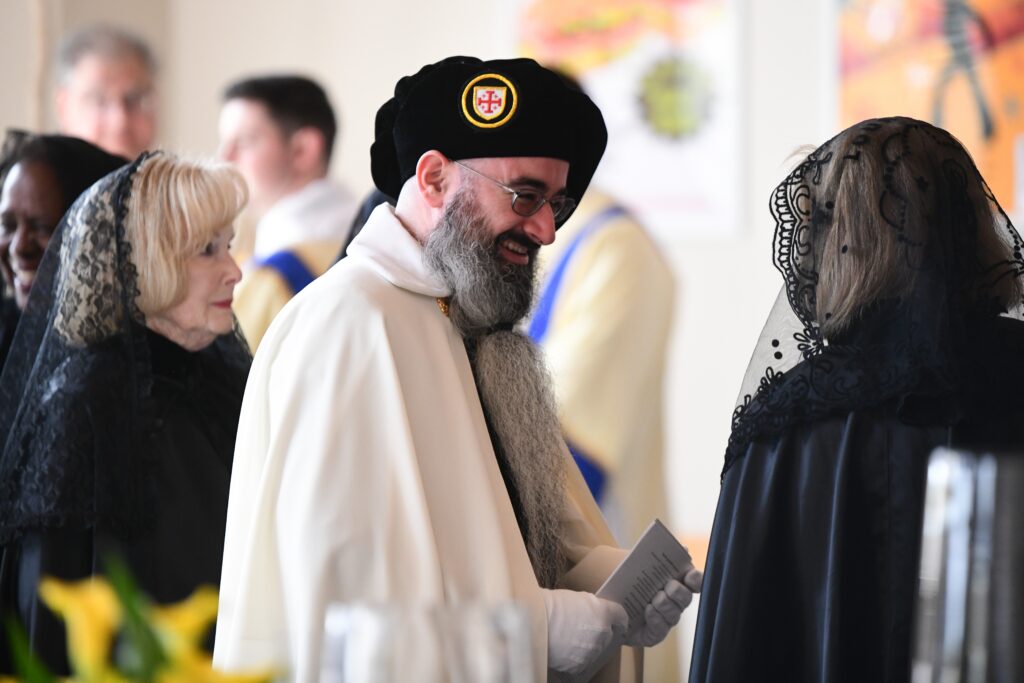
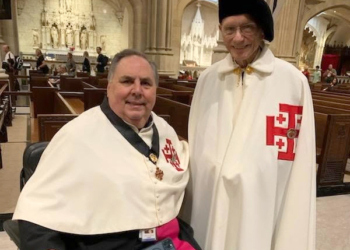
That same sense of expectation surfaced closer to home only a few weeks ago, following the celebration of the recent Chrism Mass in our Diocese. After the final hymn and procession – as priests, deacons, bishops and liturgical ministers greeted parishioners – a woman approached me and said, quite sincerely, “Monsignor, may I ask you a question? My husband and I saw a group of people dressed in long black-and-white capes, wearing black veils and berets. They were sitting together, they processed in and out of the church together, and we were wondering: Who are they? What do they do? Why are they here?”
It was a simple question, but an important one. The people she noticed were members of the Equestrian Order of the Holy Sepulchre of Jerusalem – Knights and Dames of the Church – whose visible presence so often prompts curiosity at diocesan liturgies. Their distinctive capes, berets and mantillas (veils) are not meant to draw attention to themselves, yet they inevitably do.
That moment after the Chrism Mass provided its own quiet Pentecost: an opportunity to explain not only who these men and women are, but why their mission matters to the whole Church.
For Knights and Dames of the Holy Sepulchre, Pentecost is not simply a feast marking the close of the Easter season. It is the fulfillment of everything that began on Calvary and burst forth from the Empty Tomb. When Jesus took His final breath on the Cross, He surrendered His Spirit to the Father. On Pentecost, that same Spirit is poured out upon the Church, returning life, courage and purpose to Christ’s followers – and sending them forth into the world.
Pentecost teaches us that the Cross and Resurrection were never meant to remain events trapped in the past. Through the Holy Spirit, Christ’s saving work becomes present, active and life-giving in every age. The Spirit makes reconciliation possible – not only between heaven and earth, but within our own divided hearts, our families and our communities. This is the heart of the Christian vocation, and in a particular way, the vocation embraced by the Knights and Dames of the Holy Sepulchre.
The Order is often associated with a place – the Church of the Holy Sepulcher in Jerusalem – but its mission is far more than guarding a sacred site. The Holy Sepulchre is not a monument to death; it is the birthplace of new life. What happened in Jerusalem is entrusted to the Church and carried to the ends of the earth by the power of the Spirit. The Knights and Dames are charged with keeping that mystery alive through prayerful witness and concrete service.
Their service is directed especially toward the Church of Jerusalem and the Christian communities of the Holy Land, many of whom struggle to survive amid political instability, economic hardship and emigration. Supporting peace, charity, education and coexistence is not merely a philanthropic effort; it is cooperation with the work of the Holy Spirit, who alone can turn sacrifice into communion and charity into hope.
Very often, this work does not attract attention – much like the quiet transformation of Pentecost itself. It begins with prayer offered faithfully, charity given generously and perseverance shown when progress appears slow. These small acts, entrusted to the Spirit, gradually shape hearts and open paths that only God can see.
This is why Knights and Dames process together at diocesan liturgies, wearing attire that reflects both solemn commitment and ecclesial unity. Their visible presence is not a matter of honor or prestige; it is a public reminder of responsibility. They stand with the bishop and clergy as a sign of fidelity to the Church and solidarity with Christians in the land of Christ’s life, Death and Resurrection.
Yet there is also a deeply personal challenge here. Pentecost calls every Knight and Dame – and indeed every baptized Christian – to ongoing conversion. The Spirit invites us to live reconciliation daily: in our speech, our decisions and our willingness to forgive. To sentire cum Ecclesia – to think and live with the Church – is to allow the Spirit to shape our hearts after the heart of the Risen Christ.
So when the fragrance of incense mingles with the sight of black and white capes at a diocesan celebration, it is worth remembering what they signify. They point not to themselves, but to the Empty Tomb. And if the Spirit truly lives within us, then the quiet fragrance of that Empty Tomb should follow us wherever we go – into our parishes, our families and our world.
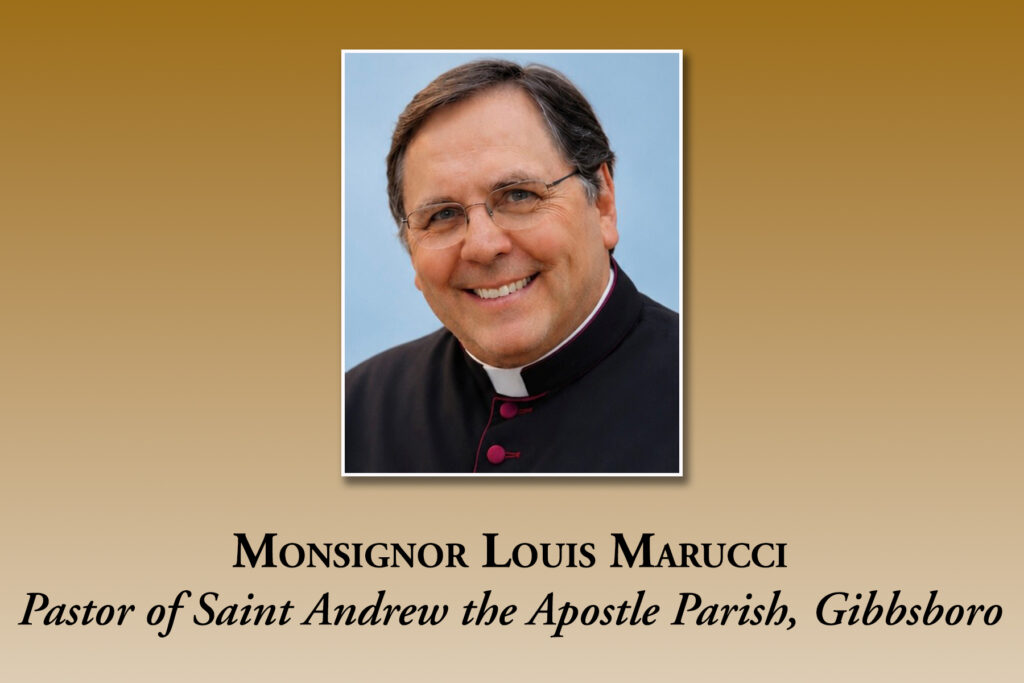
Msgr. Louis Marucci, pastor of Saint Andrew the Apostle Parish, Gibbsboro, serves as the Camden Diocesan Coordinator for the Knights and Dames of the Holy Sepulchre. For additional information, contact Msgr. Marucci at msgrmarucci@churchofstandrews.org.




 at the bottom and then tap “Add to Home Screen”

