




A group of youngsters was practicing to become altar servers. One of the girls grew pensive as she looked at the large crucifix on the wall of the sanctuary. “It must have really hurt Jesus, you know, how he died on the Cross.”
A boy, always happy and smiling, assumed a serious expression for a moment. “That was sad,” he replied. The others agreed with hushed voices. The children’s remarks were so spontaneous and simple; you could tell they felt Jesus’ pain. Genuine emotion had entered into their child-like expression of faith.
Catholicism is an incarnational faith because the central mystery of Christianity is the Incarnation, the dogma that God took on human flesh and was born in time in the person of Jesus of Nazareth. So our expression of faith is appropriately incarnational.
We put flesh on the bones of our Catholic faith. Thus, in the liturgy, we assume different postures: standing, sitting and kneeling. We perform various gestures: genuflecting, making the sign of the cross, and bowing. We speak and we sing. The priest and deacon wear vestments of different colors. Sacred vessels and books are used for the liturgy. Our churches are adorned with stained-glass windows and statues. Incarnational means we pray with our whole body.
Faith, then, is a matter of both head and heart. Unfortunately, it seems that, in recent years, a considerable amount of heart has been lost in the expression of our Catholic faith. To be human means to be emotional, too, and some of that needs to enter into expressing the faith. Meditating on certain prayers and hymns can help us do that.
The Stabat Mater is ideal to accomplish that goal during Holy Week. Composed in the 13th century in the Franciscan tradition, it is one of the greatest Latin hymns ever composed. In the traditional Way of the Cross, a verse is sung before each station. So the hymn begins: At the cross her station keeping, stood the mournful Mother weeping, close to Jesus to the last.
In the Stabat Mater, we unite our heart with the heart of Mary, the Sorrowful Mother, who shared so intimately in the passion and death of her Son. Speaking of Jesus and Mary, Saint Alphonsus Liguori said, “Two hung upon one cross.” We pray as we address the Blessed Mother: Make me feel as thou hast felt, make my soul to glow and melt, with the love of Christ my Lord.
Considering our crucified Lord, it has been said the worst pain he suffered was not from nails pounded into his hands and feet, not from sharp thorns dug deep into his skull, and not from shouts and curses of a bloodthirsty mob. Rather, the worst pain of the crucifixion was loneliness, the sense of utter abandonment by God and man. Jesus cried out from the Cross, “My God, my God! Why have you forsaken me?”
Certainly, the Sorrowful Mother at the foot of the Cross shared acutely in her Son’s sense of abandonment: Through her heart his sorrow sharing, all his bitter anguish bearing, now at length the sword hath passed. Mary really felt her Son’s pain.
Pope Francis, as chief shepherd of the flock, is known to express his feelings in public. He kisses babies and hugs the poor and infirm. He laughs with them and cries with them. He has extolled the gift of tears, which is the grace to unite our hearts so closely with others that we can weep with them and for them. He says, “The gift of tears prepares us to see Jesus.” Considering the Sorrowful Mother, we ask: Is there one who would not weep, whelmed in miseries so deep, Christ’s dear Mother to behold?
Thus the Holy Father challenges us to come face to face with human misery so that we can fully appreciate the pain of Jesus’ crucifixion, the result of sin. It is not easy to do.
This Holy Week, our hearts are united in prayer and heartfelt sympathy with the people of Ukraine caught up in a terrible unjust war. We are horrified at the slaughter of innocent civilians, especially children, struggling to get out of harm’s way. We are outraged at the war crimes being committed. Just think of the sense of abandonment, the fear and confusion the Ukrainian people feel as they huddle together for safety in subway tunnels or try to make their way as refugees to a safe haven. Their sad plight unites them so closely to the heart of our crucified Lord and the heart of his holy Mother. So we pray with Mary at the foot of the Cross: Let me share with thee his pain, who for all my sins was slain, who for me in torment died.
Face to face with human misery in Ukraine, we must do something. Pray for the victims and for the conversion of hearts. Give alms for humanitarian aid for the Ukrainian people. Insist that the elected representatives of our government do all they can to support the defense of Ukraine. Remember, Jesus himself has said we will be judged by what we did or did not do for the least of our brothers and sisters.
Christ, when thou shalt call me hence, be thy Mother my defense, be thy cross my victory.
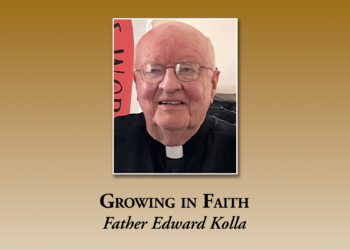
Father Edward Kolla is a retired priest of the Diocese.




 at the bottom and then tap “Add to Home Screen”
