




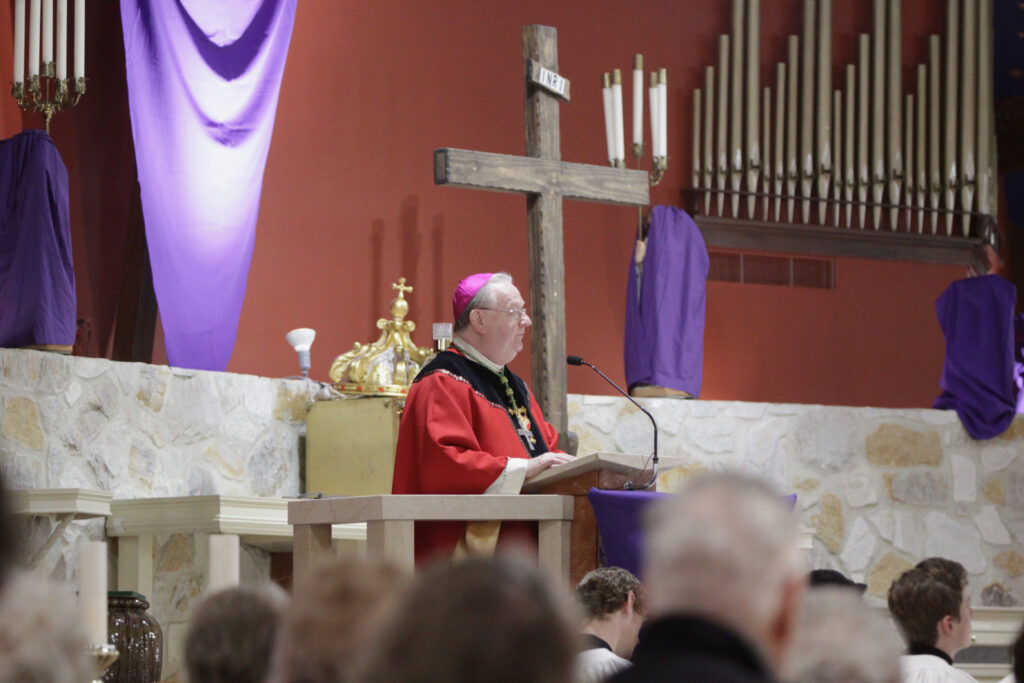
Until the 1960s, the fifth Sunday of Lent was referred to as “Passion Sunday,” and it began the liturgical period called “Passiontide.” One of the most familiar elements of this pre-Paschal stretch of time was the veiling of crucifixes and holy images, until the hours between the Good Friday services and the beginning of the Easter Vigil. Many churches in the United States continue this tradition, even though a conscious effort has been made to link the Passion and Palm Sunday more closely together (even in the latter’s official name in the revised Roman Missal: Palm Sunday of the Lord’s Passion, effectively blending the two previously distinct memorials together).
Veils play an integral part in our intellectual and spiritual identity development. In my professional life, I frequently work closely with chaplains and ministers involved in hospice care – as we offer graduate degrees geared toward that kind of diakonia, or service. Many of these students report that there are times when they feel the veil between the earthly and the heavenly becomes thin, especially around the end of life. In fact, the classical Greek notion of something being evident or even “true,” aletheia, carries overtones of this “unveiling of the veiled.” The influential German philosopher Martin Heidegger referred to this concept of “unconcealedness” as the inauguration and in-breaking of presence and self-consciousness of what he termed Dasein (“being there”).
But in a less abstruse framework, we can all think carefully about the common experience of discovery. When we “dis-cover” something – whether about ourselves, or about another person, or about Jesus Christ and the triune God – we uncover that which is somehow hidden from us, or we lay something open to view in a new way, despite the fact that whatever it is that we are encountering already exists. We are removing the veil that separates it from us.
And so, when we veil crucifixes in ecclesial settings, our natural instincts are somehow deeply frustrated and yet profoundly intensified. But that is precisely the point: We long in some way for the unconcealment of what is concealed. It’s why brides are traditionally veiled on their wedding day.
The revelation that is made manifest on Golgotha speaks directly to this reality: “And when Jesus had cried out again in a loud voice, he gave up his spirit. At that moment, the veil of the temple was torn in two from top to bottom; and the earth quaked, and the rocks split, and the tombs broke open.” (Mt 27: 51) We encounter the closeness and the pathos of the God “who pitched his tent” with us in an entirely new way when that separating veil is rent in half.
Who among us does not recognize the heightened somber effect of shrouded statues and paintings and religious artwork at this time of year, or the dramatic ritual unveiling in processions of the “Wood of the Cross, on which hung the savior of the world”? When you see them again in the coming weeks, realize their impact is much more than theatrical. They are realities hardwired into our ecclesial imaginations because they speak to who we are and what we most desire.
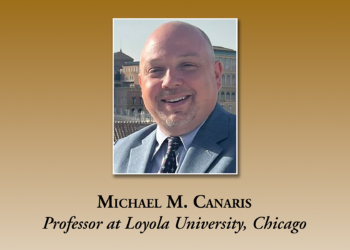
Originally from Collingswood, Michael M. Canaris, Ph.D., teaches at Loyola University, Chicago.



 at the bottom and then tap “Add to Home Screen”
